Showing posts with label Selfishness. Show all posts

Monday, January 7, 2013

Statutes of Liberty

Today's passage:  Romans 15:1-6
     "For even Christ pleased not himself; but, as it is written, The reproaches of them that reproached thee fell on me."
     Paul starts this chapter, reminding mature Christians to be careful with their Christian liberty.  The whole chapter before this dealt mostly with this subject, about not being a stumbling block, about abstaining from certain things (in this case meat offered to idols) if it would be a problem for a fellow Christian, particularly a Christian younger in the Lord.  Now, it would be easy to grumble and complain about this. I know many Christians grumble and complain about it, myself included, and I have a pretty sure guess that the Christians in the early church grumbled and complained as well.  If they hadn't, there would have been little need to address it.   Then Paul drops the anvil.  It is pretty hard to complain about giving up certain liberties until I realize that Christ gave everything up for me.
Picture is courtesy of http://breadsite.org


      If Jesus could have done it another way, I'm guessing He probably would have brought His riches from Heaven with Him. He would have been excellent help in Joseph's carpenter shop when He could speak a piece of furniture into existence rather than using the hammer, nails and wood.  Using his supernatural powers, He could have silenced the Pharisees by making them dumb.  He could transport from town to town to preach rather than walking those great distances and he would never have to borrow another man's home for a night's sleep.  If Jesus could have done it another way, He would probably never have come to earth at all.  He gave up His comforts, His powers, His life.  Anything I might have to give up seems awfully petty by comparison, doesn't it?  Now, I don't know why God chose to have Jesus come the way He did, but something tells me, that He had to live like us, to be an example for us.  None of us will have all the power of the universe, but I might have to change my way of doing things to reach someone else or help them grow.  I never had to give up golden streets or ivory palaces, but I might have to hold my tongue if someone says something unpleasant to me.  I never had to give up my life (prayerfully, never will) but I might have to steer away from certain topics of conversation if it might be offensive to a younger Christian.  Do I have the freedom to watch, go, listen to, say, whatever I want?  Of course I do.  Are there people who will take advantage of the Christian liberty issue, claiming they are offended by this thing or that thing?  Yes.  We will encounter that too, and then we have to decide if it is a matter of causing a Christian to genuinely stumble or whether they just have a critical spirit (which even if that is the case, doesn't necessarily mean I still shouldn't be accomodating).  Jesus could have barred the Pharisees from ever coming to listen to Him.  They were always critical, trying to entrap rather than enjoy.   They never came because they wanted to believe (although Nicodemus eventually did).  Jesus was not too concerned about offending them, because they never intended to receive Him.  But He is all-knowing, and He could make that judgement.  I am not.  So when my Christian liberty is in question, I would be better to let the thing go rather than examine all angles of the case to see if it is something I should continue to pursue.  Is my comfort or right to something really worth offending a fellow brother or sister in Christ, or worse yet, causing an  unsaved person to stay unsaved?  Every person has to decide that for herself, but as for me, I don't feel at liberty to risk it.

Monday, December 12, 2011

A Mary Heart

Today's passage:  Luke 2:16-17
     We were given an advent calendar a couple of years ago.  In years past, I have filled it with sweets and treats.  This year I decided to do something a little different.  Behind each door I put in a slip of paper that  I've typed up a verse of the Christmas story.  And then I have included a task or a treat that would connect to that part of the story.  For example, for the verses about Mary and Joseph having to go to Bethlehem to be taxed, I gave them each a dollar explaining that whatever they bought with it, they would need to consider the tax that would be included. If they chose to use it on a vending machine, they would have to pay Mommy and Daddy the tax amount on the item.  When I typed up the verse about the shepherds telling everyone they knew, I put a gospel tract inside the doors and asked them to hand it to somebody that needed to hear about Jesus this week.  Of course there has been a little bit of grumbling that there has not been a treat behind each door, but I have explained to them that Christmas is about Christ.  All this other stuff is fun and exciting, but Christ's birth is the reason for the celebration.
Mary Kept These Things in Her Heart--Taken from Standard Bible Story Readers, Book One
By Lillie A. Faris, Illustrated by O. A. Stemler and Bess Bruce Cleaveland
The Standard Publishing Company, 1925
     As I have been reading and typing up the passage in Luke 2, something occurred to me.  After the shepherds went and told everyone they could find about the Christ child, it stands to reason that at least a few of those people might want to check out their story.  Either they didn't believe when they were told this news and continued on with their business, or they said, "I've got to go see what these guys are talking about."  This could mean only one thing.  Mary and Joseph would not have gotten any sleep that night.  They had journeyed all that day, Mary had just given birth, and from that moment on they had visitors all the night.  They didn't need a room in the inn, because they weren't going to enjoy a cozy bed anyhow.  Now, if I were Mary I would have grumbled and complained about this.  At some point in the night I would have pleaded with Joseph to turn any other visitors away because I was exhausted.  If I had been Mary, I would have been thinking, if we hadn't been stuck in this barn, I could be sleeping right now.  Instead, I have to make small talk with strangers when all I really want to do is sleep.  Maybe Mary had those thoughts, but was too gracious to utter them.  Maybe every visitor that came by, she secretly wished was the last so she could get some rest.  Somehow, I don't think so because she "pondered them in her heart".  Mary understood what it was really all about.  This was not any ordinary baby.  This was not any ordinary birth.  This was the arrival of God Himself. If Mary had any of those selfish thoughts, she was able to fling them aside because it was far more important to allow the world to see who had just made His debut on this earth.
     Physically, she would have been completely depleted.  Of course, it was God coming into the world, maybe she had the easiest labor on record.  If it was, she would be in for a real surprise when she gave birth to her future children.  Just another way for those brothers and sisters to be compared to their perfect big brother.  God knew Mary's heart.  He knew how she would handle the pressure of being ridiculed through the whole pregnancy.  He knew that she would not be thinking about herself when the time came for the baby to be born.  He knew that she had a servant's heart, that she was willing to do what was necessary to see God's plan carried out.  Many faiths give too much credence to Mary.  Some faiths don't give her enough.  This was a remarkable woman.  She really exemplifies selflessness.  The trials of scorn and scoffing when people first learned she was pregnant.  The fear of losing the man she loved, because how was he supposed to understand this?  Traveling on a donkey while probably having contractions, but being willing to finish the journey because God had a particular place in mind when His Son would be born.  She had no idea that particular place would be in a stable.  And now a sleepless night, smiling and chatting with countless people.  Maybe she yawned here and there, it could hardly be helped, but sharing her Child with the world, remembering that this was the One so many had been waiting for their entire lives.  Mary's story started long before an angel's visit.  God was working in this young lady for years before that, and she must have displayed a surrendered heart time and time again for God to select her for this special privilege.  She had no idea the full extent of what she was surrendering to, when she agreed to God's plan.  But she bore it all with such grace and example.  If we could have a smidgen of the fortitude and willingness that was in that young lady's heart, we would get so much more accomplished for the Kingdom.
     It's hard to give ourselves to everything God wants us to do.  It is emotionally and physically exhausting sometimes.  Just yesterday, our pastor reiterated that the ministry is not about us.  Mary really got that.  Was it inconvenient to give birth in a stable?  Absolutely.  Was it a nuisance to have people coming by throughout the night?  I think it must have been.  But the whole reason she said yes to God was for this moment.  And maybe this moment wasn't exactly what she had envisioned, but she knew it was not about her.  It was about this new life she had just brought into the world.  Could God have selected me if I were living during that time?  Highly unlikely.  Mary did not have any supernatural powers that allowed her to have a more willing heart than mine.  She just understood that some of the most important things in life, are the hardest.  And she was willing to put up with some inconvenience to see God's plan through.  If I gripe about not getting a good night's rest, I obviously still don't get it.  And when I see Mary's attitude, I see I still have a lot of work to do on my own.

Thursday, December 1, 2011

Look at the Bright Side

Today's passage:  II Samuel 16
     Children have to be taught gratitude.  It doesn't come naturally.  I've met some children who seem to have been born gracious.  But I have been around children for a long time, and I know better. It is a trait that has been carefully instilled by parents, or learned individually through unfortunate experience.  As adults, gratitude either thrives or shrivels, depending on how much we use it.  If we become negative, bitter, critical people, we neglect to see the blessings.  When we praise God for every breath we take, every morsel of food we lift to our lips, every dry, warm night we spend out of the elements, thankfulness grows and envelops us.  Which brings me to today's passage about Ziba.  Do you remember Ziba?  I gave him high praise several posts ago (A Servant's Choice).  Tsk, tsk, tsk.  Alas, Ziba has somehow allowed ingratitude to creep into his heart.
Rainbow on a Cloudy Day--Taken from Standard Bible Story Readers, Book One
By Lillie A. Faris,  Illustrated by O.A. Stemler and Bess Bruce Cleaveland
The Standard Publishing Company, 1925
     David has resumed to living in the hills, now that Absalom is acting king.  Every person who approaches David is either friend or foe, and I'm sure that he can't tell who is who anymore.  Ziba arrives over the hill bearing nourishment for the deposed king.  Naturally, David wants to know where Mephibosheth stands in all of this rebellion.  Ziba tells him that Mephibosheth is looking forward to recapturing the glory days of his father, Saul.  In other words, he is aiding Absalom in this thing.  As we will see a few chapters later, Ziba is lying.  Now why would this man, who had been living in poor conditions before David found them, who had probably been Mephibosheth's feet, who had been rewarded by this king with all of Saul's former lands, make up this story?  It has to start with ingratitude.  Some people can not handle good things.  The more good they have, the more they want.  I have to think this is what happened in Ziba's life.  When he was living among the ruins, he forgot what it was like to serve in Saul's palace.  He got used to the gruel and broth for meals, he became accustomed to unmended clothes, leaky roofs, chopping his own wood for the fire.  When he was far from the high life, he forgot how low he had been plunged.  Now that he was a little closer, now that he could see the fanfare at the castle while working the field, he began to savor the taste of ambition.  The lands and home he tended in service to Mephibosheth became menial.  He was the man, after all, who had reunited Jonathan's son and King David.  Why should he be planting vineyards and plowing fields?  Why should he be figuring expenses and directing servants when he could be using his skills to advise a king?  I imagine that when Mephibosheth becomes a resident of the palace, he would need servants to attend to his needs. As Ziba saw some of his former household drafted into these positions, I wonder if Ziba was offended that none of those positions went to him.  Perhaps Ziba viewed his groundskeeper/lands manager position as a curse instead of a blessing.  Ziba needed a good dose of gratitude.  He needed to remember where he had been living prior to David's calling for them.  He needed to remember that any other king would have had the household of the previous king killed, with no mercy spared.  He needed to remember that living in the palace at the beck and call of someone else was tiring.
     Our former pastor often used the illustration of the older lady who always saw the positive side of everything.  It drove people crazy, because no matter what subject was brought up, she could always see the bright side. Determined to get her to say something negative, one man asked her if she could find anything good to say about Satan.  She just gave a little chuckle, shook her head and said, "Well, that devil, he never gives up!"  What a spectacular way to look at things!  I'm not saying we should smile when we are facing sorrow.  I'm not suggesting that we plaster a smile on our face everywhere we go.  But some people never smile or never look happy.  It makes me think they have forgotten their blessings.  It makes me think they didn't know they had any to begin with.
     When we are tempted to be somewhere other than where we are, when we yearn for things we don't have, we are preparing our hearts to go the way of Ziba.  We are acting out of ingratitude.  God has a way of dealing with that.  He is expert in stripping away all we held as dear, and showing us what is really important.  It is not always easy to magnify the good, when the bad seems so much greater.  I know that.  But shouldn't we try?  When my humdrum life seems too hum or drum, I need to look to God for giving me simple things to enjoy.  When life seems hard and steep, I need to thank God He sustains me, pushes me, keeps me going.  Ziba forgot what a blessing it was to be the loyal friend of Mephibosheth.  He failed to see that not just anyone would have been given such a position of trust.  Instead of wishing for more, he should have seen that not just anyone could do his job.  When we do what God calls us to do with gratitude, it may be that He will give us more.  Then we have to choose to be thankful for the more.

Tuesday, November 29, 2011

Height of Hypocrisy

Today's passage:  II Samuel 14
     Absalom is a petulant child.  In reality, he is a young man (he has four children already), but he behaves like a petulant child.  "But in all Israel there was none to be so much praised as Absalom for his beauty:  from the sole of his foot even to the crown of his head there was no blemish in him."  Obviously, Absalom is a good looking fellow, not surprising since he has King's David's DNA.  Can I say this?  Be very careful with your beautiful children.  All of our children are beautiful, but sometimes there are stand-outs.  You can tell this, because everywhere they go, they are admired.  People dote on them, talk to them, stare (in a good way) at them, admire them.
     My oldest son and I had a talk about this just the other day. My eight year old and my two year old are best buddies.  Firstborn takes very good care of him, but often spoils Youngest.  Now Youngest happens to be a very beautiful child.  Of course, I say that because I am his mother, but I get compliments everywhere I take him.  People naturally are taken with his blond curls and charming smile.  As nice as it is to have these compliments, Youngest is already learning that being cute can be very rewarding.  And since he is two, the tantrums when he does not get his way have increased.  I was correcting Youngest for this behavior the other day, when Firstborn asked me to be lenient.  "Oh Mom, he's just so cute!"  I explained to Firstborn, that is exactly why he needed correction.  Perhaps he is cute at two, but that behavior will not be cute at five or six.  Firstborn saw the logic in this, and let me proceed.
     I do not want to raise an Absalom.  I'm wondering if Absalom's mother, or perhaps nursemaids gave into his tempers and rewarded him with all that his heart desired--he was such a good-looking boy.  Youngest has already learned that he does not necessarily have to throw a tantrum to get his way, instead, he is learning that people give in when he flashes his sweetest smile and lowers his lashed eyelids.  Maybe that was Absalom's approach.  Parents, be careful you don't fall for that act too much either.  I can't say for sure that Absalom was spoiled as a child, but I'm guessing as handsome as he was, he was probably indulged.  A lot.  Selfish traits don't usually just spring up in adulthood, they have been carefully fostered throughout the years.
     In this passage, we see how Joab has finagled a way to get David to bring Absalom back into the fold.  But David still refuses to see his murdering son.  Joab is responsible for Absalom's return, but quickly sees that he will lose favor with the king if he gives in to any more of the prince's demands.  Absalom wants an audience with his father, and calls for Joab to mediate.  Joab refuses to come.  Absalom calls for Joab again.  Again, Joab does not comply.  So what does Absalom do?  He has his servants burn Joab's field. Are we talking about adult behavior here? I mean, that kind of thing probably worked in the palace nursery as a boy when the governess refused to give him his way, but really?  He's a grown man.  Joab seeks out Absalom (which is exactly what Absalom knew would happen) about this immature behavior.  Absalom simply responds with, "Behold, I sent unto thee, saying, Come hither,"  as if that is a good enough reason to destroy someone's property.  Absalom's action is grossly disproportionate to Joab's conduct.  But what is the most disturbing is that it works.  Joab does exactly what Absalom manipulated him to do.  If Joab had refused, Absalom would have upped the ante and probably burned his home as well, or killed Joab's servants.  The degree of selfishness in Absalom is equal to the weight of his newly shaven hair.
David Forgives Absalom--Taken from Treasures of the Bible (United Kingdom)
By Henry Davenport Northrop, D.D.
The International Publishing Company, 1894
     It is probably too late to corral Absalom's selfish ambitions.  He has been a selfish being for too long to be able to mend his ways now.  Of course, God can do that in him, but even then, it would take time.  David was always repentant when he had done wrong, but we don't see that in any of his sons.  I'm sure David taught the boys about the Lord, but unfortunately some of David's actions were so contrary to what he taught, that they saw the hypocrisy and walked away from God.  We all have some degree of hypocrisy in our lives, and our children will see it above all else.  We will never be perfect people, and we will never do everything exactly as we should.  But David's refusal to welcome Absalom back (despite his vengeful act of murder against Amnon) was the height of hypocrisy in Absalom's mind.  Why?  Hadn't David been a murderer?  Hadn't David had a man killed so that it would not be discovered he had been intimate with the man's wife?  In Absalom's mind, David's murder was so much worse.  Absalom reasoned that at least when he had his brother killed, it was retribution for dishonoring his sister.  Where was the nobility in what David had done?  David repented, and I'm sure Absalom refused to do this.  But perhaps the wise thing for David to have done, would be to have this conversation with Absalom and persuade him that his actions were unconscionable.  Maybe Absalom and David had these letters by messenger, but this was David's son--a face-to-face talk should have commenced.  Again, it is easy to sit in my office chair, play Monday-morning quarterback hundreds of years later, and advise David on what would have been a better way.  I'm sure if and when things go wrong in my life, others will do the same of me.  Still, God puts these things in His Word so we can benefit from David's triumphs and his mistakes.  God wants me to glean what I can on how to raise my children (or how not to) so that I don't have to go through the trials and tribulations that he endured.  It is too bad that David had to be the example, but I'm thinking that David had examples he could have watched.  Did he take advantage of that?  Did he have the privilege of talking to his father who had raised eight boys?  I don't know.  I just know that I do have that advantage, and I must grab hold onto any knowledge the Lord will give me.  I don't want to raise a petulant man/child.
   

Monday, November 28, 2011

The Cookie Crumbles

Today's passage:  II Samuel 13
     This is not a passage for the faint of heart.  It is one of the more difficult passages of the Bible because of the adult content in it.  In fact, trying to deal delicately with such subject matter must be a difficult job for a preacher, because there is little way to handle it delicately and still deliver the message that needs to be presented.  It is a chapter that causes me to cringe.  And yet, there is something here God wants us to learn.  Probably several somethings.
     One thing that God wants us to know is that marrying several women can create complications among the children.  I've said it before, and I will say it again, because I assure you, the movement is on the horizon.  Polygamy is trying to make a big comeback in this country.  There are TV shows promoting it, and while maybe not advocating for it, trying to pave the way for acceptance.  I don't watch any of them, but I have heard of at least 2 or 3 shows where a man has more than one wife.  And the entire point is to make them seem like a normal family.  Well, it is not normal.  God never designed for man to have more than one wife.  If He had, Adam would have had Eve #1 and Eve #2.  It happened a lot in the Old Testament, and in every instance it was trouble.  As early back as Abram and Sarai, when Hagar is introduced into the picture and Ishmael is born, multiple wives produced complications.  And that is a complication that has continued on to this day, with the Muslim world declaring Ishmael to be God's heir when clearly it was to be Isaac. The ancestors of these two children are still fighting.  It was not necessary.  Unfortunately, David's marriages were going to cause another kind of trouble among his children.  I'm sure there must have been a lot of arguing about which wife had preeminence, and therefore which son would be the next king.  It was natural that these jealousies would arise. Would they have surfaced had all the children been from the same woman?  Yes, it was likely that could have happened too, but everyone would eventually agree that the firstborn was heir to the throne.  In David's case, he had a firstborn with Maachah (Absalom), and a firstborn with Abigail (Chileab), and a firstborn with Ahinoam (Amnon) and a firstborn with Bath-sheba (the firstborn died, but the first to live was Solomon).  I mean there would be a lot of disputes as to whose son was the real firstborn.  But having so many wives with children from each wife also brings about other difficulties as seen in this passage.
     God also would want us to realize that love and lust are two completely different things.  Amnon does not love his half-sister.  He tries to convince others he does because that sounds nobler than to say he just wants to rob her of her virginity.  There is no love involved here.    Love does not deceive a young maiden into being a nursemaid for a person who is not sick in order to prey upon her.  Love does not turn to hatred within minutes. Love does not force a person against her will, and then having its way throw the person out into the cold. That is not true love.  Those are the characteristics of lust.  This poor, poor girl.  After the act is committed against her, she is more horrified because no other man will want her now, and Amnon doesn't even have the decency to take her as his wife, now that he has stolen the most precious gift she had to offer any man.  It is no wonder that when Tamar's full-blood brother Absalom learns of it, he is enraged.
     But here is the most shocking thing of all in this passage, and I can't wrap my head around it.  Maybe I'm too unfamiliar with Middle Eastern culture to understand, but David finds out about this horrific deed and does nothing.  "But when king David heard of all these things, he was very wroth."  That's it.  That is all that is said about the matter.  It is obvious that he didn't deal with the situation, or if he did he must have been extremely lenient, because it is what drives Absalom to take matters into his own hands and avenge his violated sister.  And really, I can't say I blame him.  I cheer for vigilante justice sometimes in the movies, and this just seems to be another brand.  But really, what was David thinking?  How could he let such an act go? This was his oldest son, the future king behaving this way?  It is obvious that Amnon was indulged, perhaps because he was the successor to the throne.  But being an indulgent father, and a father who completely looks the other way are two different things.  It is shameful.
     Two years go by, and Amnon is still strolling about the palace, possibly smugly smiling at Absalom like the cat who ate the canary every time he passes him by.  Very likely, sneering at Tamar any time he has the chance.  Absalom shows remarkable restraint.  "And Absalom spake unto his brother Amnon neither good nor bad:  for Absalom hated Amnon, because he had forced his sister Tamar."  What is that saying--  "Watch out for the quiet ones." ? This is one of those cases.   Absalom waits two years to carry out revenge.  And I'm not saying he was right to do it, but it is easy to see why he would when King David did nothing.  Amnon continued to bait Absalom all the while.  I'm starting to think that David's family put the dys- in dysfunctional.  Actually, that may have started with Jacob and his several wives/several children brood.
     This is just not a pleasant chapter to read.  It goes from bad to worse.  Absalom is not punished for murdering his brother, which conveniently puts Absalom as next in line for the throne.  No power motives there, right?  David's boys must have been used to having things done their way, and if in the past they have not suffered consequences for their actions, it is no wonder they think this.
     What can I learn here?  As awful a parent as David is in this chapter, there are going to be times in my life when I really will not know what to do with my children, or how to deal with them properly.

Sunday, November 6, 2011

Games People Play


Today's passage:  II Samuel 2
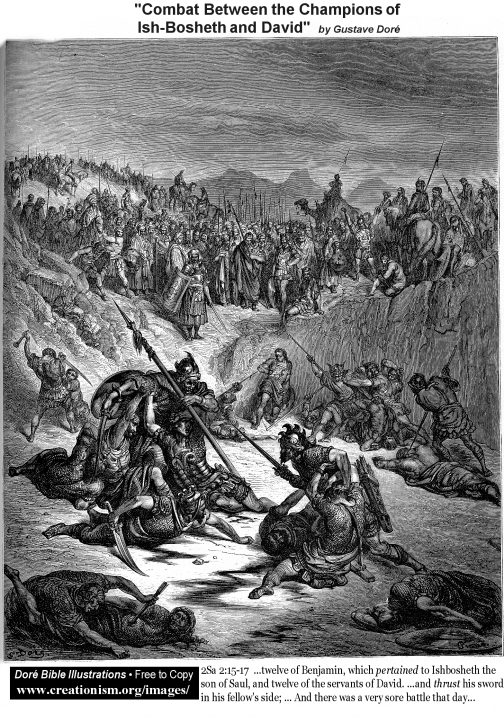
     At long last, David becomes king.  Of Judah, that is.  Despite what Saul's military captain, Abner, already knew, he decided to take matters into his own hands.  He staged a sort of coup by convincing Saul's still living son, Ish-bosheth, that he should be the next ruler.  He secures Ish-bosheth across the Jordan River in Mahanaim, Manasseh country.  He is then able to procure the loyalty of all the remaining tribes, installing Ish-bosheth as the king over the whole of Israel.  Only Judah recognizes David as king.
      It is amazing what people will do, even though they know what God's will is.  I'm not talking about when we are not sure.  I'm not talking about when we take step by step by faith because we are waiting on God to show us what to do.  I'm talking about when God has clearly shown us, and we think by doing the exact opposite, we are somehow going to change what God intended.  Abner, like his leader before him, did not bother to ask God for wisdom in this matter.  All Abner could see was that his power and control were about to end.  Maybe he even thought he was in danger because he had been Saul's number one guy.  He didn't know David very well.  Abner had been a loyal servant to Saul.  David set great store by loyalty.  The likelihood that Abner would have been rewarded, maybe even promoted was pretty high.  This stunt would cost him.  Had Abner asked God what should be done, he may have been given a pension and been enjoying retirement.  But Abner seems to be an ambitious man.  I don't know that Ish-bosheth had any plans of taking the throne when his father died.  I'm sure he had been told by more than one person that David was to be the next king.  That this is what God had ordered.  I can't believe that Abner did not know this too.  But the hunger for power can be devouring.  With the support from the lead strategist from his father's household, it was probably not a stretch for Ish-bosheth to imagine that they could pull off this coup.  Here is where the power struggle really begins.
     David's military man, Joab, and Abner meet in Gibeon.  They size each other up.  They evaluate each other's armies.  "And Abner said to Joab, Let the young men now arise, and play before us.  And Joab said, Let them arise."  Abner views this meeting as a chess match.  Both sides have kings. Who will declare "Checkmate"? Joab and Abner play bishop, rook or knight, and the rest of the soldiers are pawns in their little game.  How many casualties will there be?  How many men will be taken out, turn by turn before one is declared the winner?  Abner's army seems to be losing the match at one point.  Then Joab's brother, Asahel, another important piece, pursues after Abner.  He is determined to take him out of the game.  He ignores Abner's taunts and distractions, focused on eliminating this very important player.  But Abner makes the better move, and slays Asahel.  Abner knows Joab will come back with his fiercest move yet, but sometimes anger fuels us, and sometimes it backfires on us.  Abner knows this, and is counting on the latter.  Joab continues the pursuit, causing Abner to retreat into a defensive position.  As Abner gets closer to Ish-bosheth country, he is reinforced by Benjamin's tribe.  Joab has to settle for a stalemate.  Another game will have to be played another day.  He is not willing to lose any more men on this day.  Losing a brother was enough.  So, Abner returns to his king, and Joab returns to his.  Both men, more intent on playing a game than seeing the loss of life, until one of those lives was dear.  Joab and his remaining men bury his brother.  It is a sad reminder that war costs something. 
     I know that some believe that leaders play political games with soldier's lives.  And while that may be true in other countries, I have never thought it to be the case in America.  I don't believe it was a game to David, but I'm pretty sure Abner was not in the least concerned about his men, as long as he came out on the winning side.  In some countries, militia are used as pawns in a chess match.  And although many have accused our country of doing the same thing, I refuse to believe that.  Maybe I'm ignorant, but I'm convinced that when our military has to make a move, it really is to protect our interests, and to protect freedom.  I'm not saying that every display of our military power is always the best move, but I have never believed that our leaders have ever dealt carelessly with those lives, willing to throw them away as long as we win.  I don't believe that of our current President, and I don't believe that of our former President.  I don't believe that of our generals.  There are always power-hungry people, but as the daughter of a military man who served under some pretty high-ranking officials during his career, even though in a relative time of peace, I knew the character of some of these individuals, and I know they only had the best interests of the country and those who served under them.
     Ish-bosheth seemed to be a puppet king, succumbing to the string-pulling of his father's military captain.  Abner refuses to yield to God's will, and although he returned home safely, many of his men gave their lives for a fruitless cause.  That is selfishness at its highest, and though I haven't read ahead, I'm guessing that Abner will be taken out of the game in the next match.  The best move?  Heed God's will when we know it.  Ignoring it, avoiding it, fighting against it never plays out the way we planned.  God's strategy is always best, and we can never outplay Him.

Wednesday, October 19, 2011

The Power of Love

Today's passage:  I Corinthians 13:5
     I have always approached these verses, wondering how I can improve in my love for others.  I have always looked at them as a checklist to check my charity meter.  This week, I have been meditating on how God is all of these verses.  In my prayer time, I thank God for being each characteristic of charity, and why I know He is.  Then I thank Jesus for being each of these characteristics and then the Holy Spirit.  Praising God is easy when you just pray the Scripture and really think about how God embodies it.
     "Doth not behave itself unseemly, seeketh not her own, is not easily provoked, thinketh no evil;"
    Doth not behave itself unseemly... God never behaves inappropriately.  He never says a word too many and He never listens to or tells a raunchy joke.  We probably apply this sense of decorum to heads of state or monarchs.  There is a sense of how to behave, what to wear, how to carry yourself.  We think of the majesty of a royal position.  God is all those and never pushes the bounds of indecency. 
     Seeketh not her own...God created us to worship Him.  He created us to fellowship with Him.  He made us in His image.  Yet, most of His Creation refuses to even give Him a thought.  If He were to put us under His thumb, He could require us to worship Him as we should.  But He gives us free will.  And because of that, He allows us to go our own way, separate from Him.  He is not going to put us in a headlock until we cry out "Uncle" so that He can acquire our devotion.  If He wanted to, He could.  If Christ had been selfish, He would never have left Heaven.  If He wanted to do only what He wanted to do, He would have told the Father to have somebody else do the job.   The Holy Spirit allows God the Father and God the Son to receive all the glory, even though He does an equally important work in our lives.  His love for us prevents Him from shining a neon arrow upon Himself to remind us that He is at work as well.  I also find it interesting that the pronoun used for charity in this trait is her.  In other places in the passage, charity is referred to as it.  I am not implying that women have more love than men, but if you think about it, a mother almost always has this quality when it comes to her children, and men are told to love their wives as Christ loved the church.  I just think that maybe this quality in charity comes a little more naturally for women and therefore, God chose to use a feminine pronoun.  Just an observation.
     Is not easily provoked...This is so true of our God.  When I think about the times in the Bible that God exercised judgement upon the earth, He always gave fair warning.  He did not just react to what was taking place.  When He decided to destroy the earth by flood, He had been patient with the wickedness for hundreds of years.  Even after he instructs Noah to build the ark, He gives ample time for people to repent, to choose Him.  He didn't tell Noah and the next day send rain.  When He exiled Israel into captivity, first to the Assyrians, then to the Babylonians, He charged prophet after prophet to warn of what would be coming.  He could have destroyed them instantly, but because His righteous anger is a slow burn, He doesn't punish immediately.  That idea of lightning striking someone when they have done wrong just does not fit in with this characteristic of God.  Jesus was not easily provoked when the Pharisees questioned Him unfairly.  He could have zapped them.  He could have stricken them with leprosy.  If he was a vengeful God, He would have.  How many times have I provoked the Holy Spirit?  How many times have I told Him no, have I waved Him away, have I hardened my heart against Him?  If He was easily provoked, He would just take His presence and leave.
     Thinketh no evil...Some people believe that God is sitting up in Heaven hatching up plans for us.  Some think that He is sketching out every detail on how to make us more miserable.  If God is a God of love, which He is, and these are the characteristics of love, then we know this cannot be true.  First of all, God is not capable of evil, but to even think of Him scheming and plotting gives an evil slant to His plans.  Christ could have pocketed a ledger with names of those who spit on Him, who challenged His deity, who withheld food or shelter from Him.  He could have studied that list and prayed to His Father to allow some unforeseen danger to happen in that person's path.  Instead, when we read the Gospels, Jesus is never praying evil on us, only good.  He intercedes for us, and an intercessor wants our best, not our worst.
     When I think about how God the Father, God the Son, and God the Holy Spirit embody these qualities of charity, it doesn't make me feel defeated.  It might seem that it would, because He is perfect and I am imperfect.  He is holy and I am unholy.  But because He is living in me, His power becomes my power, His holiness becomes my holiness, His love becomes my love.  I have access to this kind of love because He resides in me and so as a by-product, I have His love in me.  I can choose to not use it, but I always have access to it, and that is a thought that fills me with hope.
Related Posts Plugin for WordPress, Blogger...