Today's passage: II Samuel 20
I'm not going to deny it. I have put off writing about this chapter. I seriously have been stuck. It is excessively violent. I'm not sure movies I've watched are as violent as what I'm reading here. I shudder, I cringe, I wish I could just skip this chapter completely. And I could. I don't think anyone pays that close attention that they would notice I decided not to post what I learned here. But I know, and I feel like when I don't write about a passage, maybe I am saying God couldn't teach me anything through it. And He always teaches me something.
For instance, the man mentioned in the first verse of the chapter, Sheba, a Benjamite, which would have meant he was a relative of Saul absolutely denounces David's leadership. He encourages the rest of his tribe to do the same. The Bible calls him a "man of Belial". Now, God commanded Israel very particularly how to handle children of Belial. And I'm not certain if Sheba was deemed this because he was rebelling against God's anointed, King David, or if he was involved in occultist behavior to be labeled a son of Satan. In either case, Deuteronomy 13:12-18 gives specific charge as to how to handle these types of people. The Israelites were to make certain that people accused of this behavior were authentic (unlike the Salem witch trials of old) and if so, they were to slay them with the sword, destroy all their livestock and belongings, make a bonfire with any of their possessions in the midst of the village and see to it that any trace of them was consumed. Does this seem a little extreme? For someone who has never dealt with Satanic power, it may. I have heard on more than one occasion that when Satan has a foothold in someone's home, especially someone who had been dealing with him directly, every item they possessed was a portal to allow his demonic powers to have reign. God always knows what He is doing. If He said to destroy everything that person had dealings with, I think I would obey that command, because God created Satan, and He knows what He is capable of. This also makes me wonder about Saul's whole family. He had trouble with evil spirits, he visited the witch at En-dor, it makes me wonder if the Benjamites had a history with the occult. If they did, it could explain Saul's constant struggle with those powers. If he couldn't be free of them, it could mean that he still had something in his possession, something that was a doorway for those dark, evil, oppressions he had been experiencing. I've heard a lot about this kind of stuff lately. Satan has no power over us, but don't think he can't mess with us a little bit. He certainly can. His power is real, and though not more powerful than God, he has dominion over this world, and therefore, can manipulate the things of this earth by his choosing. If the Benjamites were often involved in these types of activities, it might be why David commmanded his generals to go after Sheba. He concludes that "Now shall Sheba the son of Bichri do us more harm than did Absalom".
So David dispenses his men to go after this son of Belial. In the midst of this is a vengeful Joab. Amasa is the one David chooses to lead up this expedition against Sheba. I'm guessing his relationship with Joab has never been the same since Absalom's death. David choosing Amasa , who aided Absalom, was an even greater insult to his former general. Joab never forgets an enemy. He had not forgotten that Amasa chose to work with those against the king. He would not allow this to stand. David may have forgiven Amasa, but Joab certainly would not. And in true Joab style, he kills Amasa. But this is not just a soldier against soldier killing. This is a vengeful, make the enemy suffer type of death. I would rather not describe it. The Bible does a fine job on its own. Let's just say Amasa's death is so horrific that others going by can not help but stare in disbelief. His body actually becomes a distraction to the rest of the regiment pursuing Sheba. Someone was finally wise enough to move and cover this distraction.
Joab takes charge of the campaign and comes to the city that is harboring Sheba. The inhabitants do not want war, especially not with Joab. His name has become a name to be feared. The passage says "a wise woman out of the the city" confers with Joab about why he wants to destroy their fine city. Joab assures her that is not his desire, but they will accomplish their mission and that is to fetch Sheba. The woman determines that the city will handle Sheba. Again, another description of his demise by the citizens of the city. The objective was achieved.
There is really no excuse for Joab's behavior towards Amasa. He viewed him as a threat and an enemy. I think it was more that he viewed him as a rival as the king's adviser. Joab may think that eliminating other counselors or generals will heal the relationship with David. But he is wrong. That can only heal with the miracle of forgiveness. I'm not saying it would be a miracle for David to forgive. I'm saying that forgiveness is a miracle in itself when it can mend a broken relationship between a king who has lost his rebellious son, and the general who has taken the rebellious son's life and who has continuously disobeyed his king. I don't see how this relationship can be mended. But forgiveness is powerful when we choose to use it. Do I think Joab deserves forgiveness? From a human perspective, no. He has been given many, many chances. But so have I. I don't deserve any of the forgiveness I have been granted either. May I ever be mindful of God's great forgiveness to me every day.

Showing posts with label Betrayal. Show all posts
Showing posts with label Betrayal. Show all posts
Wednesday, December 14, 2011


Monday, December 5, 2011
Generally Speaking
Today's passage: II Samuel 18: 1-17
There is no easy explanation for Joab. He is a warrior with a military mindset. Often he goes into a situation with a "kill or be killed" attitude. And why shouldn't he since he has practically led every battle since David has been king? He is King David's nephew and has been his trusted friend and go-to guy. He doesn't always carry out David's orders as precisely as he should. Since he was family, he sometimes disregarded David's commands if he thought the ends would justify the means. Since David was his uncle, he sometimes disobeyed David's orders because it was bad strategy. As the general, he was in the midst of the conflict and he could see what would be best for the kingdom. And being related to the king, meant that the king would more than likely show leniency with him as long as the battle turned out in their favor. Joab hasn't always gone along with the program, but I have no doubts that his motives were pure, that his intentions were sincere. His ambition was to serve his king, and if that meant defying him sometimes to keep him protected, than he had no qualms about doing that. He respects David, but he doesn't fear him. He knows that David values loyalty. And like his methods or not, Joab is loyal.
Absalom has decided to take Hushai's advice and go after his father himself. This leaves David with no other option than to have his men try to subdue him. This breaks David's heart. We can see how anguished he is when in verse 5 he says, "Deal gently for my sake with the young man, even with Absalom." Doesn't sound like a lot of wiggle room in that statement. It is not a wanted-dead-or-alive command by any means. So I know Joab does not misinterpret this, he just chooses to forget he heard it. From Joab's perspective, his cousin Absalom has caused nothing but grief for David for a few years now. Joab may feel partially responsible for this, since it was at his own bidding that Absalom was invited back to the palace. Joab thought David and Absalom could mend their relationship, but instead it had become more strained. And then Absalom decides to rebel against his father in the most despicable way. I'm sure Joab was not only infuriated by Absalom's actions, but humiliated. Joab was probably muttering to himself, if he had just stayed out of this family affair, if he had only kept his thoughts to himself, if he had never encouraged David to reach out to Absalom then they would not be in this mess. Had his heart not been touched by his cousin's despair at being isolated from his father, he might not have to contend with this family war.
There is no disputing what David said as Joab departs to fight this battle. Every one of the soldiers understood this clear order to spare Absalom if it could at all be helped. When Absalom's abundance of hair (maybe he should have had it cut before riding into the woods) gets caught in some tree branches, donkey surging on ahead without him, he is a pitiful sight. He must have been really stuck, because I'm sure he must have been flailing about trying to free himself to no avail. He can not harm any one in this vulnerable position. Even if he had bow and arrow on him, he is not likely to get off a good shot. One of David's soldiers reports this situation to Joab. Joab rebukes the soldier for sparing him. The soldier is not apologetic for following the king's orders. He even argues that had he decided upon this action, Joab would have not backed him, but would have left him out to dry. This soldier does not have the advantage of a familial relationship with the king. He reminds Joab clearly of David's plea to not kill Absalom. Joab really has no excuse here, and feels he doesn't need one. This cousin of his, had more than aggravated his father, he had aggravated him. This was an embarrassing situation-- to be fighting in the woods trying to regain the throne from the one he had tried to help. Joab felt that if they were to spare Absalom, this would be a sign of weakness to any other usurper. If, however, the king's own son were duly punished for his treasonous act, wouldn't it cause future rebels to tread more cautiously? Joab does not spare Absalom. And it is not pretty. He shoots three arrows directly into him, and has ten armorbearers finish him off. Then they dig a hole and bury the body in the woods, covering it with stones.
I'm not sure how Joab is going to explain this disobedience because I chose not to finish reading the chapter at this point, but I know there are enough witnesses to make Joab look really bad. Joab doesn't seem too concerned. He did what he felt needed to be done. He knows what the king said, but just as he has done in the past, he also knows that he is trying to keep his king on the throne as long as possible, and he will take any action necessary to achieve that. Is Joab happy about this deed? I doubt it. He just killed his cousin. That can't be a euphoric feeling, but Joab keeps his feelings on the sidelines when it comes to battle. He has an almost robotic response when he has a military decision to make. Disregard feelings, disregard orders, disregard relationships. What is going to achieve the objective? Joab was a man of action. He was decisive. This is why David keeps him as one of his generals.
I'm not saying Joab was right or wrong here. If he allowed Absalom to live, Joab knew David would have forgiven him and he knew Absalom would have probably attempted this same thing again, and possibly succeed the next time. Do I think Joab should have disregarded David's orders? Not really. But I also know, that God was meting out judgement on Absalom and it is unfortunate that this is how it came to pass. Absalom wasn't exactly merciful towards his brother (not saying he should have been). And his lack of mercy on Amnon brought about a lack of mercy from Joab. But I won't be surprised if Joab's lack of mercy is revisited upon himself.
There is no easy explanation for Joab. He is a warrior with a military mindset. Often he goes into a situation with a "kill or be killed" attitude. And why shouldn't he since he has practically led every battle since David has been king? He is King David's nephew and has been his trusted friend and go-to guy. He doesn't always carry out David's orders as precisely as he should. Since he was family, he sometimes disregarded David's commands if he thought the ends would justify the means. Since David was his uncle, he sometimes disobeyed David's orders because it was bad strategy. As the general, he was in the midst of the conflict and he could see what would be best for the kingdom. And being related to the king, meant that the king would more than likely show leniency with him as long as the battle turned out in their favor. Joab hasn't always gone along with the program, but I have no doubts that his motives were pure, that his intentions were sincere. His ambition was to serve his king, and if that meant defying him sometimes to keep him protected, than he had no qualms about doing that. He respects David, but he doesn't fear him. He knows that David values loyalty. And like his methods or not, Joab is loyal.
Absalom has decided to take Hushai's advice and go after his father himself. This leaves David with no other option than to have his men try to subdue him. This breaks David's heart. We can see how anguished he is when in verse 5 he says, "Deal gently for my sake with the young man, even with Absalom." Doesn't sound like a lot of wiggle room in that statement. It is not a wanted-dead-or-alive command by any means. So I know Joab does not misinterpret this, he just chooses to forget he heard it. From Joab's perspective, his cousin Absalom has caused nothing but grief for David for a few years now. Joab may feel partially responsible for this, since it was at his own bidding that Absalom was invited back to the palace. Joab thought David and Absalom could mend their relationship, but instead it had become more strained. And then Absalom decides to rebel against his father in the most despicable way. I'm sure Joab was not only infuriated by Absalom's actions, but humiliated. Joab was probably muttering to himself, if he had just stayed out of this family affair, if he had only kept his thoughts to himself, if he had never encouraged David to reach out to Absalom then they would not be in this mess. Had his heart not been touched by his cousin's despair at being isolated from his father, he might not have to contend with this family war.
 |
| Absalom is caught in a tree--Taken from The Boys of the Bible By Hartwell James Henry Altemus Company, 1905, 1916 |
I'm not sure how Joab is going to explain this disobedience because I chose not to finish reading the chapter at this point, but I know there are enough witnesses to make Joab look really bad. Joab doesn't seem too concerned. He did what he felt needed to be done. He knows what the king said, but just as he has done in the past, he also knows that he is trying to keep his king on the throne as long as possible, and he will take any action necessary to achieve that. Is Joab happy about this deed? I doubt it. He just killed his cousin. That can't be a euphoric feeling, but Joab keeps his feelings on the sidelines when it comes to battle. He has an almost robotic response when he has a military decision to make. Disregard feelings, disregard orders, disregard relationships. What is going to achieve the objective? Joab was a man of action. He was decisive. This is why David keeps him as one of his generals.
I'm not saying Joab was right or wrong here. If he allowed Absalom to live, Joab knew David would have forgiven him and he knew Absalom would have probably attempted this same thing again, and possibly succeed the next time. Do I think Joab should have disregarded David's orders? Not really. But I also know, that God was meting out judgement on Absalom and it is unfortunate that this is how it came to pass. Absalom wasn't exactly merciful towards his brother (not saying he should have been). And his lack of mercy on Amnon brought about a lack of mercy from Joab. But I won't be surprised if Joab's lack of mercy is revisited upon himself.
Friday, December 2, 2011
Risk-y
Today's passage: II Samuel 17
A great amount of military strategy is trying to get into the enemy's head and predict his next move. This is probably why I never enjoyed the game Risk. I have never been a very strategic person. Most men love that game. In college, a few people tried to teach me how to play, but gave up after the first five minutes. I was hopelessly clueless. My logic and reasoning skills have only kicked in since being an adult--at least I would like to think I have some now.
This whole passage is Absalom's determining what his father might do next. Everyone understands that Absalom is staking his claim as king. He made it quite clear at the end of the last chapter when before all of Israel, he treats King David's concubines as his own. So what next? Absalom knows he needs to secure his kingdom. He knows that there will always be those loyal to his father unless his father is dead. He needs to know how best to achieve that objective. The advice from Ahithophel is to take some troops out to pursue David. He will kill David himself, and all of David's followers will somehow come following him back to the palace, Pied-Piper-of-Hamlin style. That is not exactly the picture Ahithophel paints, but pretty close. Of course, the hero in this little narrative would be Ahithophel. Absalom would have sat around the palace waiting for his return, cheering his general's wise military genius. This is the cartoon dream bubble I see above Ahithophel's head.
Surprisingly, although Absalom thinks it is a brilliant plan, he wants to hear another choice. He summons Hushai, who he doesn't realize is working as a double agent for David. This is because Hushai understood that the way to Absalom's heart was to appeal to his pride. He does this at the end of the last chapter, when asked wasn't he one of David's men, by saying, "Nay; but whom the LORD, and this people, and all the men of Israel, choose, his will I be, and with him will I abide." He uses the same technique in this passage. When asked how they should go after David, Hushai shoots down Ahithophel's idea. He reminds Absalom that his father is a valiant warrior, and that his men are too. Wouldn't it be better if brawny, strapping, mighty Absalom should go after his father himself? In one respect, Hushai is taunting Absalom by touting his father's military abilities, and in the other respect is suggesting that Absalom is the only one who could defeat him. Hushai has a real understanding of his enemy, and uses the wisest method to gain the upper hand. The rest of Absalom's counselors agree, and don't they kind of have to, because otherwise they are telling Absalom that Ahithophel would be far better suited to battle the enemy, that he would be a much better match for David. These guys are not dummies. They know that you don't tell your new king he is not strong enough to take down his father.
Now here is something that I have to wonder about, because the Bible does not use quotations marks the way we do today. Verse 14 says,
Is the second sentence something the counselors said? Or is it what God wrote to explain why Hushai's advice was taken over Ahithophel's? Was it the counselors saying that they thought God preferred Hushai's advice over Ahithophel's because the latter would bring harm to Absalom? Or is God telling us He persuaded these counselors so that He could bring evil upon Absalom? It might seem like a small detail, but if you read it all together, it just sounds like the counselors are reasoning this together. When I take a second look, it almost seems this is not a quotation, but God explaining that the reason those counselors took hold of Hushai's plan was His exact design. If this is the case, and I am persuaded that it is, Absalom is doomed. No military strategy he develops is going to win him this war. God is working behind the scenes. He is giving Hushai the wisdom to sway Absalom, he is putting foolish words into Ahithophel's mouth (which is exactly what David prayed for in Chapter 15). It really doesn't matter what Absalom decides, because if God is against him, he will not succeed.
Things do start to fall apart. Hushai has already sent word to David about Absalom's plans, the surrounding countries are supplying David and his men with food, and Ahithophel commits suicide after his humiliating rejection. Absalom can not yet see that his time on the throne will be very short-lived.
I think that if I ever got to the place in my life where God had to bring evil upon me, I would be devastated. And it could happen so easily. If I start by taking little steps away from Him, maybe skipping my Bible reading a day or two, perhaps forgetting to pray here or there, finding excuses to not be in His House (or grabbing hold of excuses the devil hands me) I can drift farther and farther away from God. If I were to let down my guard with things I watch, what I listen to, places I go, I could slip out of His service and onto His watchlist. I don't ever want to be aiding the Enemy. I don't ever want to cultivate negative things in my life that might cause Him to eliminate me. Oh, I'm not worried about my Home in Heaven. That was secured long ago, and had nothing to do with me, but my fellowship with God could be easily compromised if I slowly start to aid the other side. This is why I need to be a strategist, myself. I always need to anticipate Satan's next move to bring me down. He is always trying. He would like nothing better than to recruit someone to work for his team. And as tempting as he tries to make his recruitment package sound, that is a move that is way too risky.
A great amount of military strategy is trying to get into the enemy's head and predict his next move. This is probably why I never enjoyed the game Risk. I have never been a very strategic person. Most men love that game. In college, a few people tried to teach me how to play, but gave up after the first five minutes. I was hopelessly clueless. My logic and reasoning skills have only kicked in since being an adult--at least I would like to think I have some now.
This whole passage is Absalom's determining what his father might do next. Everyone understands that Absalom is staking his claim as king. He made it quite clear at the end of the last chapter when before all of Israel, he treats King David's concubines as his own. So what next? Absalom knows he needs to secure his kingdom. He knows that there will always be those loyal to his father unless his father is dead. He needs to know how best to achieve that objective. The advice from Ahithophel is to take some troops out to pursue David. He will kill David himself, and all of David's followers will somehow come following him back to the palace, Pied-Piper-of-Hamlin style. That is not exactly the picture Ahithophel paints, but pretty close. Of course, the hero in this little narrative would be Ahithophel. Absalom would have sat around the palace waiting for his return, cheering his general's wise military genius. This is the cartoon dream bubble I see above Ahithophel's head.
Surprisingly, although Absalom thinks it is a brilliant plan, he wants to hear another choice. He summons Hushai, who he doesn't realize is working as a double agent for David. This is because Hushai understood that the way to Absalom's heart was to appeal to his pride. He does this at the end of the last chapter, when asked wasn't he one of David's men, by saying, "Nay; but whom the LORD, and this people, and all the men of Israel, choose, his will I be, and with him will I abide." He uses the same technique in this passage. When asked how they should go after David, Hushai shoots down Ahithophel's idea. He reminds Absalom that his father is a valiant warrior, and that his men are too. Wouldn't it be better if brawny, strapping, mighty Absalom should go after his father himself? In one respect, Hushai is taunting Absalom by touting his father's military abilities, and in the other respect is suggesting that Absalom is the only one who could defeat him. Hushai has a real understanding of his enemy, and uses the wisest method to gain the upper hand. The rest of Absalom's counselors agree, and don't they kind of have to, because otherwise they are telling Absalom that Ahithophel would be far better suited to battle the enemy, that he would be a much better match for David. These guys are not dummies. They know that you don't tell your new king he is not strong enough to take down his father.
 |
| Young Knight, the Armor of God--Taken from Standard Bible Story Readers, Book Four By Lillie A. Faris, Illustrated by O.A. Stemler and Bess Bruce Cleaveland Standard Publishing Company, 1927 |
"And Absalom and all the men of Israel said, The counsel of Hushai the Archite is better than the counsel of Ahithophel. For the LORD had appointed to defeat the good counsel of Ahithophel, to the intent that the LORD might bring evil upon Absalom."
Is the second sentence something the counselors said? Or is it what God wrote to explain why Hushai's advice was taken over Ahithophel's? Was it the counselors saying that they thought God preferred Hushai's advice over Ahithophel's because the latter would bring harm to Absalom? Or is God telling us He persuaded these counselors so that He could bring evil upon Absalom? It might seem like a small detail, but if you read it all together, it just sounds like the counselors are reasoning this together. When I take a second look, it almost seems this is not a quotation, but God explaining that the reason those counselors took hold of Hushai's plan was His exact design. If this is the case, and I am persuaded that it is, Absalom is doomed. No military strategy he develops is going to win him this war. God is working behind the scenes. He is giving Hushai the wisdom to sway Absalom, he is putting foolish words into Ahithophel's mouth (which is exactly what David prayed for in Chapter 15). It really doesn't matter what Absalom decides, because if God is against him, he will not succeed.
Things do start to fall apart. Hushai has already sent word to David about Absalom's plans, the surrounding countries are supplying David and his men with food, and Ahithophel commits suicide after his humiliating rejection. Absalom can not yet see that his time on the throne will be very short-lived.
I think that if I ever got to the place in my life where God had to bring evil upon me, I would be devastated. And it could happen so easily. If I start by taking little steps away from Him, maybe skipping my Bible reading a day or two, perhaps forgetting to pray here or there, finding excuses to not be in His House (or grabbing hold of excuses the devil hands me) I can drift farther and farther away from God. If I were to let down my guard with things I watch, what I listen to, places I go, I could slip out of His service and onto His watchlist. I don't ever want to be aiding the Enemy. I don't ever want to cultivate negative things in my life that might cause Him to eliminate me. Oh, I'm not worried about my Home in Heaven. That was secured long ago, and had nothing to do with me, but my fellowship with God could be easily compromised if I slowly start to aid the other side. This is why I need to be a strategist, myself. I always need to anticipate Satan's next move to bring me down. He is always trying. He would like nothing better than to recruit someone to work for his team. And as tempting as he tries to make his recruitment package sound, that is a move that is way too risky.
Wednesday, November 30, 2011
Promises, Promises
Today's passage: II Samuel 15
It looks as if David's reign as king is over. David can not know any differently. After all, he has sat on the throne for a while now. The one who wants to take his throne is his own son. It is not as if God has not kept his promise to David. The Lord told David that his kingdom would continue on, that his line would sire the Messiah. Both parts of God's promise will still be fulfilled if Absalom's rebellion is successful. Now David (a much older man by now) is weeping in the wilderness, wondering whether he will die here.
That beguiling son of David had charmed the people into thinking he should be king now, instead of when David died. He convinced the people that David did not care about the problems of the common man. He disciplined himself (good to know he was disciplined about something) to wake and arrive early at the city gate each morning. He greeted and campaigned, listened to the people's gripes and offered his solutions. Sounds a little like a presidential candidate. Only Absalom doesn't want to wait for an election, he wants to oust his father and replace him. Why the hurry? Absalom was the next successor to the throne. Why shouldn't he bide his time? I think partly because he wants to hurt his father. His feelings of pride at not having been received by David as soon as he was invited back to the palace are still strong. He wants to show good old Dad that he will make a better king. He certainly can't do that when the old man is dead, so he must prove it to him while he is living.
David can't be sure that God is not in this usurping. He knows it is not the way God would have done things, but he does not know if this is not a plan of God to teach some lessons. He can not be sure that his kingship is over, that God will move him onto new things, that maybe He will move him into Heaven. David has no way of being able to see ahead to know any differently. He can see his mistakes. He is looking back at the way Absalom was raised and realizing what he could have been wiser. He is praying that he will have another chance to do things right by Absalom, to be the leader God wants him to be. All those years in the wilderness, preparing for the monarchy, did not prepare him that he would one day be back here. All the opportunities he had to take Saul's life, and spared him, was not taken into account for his own throne. Where was the law of sowing and reaping? David had showed such high regard for the man God allowed to wear the crown. Why wasn't God allowing David to have some measure of that respect shown towards himself? Why is God allowing David to be so dishonored? I know David's possible folly in rearing Absalom will bring about consequences. But isn't it strange that the consequences God should choose to allow come to David would be in something he would never have been involved? David would have never plotted against Saul, looking for ways to win the hearts of the people (even though he had those hearts early in Saul's reign). David could have whispered all of the court secrets about Saul's moodiness around the palace, influencing them that he should no longer be their leader. David could have abused this and taken the throne from Saul. David could have raised an army of supporters while in the wilderness and stormed the castle, ousting Saul from his position. David could have made Jonathan (the next in line) his enemy rather than his bosom friend. It just seems odd that God would choose this set of circumstances. I think that if it had not been David's own flesh and blood leading this coup, he would have had his armed men destroy the usurper. Since it was his own son, not only would he not want to harm him, but he could not know whether his time on the throne had expired, and God was allowing his son to reign in his stead. David knew what God had promised him, but he did not know just how God was going to keep this promise. Remember this covenant?
I can remind God of His promises, but I can't tell Him how to carry them out. David knows this too. He is humbled by what God is doing in his life. He knows God has given him a promise and he will cling to that, but he can't know just how God will fulfill it. God has promised us a lot of things in His Word. Some of those things will be realized while I am living but some of them won't be realized until I am sleeping with my fathers. And I don't know how soon that may be. It may be tomorrow, it may not be for another forty years. In any case, when God surprises me yet again with the way He chooses to do things, and it wasn't the way I expected, I have to trust and believe that He will get more glory doing it His Way.
Why does God allow David to go through this? Why does He allow his reign to be compromised in a most disrespectful way? I can't say. I know that David was not wrong to be an honorable follower under Saul. I know that David did not do that thinking in the back of his mind, "When I am king someday, people will show me the same respect." The sowing and reaping principle does not always parallel our lives exactly. The loyalty that David displayed will be realized in the son who will eventually take the throne. God has to prepare the way for Solomon, in order to carry out His Word to David, and getting Absalom out of the way is how God will get there.
God's promises have never failed. Not then, not today.
It looks as if David's reign as king is over. David can not know any differently. After all, he has sat on the throne for a while now. The one who wants to take his throne is his own son. It is not as if God has not kept his promise to David. The Lord told David that his kingdom would continue on, that his line would sire the Messiah. Both parts of God's promise will still be fulfilled if Absalom's rebellion is successful. Now David (a much older man by now) is weeping in the wilderness, wondering whether he will die here.
That beguiling son of David had charmed the people into thinking he should be king now, instead of when David died. He convinced the people that David did not care about the problems of the common man. He disciplined himself (good to know he was disciplined about something) to wake and arrive early at the city gate each morning. He greeted and campaigned, listened to the people's gripes and offered his solutions. Sounds a little like a presidential candidate. Only Absalom doesn't want to wait for an election, he wants to oust his father and replace him. Why the hurry? Absalom was the next successor to the throne. Why shouldn't he bide his time? I think partly because he wants to hurt his father. His feelings of pride at not having been received by David as soon as he was invited back to the palace are still strong. He wants to show good old Dad that he will make a better king. He certainly can't do that when the old man is dead, so he must prove it to him while he is living.
 |
| Absalom's rebellion (cropped)--Taken from Religion in the Home (Part 4) The United Kingdom By Charlotte M. Yonge, Illustrated by Julius Schnorr von Karolsfeld Published by George W. Bertron, 1913 |
David can't be sure that God is not in this usurping. He knows it is not the way God would have done things, but he does not know if this is not a plan of God to teach some lessons. He can not be sure that his kingship is over, that God will move him onto new things, that maybe He will move him into Heaven. David has no way of being able to see ahead to know any differently. He can see his mistakes. He is looking back at the way Absalom was raised and realizing what he could have been wiser. He is praying that he will have another chance to do things right by Absalom, to be the leader God wants him to be. All those years in the wilderness, preparing for the monarchy, did not prepare him that he would one day be back here. All the opportunities he had to take Saul's life, and spared him, was not taken into account for his own throne. Where was the law of sowing and reaping? David had showed such high regard for the man God allowed to wear the crown. Why wasn't God allowing David to have some measure of that respect shown towards himself? Why is God allowing David to be so dishonored? I know David's possible folly in rearing Absalom will bring about consequences. But isn't it strange that the consequences God should choose to allow come to David would be in something he would never have been involved? David would have never plotted against Saul, looking for ways to win the hearts of the people (even though he had those hearts early in Saul's reign). David could have whispered all of the court secrets about Saul's moodiness around the palace, influencing them that he should no longer be their leader. David could have abused this and taken the throne from Saul. David could have raised an army of supporters while in the wilderness and stormed the castle, ousting Saul from his position. David could have made Jonathan (the next in line) his enemy rather than his bosom friend. It just seems odd that God would choose this set of circumstances. I think that if it had not been David's own flesh and blood leading this coup, he would have had his armed men destroy the usurper. Since it was his own son, not only would he not want to harm him, but he could not know whether his time on the throne had expired, and God was allowing his son to reign in his stead. David knew what God had promised him, but he did not know just how God was going to keep this promise. Remember this covenant?
II Samuel 7:12-15
12 And when thy days be fulfilled, and thou shalt sleep with thy fathers, I will set up thy seed after thee, which shall proceed out of thy bowels, and I will establish his kingdom.
13 He shall build an house for my name, and I will stablish the throne of his kingdom for ever.
14 I will be his father, and he shall be my son. If he commit iniquity, I will chasten him with the rod of men, and with the stripes of the children of men:
15 But my mercy shall not depart away from him, as I took it from Saul, whom I put away before thee.
16 And thine house and thy kingdom shall be established for ever before thee: thy throne shall be established for ever.There is nothing in this promise that says how long it will be before David will sleep with his fathers. This could be the time for that. David does not know. Absalom is his seed, so God is honoring the covenant He established with David. It is David's prayer that this is not the end, but he can't know for sure. And I can't be critical of David's seeming lack of faith, because given the evidence, David's time might be up.
I can remind God of His promises, but I can't tell Him how to carry them out. David knows this too. He is humbled by what God is doing in his life. He knows God has given him a promise and he will cling to that, but he can't know just how God will fulfill it. God has promised us a lot of things in His Word. Some of those things will be realized while I am living but some of them won't be realized until I am sleeping with my fathers. And I don't know how soon that may be. It may be tomorrow, it may not be for another forty years. In any case, when God surprises me yet again with the way He chooses to do things, and it wasn't the way I expected, I have to trust and believe that He will get more glory doing it His Way.
Why does God allow David to go through this? Why does He allow his reign to be compromised in a most disrespectful way? I can't say. I know that David was not wrong to be an honorable follower under Saul. I know that David did not do that thinking in the back of his mind, "When I am king someday, people will show me the same respect." The sowing and reaping principle does not always parallel our lives exactly. The loyalty that David displayed will be realized in the son who will eventually take the throne. God has to prepare the way for Solomon, in order to carry out His Word to David, and getting Absalom out of the way is how God will get there.
God's promises have never failed. Not then, not today.
Tuesday, November 22, 2011
I Did it My Way
Today's passage: II Samuel 11
Maybe the reason we have so many bumps in our road in this life is because when we have too many victories, too many successes, we lose our way and wander from God. I can only believe that is what happened to David in this chapter. What happened here? How did David go from being a man who asked God what to do, who quelled his enemies (all Jehovah haters) to such depravity in this passage? It is hard to fathom. But it certainly shows me how careful I must be. It is a warning that each day we must live anew and devoted to God. I can not assume that because yesterday was a "good" day, that today will not be a bad one. I can not depend on the Bible reading and prayer from last week to get me through this week. I need to be searching for God each and every day of life. I need to grasp hold of His wonderful mercies, of His Words of Life every day that I can. Does it mean I still may fall? Yes. But the more of God's Word I have in me, the more of His wisdom I have. The more wisdom I have, the more able I am to discern situations and hopefully steer clear of ones that could doom me.
Let me point out one more thing in this passage. Sometimes if we want to do things our way long enough, God says okay. What am I talking about? After David has committed this sin with Bathsheba, after he finds out they are going to have a child together, he does everything he can to make it look like Uriah fathered that child. He calls him back from battle and encourages him to go home to his wife. This backfires because Uriah has an inordinate sense of duty which dictates to his conscience that he should still act the soldier even back on the home front. So then, David keeps Uriah off the battlefield for a few days, apparently getting him drunk so that his conscience will be dimmed, and then perhaps he will go home to his wife. This doesn't work either. Too intoxicated, Uriah can only stumble as far as the servant's quarters, where he spends the night. David is getting frustrated. Does it seem that maybe God is giving David an out here? I mean, in both of these instances, David could have made this situation right. He could have owned up to his sin, asked forgiveness of this brother, and let God handle the matter. But David is still plotting and scheming. He gives Uriah a note to deliver to Joab when he returns to battle. David has assessed enough about Uriah that his loyalty will have him deliver his own death warrant to the general, unopened and unread.
Think about that. Wasn't Uriah even a little curious as to what the letter contained? Wouldn't he have wanted to sneak a little peek? God could have had that happen. That certainly would have been an awkward scenario. But God lets David carry out this treacherous plan. Uriah delivers the letter with David's wishes to have him killed, Joab reads and seems to immediately understand the situation. Maybe Joab had been accustomed to David's wandering eye. David did have a few wives already. Joab does not ask questions. He does what his king orders. The move he makes is contrary to any he would make at other times. Joab is too good of a military leader to do what he does here. He moves his troops ridiculously close to the enemy wall. In Judges, there is a similar story, where Gideon's son, Abimelech goes close to the wall and a woman drops a millstone on his head, which injures him enough that he could die a slow suffering death. He chooses to have his men to run him through so that his death is quick and so that a woman does not get the credit for his demise. Joab refers to this incident when he sends a messenger back to David to inform him of Uriah's death. He basically tells him, "Ordinarily, we wouldn't have been so close to the wall as our forefather, Abimelech, but you did want Uriah dead, and we achieved that objective."
David is relieved. Little does he know that God allowing him to have his own way, is going to bring greater grief than David feels he can bear. Sometimes God lets us have our own way. Many times He gives us chances to make things right, to come clean, but if we refuse, God will allow us to bear the full consequences of our choices. I will make mistakes. I will make big mistakes. Prayerfully, at the first opportunity, I will make it right, and not compound it with more foolish choices. Prayerfully, I will allow His Word to saturate my decision making to avoid the mistake in the first place. God allows me to do things my way, but it doesn't mean I will get away with sin.
Maybe the reason we have so many bumps in our road in this life is because when we have too many victories, too many successes, we lose our way and wander from God. I can only believe that is what happened to David in this chapter. What happened here? How did David go from being a man who asked God what to do, who quelled his enemies (all Jehovah haters) to such depravity in this passage? It is hard to fathom. But it certainly shows me how careful I must be. It is a warning that each day we must live anew and devoted to God. I can not assume that because yesterday was a "good" day, that today will not be a bad one. I can not depend on the Bible reading and prayer from last week to get me through this week. I need to be searching for God each and every day of life. I need to grasp hold of His wonderful mercies, of His Words of Life every day that I can. Does it mean I still may fall? Yes. But the more of God's Word I have in me, the more of His wisdom I have. The more wisdom I have, the more able I am to discern situations and hopefully steer clear of ones that could doom me.
Let me point out one more thing in this passage. Sometimes if we want to do things our way long enough, God says okay. What am I talking about? After David has committed this sin with Bathsheba, after he finds out they are going to have a child together, he does everything he can to make it look like Uriah fathered that child. He calls him back from battle and encourages him to go home to his wife. This backfires because Uriah has an inordinate sense of duty which dictates to his conscience that he should still act the soldier even back on the home front. So then, David keeps Uriah off the battlefield for a few days, apparently getting him drunk so that his conscience will be dimmed, and then perhaps he will go home to his wife. This doesn't work either. Too intoxicated, Uriah can only stumble as far as the servant's quarters, where he spends the night. David is getting frustrated. Does it seem that maybe God is giving David an out here? I mean, in both of these instances, David could have made this situation right. He could have owned up to his sin, asked forgiveness of this brother, and let God handle the matter. But David is still plotting and scheming. He gives Uriah a note to deliver to Joab when he returns to battle. David has assessed enough about Uriah that his loyalty will have him deliver his own death warrant to the general, unopened and unread.
 |
| Nathan Confronts David Original source and illustrator unknown |
Think about that. Wasn't Uriah even a little curious as to what the letter contained? Wouldn't he have wanted to sneak a little peek? God could have had that happen. That certainly would have been an awkward scenario. But God lets David carry out this treacherous plan. Uriah delivers the letter with David's wishes to have him killed, Joab reads and seems to immediately understand the situation. Maybe Joab had been accustomed to David's wandering eye. David did have a few wives already. Joab does not ask questions. He does what his king orders. The move he makes is contrary to any he would make at other times. Joab is too good of a military leader to do what he does here. He moves his troops ridiculously close to the enemy wall. In Judges, there is a similar story, where Gideon's son, Abimelech goes close to the wall and a woman drops a millstone on his head, which injures him enough that he could die a slow suffering death. He chooses to have his men to run him through so that his death is quick and so that a woman does not get the credit for his demise. Joab refers to this incident when he sends a messenger back to David to inform him of Uriah's death. He basically tells him, "Ordinarily, we wouldn't have been so close to the wall as our forefather, Abimelech, but you did want Uriah dead, and we achieved that objective."
David is relieved. Little does he know that God allowing him to have his own way, is going to bring greater grief than David feels he can bear. Sometimes God lets us have our own way. Many times He gives us chances to make things right, to come clean, but if we refuse, God will allow us to bear the full consequences of our choices. I will make mistakes. I will make big mistakes. Prayerfully, at the first opportunity, I will make it right, and not compound it with more foolish choices. Prayerfully, I will allow His Word to saturate my decision making to avoid the mistake in the first place. God allows me to do things my way, but it doesn't mean I will get away with sin.
Wednesday, November 9, 2011
Peace and Paranoia
Today's passage: II Samuel 4
The Israelites would soon learn that they were serving under a very different king. After Abner's death, Ish-bosheth is afraid for his life and his kingdom. He depended on Abner's counsel. Actually, I think he depended on Abner's decisions, since it doesn't appear Ish-bosheth ever makes one. He will not get a chance to prove he can do things without Abner's help either, because two of his father's military men murder him in his own bed. They had apparently not heard what happened to the Amalekite who assisted, or said he assisted, in Saul's demise. They believe this action against Ish-bosheth will result in David's confidence. Saul would have rewarded them for such an act (well, maybe not against his own son). They were used to working for a king who pursued enemies, real or invisible. They had been accustomed to alleviating paranoia by eliminating any potential threats to the throne. They think they are showing loyalty, but it will not be a brand of loyalty David appreciates or rewards.
When these men present Ish-bosheth's trophy head to David, he responds by having these same men's hands and feet cut off, and then hanging their bodies for display above a pool. I'm thinking this is probably not what they were expecting. David wants to send a clear message, since the Amalekite's death did not seem to do the job, that the new king will not tolerate anyone who takes these matters into their own hands.
What was the main difference between Saul and David? Saul encouraged his men to destroy his enemies, even if he just believed them to oppose him. David trusted God to take care of the opposition. David knew that God had placed him on the throne. He trusted that if God had put him there, then God would handle those who tried to usurp him. David is not a worrier. He does not pace the floor, wondering when the rest of the tribes will fall in line and recognize his leadership. He leaves those things to the Lord. This is not to say he didn't have armed guards or watchkeepers. This does not mean he didn't have a military strategy in place should enemies storm the castle. He would defend his kingdom, but he did not see the need to go on the offense, and mow down regents or anyone else in Saul's line who might be Ish-bosheth's successor.
Saul, on the other hand seemed consumed with securing his throne. He could not rest easily unless he or his men were pursuing any threats to his reign. Perhaps, he never really felt confident that God had put him in that position. I only know that Saul and David's approach was different because their trust was different. Saul believed it was his kingship. David believed it was His kingship.
That one letter changes a person's perspective. When I leave everything in His hands, I don't have to worry about my enemies, my opposers, my critics. God will take care of those who try to sully my name, who make false accusations, who paint me in a bad light. Should I be ousted from my position, if He is the One who put me in it to begin with, I have to trust that He knows what He is doing and is taking me out of that position for a little while. I don't have to go looking for my enemies, they will always be around. But God could be using them in my life to either build up my faith in Him, to allow me to be a witness to them, or to show His strength and His ability to handle the situation. David trusted in God when he was on the throne, before he was on the throne, and during the times he was taken off the throne. He always knew that if it was God's plan, he would be put back in his rightful place, and if it was not God's plan, than His plan was better. With that perspective, with that foresight, David was able to be one of Israel's greatest kings. He made mistakes, he wasn't perfect, but David trusted God to even help him in his messes. God can help me in mine.
The Israelites would soon learn that they were serving under a very different king. After Abner's death, Ish-bosheth is afraid for his life and his kingdom. He depended on Abner's counsel. Actually, I think he depended on Abner's decisions, since it doesn't appear Ish-bosheth ever makes one. He will not get a chance to prove he can do things without Abner's help either, because two of his father's military men murder him in his own bed. They had apparently not heard what happened to the Amalekite who assisted, or said he assisted, in Saul's demise. They believe this action against Ish-bosheth will result in David's confidence. Saul would have rewarded them for such an act (well, maybe not against his own son). They were used to working for a king who pursued enemies, real or invisible. They had been accustomed to alleviating paranoia by eliminating any potential threats to the throne. They think they are showing loyalty, but it will not be a brand of loyalty David appreciates or rewards.
When these men present Ish-bosheth's trophy head to David, he responds by having these same men's hands and feet cut off, and then hanging their bodies for display above a pool. I'm thinking this is probably not what they were expecting. David wants to send a clear message, since the Amalekite's death did not seem to do the job, that the new king will not tolerate anyone who takes these matters into their own hands.
What was the main difference between Saul and David? Saul encouraged his men to destroy his enemies, even if he just believed them to oppose him. David trusted God to take care of the opposition. David knew that God had placed him on the throne. He trusted that if God had put him there, then God would handle those who tried to usurp him. David is not a worrier. He does not pace the floor, wondering when the rest of the tribes will fall in line and recognize his leadership. He leaves those things to the Lord. This is not to say he didn't have armed guards or watchkeepers. This does not mean he didn't have a military strategy in place should enemies storm the castle. He would defend his kingdom, but he did not see the need to go on the offense, and mow down regents or anyone else in Saul's line who might be Ish-bosheth's successor.
Saul, on the other hand seemed consumed with securing his throne. He could not rest easily unless he or his men were pursuing any threats to his reign. Perhaps, he never really felt confident that God had put him in that position. I only know that Saul and David's approach was different because their trust was different. Saul believed it was his kingship. David believed it was His kingship.
That one letter changes a person's perspective. When I leave everything in His hands, I don't have to worry about my enemies, my opposers, my critics. God will take care of those who try to sully my name, who make false accusations, who paint me in a bad light. Should I be ousted from my position, if He is the One who put me in it to begin with, I have to trust that He knows what He is doing and is taking me out of that position for a little while. I don't have to go looking for my enemies, they will always be around. But God could be using them in my life to either build up my faith in Him, to allow me to be a witness to them, or to show His strength and His ability to handle the situation. David trusted in God when he was on the throne, before he was on the throne, and during the times he was taken off the throne. He always knew that if it was God's plan, he would be put back in his rightful place, and if it was not God's plan, than His plan was better. With that perspective, with that foresight, David was able to be one of Israel's greatest kings. He made mistakes, he wasn't perfect, but David trusted God to even help him in his messes. God can help me in mine.
Monday, November 7, 2011
Trust Issues
Today's passage: II Samuel 3
Abner was a crafty fellow. He obviously was in this king-making business for how it benefitted him. Most people in politics are in it for what they can get, and I think that is why we become so disillusioned with them. Backroom deals, compromises, loophole promises pave the way for power and influence. Abner was no exception to these schemes. "Now there was long war between the house of Saul and the house of David: but David waxed stronger and stronger, and the house of Saul waxed weaker and weaker." Abner is on a sinking ship, and he knows it. The numbers would seem to be in Ish-bosheth's favor. After all, most of the tribes had gone with him. But God was on David's side, and that makes up for any weakness in numbers. When Ish-bosheth accuses Abner of a liaison with his father's concubine, Abner makes a great deal of being offended. He makes it clear to Ish-bosheth that all he need do is say the word and Ish-bosheth will be ousted. It is obvious who is running the show. I think Abner was looking for any excuse to go work for David. David's kingdom was on the rise, and Abner now realizes he picked the wrong side. He also remembers what happened at Gibeon. He knows that Joab will never rest until he has avenged the death of his brother, Asahel. Ish-bosheth knows that Abner can dethrone him and doesn't push the concubine matter any farther.
Still, Abner decides to do some under-the-table dealings anyway. He contacts David and assures him of his allegiance, and the future allegiance of the other tribes. David accepts with the condition that Abner will bring Michal, the wife Saul had promised to him so long ago but then married off to someone else. David feels it is time that Saul's promise be honored. So Abner arrives, treated like a guest. It is fortunate for him that Joab and his men are in battle, because he may have not been received so graciously. Abner leaves with an assurance from David that he will leave in peace. I believe this is all Abner was really after. Unlike that other king, Ish-bosheth, David was in command of his men. Abner knows this. He knows that if David makes a promise, it will be kept. He knows that if David says to withhold harm from Abner, he will be given safe passage.
When Joab gets word of Abner's visit, treated like a respected ambassador, Joab is furious. He confronts David about the matter. He tells David he is being played, just as Ish-bosheth had been. David apparently does not give Joab the answers he is looking for, because Joab sends servants to retrieve Abner, without David's knowledge.
Under other circumstances, Abner might have had cause for concern. But he knows David. This is the man who spared Saul's life in the cave. This is the man who tiptoed around Abner's sleeping men to confiscate Saul's spear and water canteen. Abner had become quite familiar with David's character. He knew that he was not given to deceit or masquerades. So when Joab requests a private conversation with Abner, Abner doesn't worry. I'm sure he smiled smugly at Joab, knowing there was little Joab could do. Although Abner may have known David's character, he obviously did not know Joab's. Joab takes Abner's life in the same style Abner had taken his brother's.
When David learns of the news, he orders Joab to mourn this man. Joab had his revenge, but Abner will have the last play. Joab must humiliate himself by being respectful of this man's death. The man who had murdered his brother would be given a statesmen's burial. I'm surprised that David does not require a more stringent punishment upon Joab. This action would make it appear that Joab was calling the shots. It might make David appear weak. It might make people question David's word. But Joab is also family. He is David's nephew. Asahel was David's nephew. Maybe just a little part of him knew that Abner got what was coming. So for now, Joab is spared any further punishment.
Abner played the political game. His allegiance was with whoever he thought was the rising star at the time. When it was Saul, he was loyal to Saul. When he thought it would be Ish-bosheth, he was loyal to Ish-bosheth. Now that David's influence had increased, he became loyal to David. In reality, he was only loyal to himself. Shifting allegiances make a lot of enemies. Abner thought if he befriended his enemies, that would cause them to forget their grievances, or at least be controlled by them. He thought he had cleverly ingratiated himself to David enough that his nephew could only follow his lead. He didn't take into account that like himself, Joab had a mind of his own. He didn't trust Joab, but he trusted his pact with David, and he assumed that Joab was loyalty bound as David was. It was his undoing.
This is what David says at Abner's memorial: "Died Abner as a fool dieth? Thy hands were not bound, nor thy feet put into fetters: as a man falleth before wicked men, so fellest thou." Abner's life and death are reminders that we can never be too sure of others. Our trust is only entirely safe in one place. In Him.
Abner was a crafty fellow. He obviously was in this king-making business for how it benefitted him. Most people in politics are in it for what they can get, and I think that is why we become so disillusioned with them. Backroom deals, compromises, loophole promises pave the way for power and influence. Abner was no exception to these schemes. "Now there was long war between the house of Saul and the house of David: but David waxed stronger and stronger, and the house of Saul waxed weaker and weaker." Abner is on a sinking ship, and he knows it. The numbers would seem to be in Ish-bosheth's favor. After all, most of the tribes had gone with him. But God was on David's side, and that makes up for any weakness in numbers. When Ish-bosheth accuses Abner of a liaison with his father's concubine, Abner makes a great deal of being offended. He makes it clear to Ish-bosheth that all he need do is say the word and Ish-bosheth will be ousted. It is obvious who is running the show. I think Abner was looking for any excuse to go work for David. David's kingdom was on the rise, and Abner now realizes he picked the wrong side. He also remembers what happened at Gibeon. He knows that Joab will never rest until he has avenged the death of his brother, Asahel. Ish-bosheth knows that Abner can dethrone him and doesn't push the concubine matter any farther.
Still, Abner decides to do some under-the-table dealings anyway. He contacts David and assures him of his allegiance, and the future allegiance of the other tribes. David accepts with the condition that Abner will bring Michal, the wife Saul had promised to him so long ago but then married off to someone else. David feels it is time that Saul's promise be honored. So Abner arrives, treated like a guest. It is fortunate for him that Joab and his men are in battle, because he may have not been received so graciously. Abner leaves with an assurance from David that he will leave in peace. I believe this is all Abner was really after. Unlike that other king, Ish-bosheth, David was in command of his men. Abner knows this. He knows that if David makes a promise, it will be kept. He knows that if David says to withhold harm from Abner, he will be given safe passage.
When Joab gets word of Abner's visit, treated like a respected ambassador, Joab is furious. He confronts David about the matter. He tells David he is being played, just as Ish-bosheth had been. David apparently does not give Joab the answers he is looking for, because Joab sends servants to retrieve Abner, without David's knowledge.
Under other circumstances, Abner might have had cause for concern. But he knows David. This is the man who spared Saul's life in the cave. This is the man who tiptoed around Abner's sleeping men to confiscate Saul's spear and water canteen. Abner had become quite familiar with David's character. He knew that he was not given to deceit or masquerades. So when Joab requests a private conversation with Abner, Abner doesn't worry. I'm sure he smiled smugly at Joab, knowing there was little Joab could do. Although Abner may have known David's character, he obviously did not know Joab's. Joab takes Abner's life in the same style Abner had taken his brother's.
When David learns of the news, he orders Joab to mourn this man. Joab had his revenge, but Abner will have the last play. Joab must humiliate himself by being respectful of this man's death. The man who had murdered his brother would be given a statesmen's burial. I'm surprised that David does not require a more stringent punishment upon Joab. This action would make it appear that Joab was calling the shots. It might make David appear weak. It might make people question David's word. But Joab is also family. He is David's nephew. Asahel was David's nephew. Maybe just a little part of him knew that Abner got what was coming. So for now, Joab is spared any further punishment.
Abner played the political game. His allegiance was with whoever he thought was the rising star at the time. When it was Saul, he was loyal to Saul. When he thought it would be Ish-bosheth, he was loyal to Ish-bosheth. Now that David's influence had increased, he became loyal to David. In reality, he was only loyal to himself. Shifting allegiances make a lot of enemies. Abner thought if he befriended his enemies, that would cause them to forget their grievances, or at least be controlled by them. He thought he had cleverly ingratiated himself to David enough that his nephew could only follow his lead. He didn't take into account that like himself, Joab had a mind of his own. He didn't trust Joab, but he trusted his pact with David, and he assumed that Joab was loyalty bound as David was. It was his undoing.
This is what David says at Abner's memorial: "Died Abner as a fool dieth? Thy hands were not bound, nor thy feet put into fetters: as a man falleth before wicked men, so fellest thou." Abner's life and death are reminders that we can never be too sure of others. Our trust is only entirely safe in one place. In Him.
Sunday, November 6, 2011
Games People Play
Today's passage: II Samuel 2
At long last, David becomes king. Of Judah, that is. Despite what Saul's military captain, Abner, already knew, he decided to take matters into his own hands. He staged a sort of coup by convincing Saul's still living son, Ish-bosheth, that he should be the next ruler. He secures Ish-bosheth across the Jordan River in Mahanaim, Manasseh country. He is then able to procure the loyalty of all the remaining tribes, installing Ish-bosheth as the king over the whole of Israel. Only Judah recognizes David as king.
It is amazing what people will do, even though they know what God's will is. I'm not talking about when we are not sure. I'm not talking about when we take step by step by faith because we are waiting on God to show us what to do. I'm talking about when God has clearly shown us, and we think by doing the exact opposite, we are somehow going to change what God intended. Abner, like his leader before him, did not bother to ask God for wisdom in this matter. All Abner could see was that his power and control were about to end. Maybe he even thought he was in danger because he had been Saul's number one guy. He didn't know David very well. Abner had been a loyal servant to Saul. David set great store by loyalty. The likelihood that Abner would have been rewarded, maybe even promoted was pretty high. This stunt would cost him. Had Abner asked God what should be done, he may have been given a pension and been enjoying retirement. But Abner seems to be an ambitious man. I don't know that Ish-bosheth had any plans of taking the throne when his father died. I'm sure he had been told by more than one person that David was to be the next king. That this is what God had ordered. I can't believe that Abner did not know this too. But the hunger for power can be devouring. With the support from the lead strategist from his father's household, it was probably not a stretch for Ish-bosheth to imagine that they could pull off this coup. Here is where the power struggle really begins.
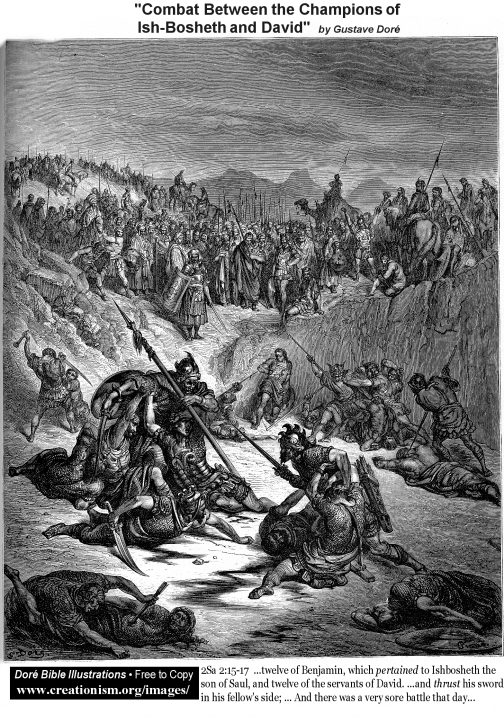
I know that some believe that leaders play political games with soldier's lives. And while that may be true in other countries, I have never thought it to be the case in America. I don't believe it was a game to David, but I'm pretty sure Abner was not in the least concerned about his men, as long as he came out on the winning side. In some countries, militia are used as pawns in a chess match. And although many have accused our country of doing the same thing, I refuse to believe that. Maybe I'm ignorant, but I'm convinced that when our military has to make a move, it really is to protect our interests, and to protect freedom. I'm not saying that every display of our military power is always the best move, but I have never believed that our leaders have ever dealt carelessly with those lives, willing to throw them away as long as we win. I don't believe that of our current President, and I don't believe that of our former President. I don't believe that of our generals. There are always power-hungry people, but as the daughter of a military man who served under some pretty high-ranking officials during his career, even though in a relative time of peace, I knew the character of some of these individuals, and I know they only had the best interests of the country and those who served under them.
Ish-bosheth seemed to be a puppet king, succumbing to the string-pulling of his father's military captain. Abner refuses to yield to God's will, and although he returned home safely, many of his men gave their lives for a fruitless cause. That is selfishness at its highest, and though I haven't read ahead, I'm guessing that Abner will be taken out of the game in the next match. The best move? Heed God's will when we know it. Ignoring it, avoiding it, fighting against it never plays out the way we planned. God's strategy is always best, and we can never outplay Him.
Monday, September 26, 2011
Goin' Courtin'
Today's passage: I Corinthians 6:1-8
One year, I had a class of lively girls. They were each little personalities on their own, but together, they were non-stop entertainment. On break times, they would play Judge Judy. Each day they would take turns being the judge, while the others pretended to be plaintiffs and defendants bringing their cases before her. I often laughed so hard, it brought me to tears. What is more, their pretend judgements were probably as reasoned as the actual judgements on the show, and their imaginary grievances as petty.
Unfortunately, we have too many Christians who would be willing to take their disputes into a Judge Judy courtroom. Paul tells us this is a mistake. A Christian ought not to take another Christian before an unbeliever to judge the merits of their argument. For one thing, an unbeliever will not judge with Godly wisdom (which I have to say, might be the whole reason Christians would go to an unbelieving judge, because they are not interested in God's wisdom about the matter in the first place). A judge in the world is not going to judge according to God's standard, he will judge according to the laws of the city, county or state. He may or may not hand down a verdict that befits the violation. We cannot argue that we did not like the way he handled the case, because we left the case in his hands and trusted him with the judgement in it. Why not leave it in God's? I know His ways are perfect. I know His judgement is just. I know that He understands every angle of the case, and does not need me to argue why I am right. When we go to the courts, we are basically telling God that we have found something that He has no power to handle. Aren't we? Aren't we saying to God, "My Christian brother took advantage of my gullibility, kindness (whatever it is) and I know You can't change his heart about it, God." It is a complete lack of trust in God's ability to transform people. It is a complete lack of faith in God's perfect knowledge of every situation.
Besides the fact that taking my Christian sister to court is faithlessness on my part, what does it tell an unbelieving world? We are supposed to bring souls to Christ, not push them away. In what way at all will God get glory when we take our issues before the world? I can't think of one way that is possible. I can't think of any good thing that can come of it. I can't imagine any outcome that will put the church or Christians in a good light. I am guessing that if anything, people will make sure they avoid the church that is the source for this strife.
But what if I am the one being accused of wrongdoing? What if I haven't done wrong? What if my sister believes I have defrauded her, but I honestly have not. I am writing this to remind myself, should the time come along. Paul says, "Why do ye not rather take wrong? why do ye not rather suffer yourselves to be defrauded?" I should take the hit. If I can at all correct the situation, whether it be paying for something I did not do, donating a service I did not offer, I should appease my sister as best I can to keep it out of the courts. If I am the one who has been cheated, and I have talked to my Christian sister about the situation, but she refuses to make it right, I should cut my losses. But more than either of these, I should pray. Don't pray that the other person will see the light, that God will change their heart, but pray and ask God how He can use me to be a better witness for Him. I am certain I cannot be a better witness sitting in the courtroom, arguing why I am right and she is wrong. All that accomplishes is showing the world how petty Christians can be.
There is another thing. How am I ever to serve in a church with a Christian I took to court? How on earth would that work? It is going to result in one of us worshipping in a different congregation. It is going to result in the church family taking sides with the two disputers, causing a greater rift among the members. This is never a desirable result. This is never something that is pleasing to God. The ripple effect of this never seems to end.
I may leave a courtroom with the verdict in my favor. I may have all the wrongs restored. But in the courtroom of the world, I have lost. I have lost credibility in the God who could have judged for me, and I have lost my testimony as someone who proclaims Christ and His love. Where is my love when all I can see is how I have been defrauded? I think even school-age Judge Judy's could see through that.
One year, I had a class of lively girls. They were each little personalities on their own, but together, they were non-stop entertainment. On break times, they would play Judge Judy. Each day they would take turns being the judge, while the others pretended to be plaintiffs and defendants bringing their cases before her. I often laughed so hard, it brought me to tears. What is more, their pretend judgements were probably as reasoned as the actual judgements on the show, and their imaginary grievances as petty.
Unfortunately, we have too many Christians who would be willing to take their disputes into a Judge Judy courtroom. Paul tells us this is a mistake. A Christian ought not to take another Christian before an unbeliever to judge the merits of their argument. For one thing, an unbeliever will not judge with Godly wisdom (which I have to say, might be the whole reason Christians would go to an unbelieving judge, because they are not interested in God's wisdom about the matter in the first place). A judge in the world is not going to judge according to God's standard, he will judge according to the laws of the city, county or state. He may or may not hand down a verdict that befits the violation. We cannot argue that we did not like the way he handled the case, because we left the case in his hands and trusted him with the judgement in it. Why not leave it in God's? I know His ways are perfect. I know His judgement is just. I know that He understands every angle of the case, and does not need me to argue why I am right. When we go to the courts, we are basically telling God that we have found something that He has no power to handle. Aren't we? Aren't we saying to God, "My Christian brother took advantage of my gullibility, kindness (whatever it is) and I know You can't change his heart about it, God." It is a complete lack of trust in God's ability to transform people. It is a complete lack of faith in God's perfect knowledge of every situation.
Besides the fact that taking my Christian sister to court is faithlessness on my part, what does it tell an unbelieving world? We are supposed to bring souls to Christ, not push them away. In what way at all will God get glory when we take our issues before the world? I can't think of one way that is possible. I can't think of any good thing that can come of it. I can't imagine any outcome that will put the church or Christians in a good light. I am guessing that if anything, people will make sure they avoid the church that is the source for this strife.
But what if I am the one being accused of wrongdoing? What if I haven't done wrong? What if my sister believes I have defrauded her, but I honestly have not. I am writing this to remind myself, should the time come along. Paul says, "Why do ye not rather take wrong? why do ye not rather suffer yourselves to be defrauded?" I should take the hit. If I can at all correct the situation, whether it be paying for something I did not do, donating a service I did not offer, I should appease my sister as best I can to keep it out of the courts. If I am the one who has been cheated, and I have talked to my Christian sister about the situation, but she refuses to make it right, I should cut my losses. But more than either of these, I should pray. Don't pray that the other person will see the light, that God will change their heart, but pray and ask God how He can use me to be a better witness for Him. I am certain I cannot be a better witness sitting in the courtroom, arguing why I am right and she is wrong. All that accomplishes is showing the world how petty Christians can be.
There is another thing. How am I ever to serve in a church with a Christian I took to court? How on earth would that work? It is going to result in one of us worshipping in a different congregation. It is going to result in the church family taking sides with the two disputers, causing a greater rift among the members. This is never a desirable result. This is never something that is pleasing to God. The ripple effect of this never seems to end.
I may leave a courtroom with the verdict in my favor. I may have all the wrongs restored. But in the courtroom of the world, I have lost. I have lost credibility in the God who could have judged for me, and I have lost my testimony as someone who proclaims Christ and His love. Where is my love when all I can see is how I have been defrauded? I think even school-age Judge Judy's could see through that.
Saturday, July 16, 2011
Snake Bite
Today's passage: John 13/Genesis 3
"I speak not of you all: I know whom I have chosen: but that the scripture may be fulfilled, He that eateth bread with me hath lifted up his heel against me."
For a couple of years now, I have been struggling with pain in my heel. It started slowly, sometime after I had my third child. When I would get out of bed in the morning, it would be difficult to put any weight on it. The pain some days was almost unbearable. I tried wrapping it, massaging it, medicating it, nothing seemed to work. Obviously the first question would be, "Why didn't you go to the doctor about it?" Many moms will understand this, sometimes we are too busy to take care of ourselves the way we ought to. Mommies tend to put off what they need to do for themselves to take care of their families. My husband had taken on sidejobs in addition to his regular job, and his health issues (which seemed far more serious at the time) were the only ones we could schedule appointments for on his actual days off. When I finally was able to get to the doctor, she guessed that I have plantar fasciitis (an inflammation of the heel tissue) with a possible bone spur. She recommended avoiding backless shoes (goodbye my beloved sandals) and stretching the heel muscles with some physical therapy exercises. I followed her recommendations. I started doing the stretches, but my youngest was only a few months old at the time and still in the unpredictable sleep pattern stage. It seemed no matter how early I would get up to do these, he would wake up in the middle of my stretching. It was hard to get into a routine, and I got out of the routine for so long, that I forget to even do them now. I need to put a message on my alarm in the morning that says, "Stretch!" You would think that hobbling around the house on one foot for the first part of the morning would be reminder enough, but I'm so focused on what I need to get done, it doesn't even occur to me. I've lived with the pain for so long, it is just second nature.
I am thinking back to the verse in Genesis, when God is rebuking the serpent in the Garden of Eden. "And I will put enmity between thee and the woman, and between thy seed and her seed; it shall bruise thy head, and thou shalt bruise his heel." The heel that would be lifted up against Christ was an infected heel. It was a heel filled with Satan's venom. It would do a lot of damage in the coming days. It was the heel of Judas Iscariot, the betrayer.
We have been subjected to Satan's devices for so long, we are practically immune to them. We notice a little bite at first, maybe we try to do something about it, but eventually we get used to it. The pain continues. We limp from place to place, hardly noticing that our whole foot is infected and the infection is spreading. Eventually, the infection weakens our heart. We haven't taken any medication to counteract its effects, we've become accustomed to parts of our body not functioning properly. It is not surprising when we make ungodly decisions because we haven't had proper therapy. We haven't read our Bible, we haven't prayed, we haven't attended church, we haven't guarded our eyes and our minds. Satan's poisonous bite, without proper medical attention will destroy us. If I don't take the time to tend to it, I will do something I will regret. I wonder if this is what happened to Judas. He had no idea that Satan had possessed him because it started in his heel, the farthest part from his heart, and worked its way up until it was too late. There is a remedy for a snake bite. Destroy the snake. Christ did that when He died on the cross for me. When I accepted Christ, I have the power to bash the serpent in the head, and prevent him from injecting his poison. He will scurry away and find another victim. In God's time, Satan will not be able to infect anyone else. But how many will fall prey before his time is up?
The obvious solution to my heal mending would be to follow the doctor's orders. I should remind myself every morning to do those exercises before my heel becomes an even worse problem. If I have become accustomed to the pain, I really ought to do something about that.
"I speak not of you all: I know whom I have chosen: but that the scripture may be fulfilled, He that eateth bread with me hath lifted up his heel against me."
For a couple of years now, I have been struggling with pain in my heel. It started slowly, sometime after I had my third child. When I would get out of bed in the morning, it would be difficult to put any weight on it. The pain some days was almost unbearable. I tried wrapping it, massaging it, medicating it, nothing seemed to work. Obviously the first question would be, "Why didn't you go to the doctor about it?" Many moms will understand this, sometimes we are too busy to take care of ourselves the way we ought to. Mommies tend to put off what they need to do for themselves to take care of their families. My husband had taken on sidejobs in addition to his regular job, and his health issues (which seemed far more serious at the time) were the only ones we could schedule appointments for on his actual days off. When I finally was able to get to the doctor, she guessed that I have plantar fasciitis (an inflammation of the heel tissue) with a possible bone spur. She recommended avoiding backless shoes (goodbye my beloved sandals) and stretching the heel muscles with some physical therapy exercises. I followed her recommendations. I started doing the stretches, but my youngest was only a few months old at the time and still in the unpredictable sleep pattern stage. It seemed no matter how early I would get up to do these, he would wake up in the middle of my stretching. It was hard to get into a routine, and I got out of the routine for so long, that I forget to even do them now. I need to put a message on my alarm in the morning that says, "Stretch!" You would think that hobbling around the house on one foot for the first part of the morning would be reminder enough, but I'm so focused on what I need to get done, it doesn't even occur to me. I've lived with the pain for so long, it is just second nature.
I am thinking back to the verse in Genesis, when God is rebuking the serpent in the Garden of Eden. "And I will put enmity between thee and the woman, and between thy seed and her seed; it shall bruise thy head, and thou shalt bruise his heel." The heel that would be lifted up against Christ was an infected heel. It was a heel filled with Satan's venom. It would do a lot of damage in the coming days. It was the heel of Judas Iscariot, the betrayer.
We have been subjected to Satan's devices for so long, we are practically immune to them. We notice a little bite at first, maybe we try to do something about it, but eventually we get used to it. The pain continues. We limp from place to place, hardly noticing that our whole foot is infected and the infection is spreading. Eventually, the infection weakens our heart. We haven't taken any medication to counteract its effects, we've become accustomed to parts of our body not functioning properly. It is not surprising when we make ungodly decisions because we haven't had proper therapy. We haven't read our Bible, we haven't prayed, we haven't attended church, we haven't guarded our eyes and our minds. Satan's poisonous bite, without proper medical attention will destroy us. If I don't take the time to tend to it, I will do something I will regret. I wonder if this is what happened to Judas. He had no idea that Satan had possessed him because it started in his heel, the farthest part from his heart, and worked its way up until it was too late. There is a remedy for a snake bite. Destroy the snake. Christ did that when He died on the cross for me. When I accepted Christ, I have the power to bash the serpent in the head, and prevent him from injecting his poison. He will scurry away and find another victim. In God's time, Satan will not be able to infect anyone else. But how many will fall prey before his time is up?
The obvious solution to my heal mending would be to follow the doctor's orders. I should remind myself every morning to do those exercises before my heel becomes an even worse problem. If I have become accustomed to the pain, I really ought to do something about that.
Saturday, April 23, 2011
What He Knew
Today's passage: Isaiah 49
I am not a quick decision maker. Sometimes, it is my downfall. I like to mull things over. I do not like to fail, so I tend to examine every angle to be sure that I will succeed. In the first few verses of this passage, the Lord Jesus tells about His future coming. He says, "....I have laboured in vain, I have spent my strength for nought, and in vain..." In people's eyes, He was going on a doomed mission. This was not going to end well and would appear to be a failure. We know differently. How Satan must have been celebrating when Christ died on the cross. How he must have made plans for what he thought was his triumph. He would soon find out that Christ succeeded for all eternity.
From a human perspective, I would not want to go where I was not wanted, I would not want to woo those who had no love or need for me. I would not want to expend precious time and energy on a project that seemed hopeless and futile. From a spiritual perspective, every tract I give out that is thrown to the ground is a soul that needs Christ. Every person I invest emotion in, who may betray my trust, is a potential servant for the Lord. Every hour I spend teaching rowdy, sometimes ungrateful, children is time training future teachers, preachers or missionaries. Do I always view it this way? No. Not always. Sometimes I don't give out the tract, take someone under my wing, throw myself into my lesson the way I should, to my shame. Sometimes I want to see the bottom of the pool before I decide to dive in. I'm so thankful that my Lord Jesus Christ did see the end of His earthly life beforehand and decided to go through with it anyway. He knew about the scorn, the rejection, the hatred He would face. He knew about the scourging, the crown of thorns, the crucifixion. He knew about His Father turning away from Him when He needed Him most. He knew. And He did it anyway. Because He also knew about the empty tomb, the sinner who believes, the reunion with His Father. It was not in vain. It was not for nought. It was not wasted. That is what He knew.
Thank you, Lord Jesus for what you knew and for coming anyway. I am not worth it. You know that too. But thank you for making me feel as though I am worth something to go to all the trouble of saving my worthless soul. I am humbled and amazed (every day and in every way.)
I am not a quick decision maker. Sometimes, it is my downfall. I like to mull things over. I do not like to fail, so I tend to examine every angle to be sure that I will succeed. In the first few verses of this passage, the Lord Jesus tells about His future coming. He says, "....I have laboured in vain, I have spent my strength for nought, and in vain..." In people's eyes, He was going on a doomed mission. This was not going to end well and would appear to be a failure. We know differently. How Satan must have been celebrating when Christ died on the cross. How he must have made plans for what he thought was his triumph. He would soon find out that Christ succeeded for all eternity.
From a human perspective, I would not want to go where I was not wanted, I would not want to woo those who had no love or need for me. I would not want to expend precious time and energy on a project that seemed hopeless and futile. From a spiritual perspective, every tract I give out that is thrown to the ground is a soul that needs Christ. Every person I invest emotion in, who may betray my trust, is a potential servant for the Lord. Every hour I spend teaching rowdy, sometimes ungrateful, children is time training future teachers, preachers or missionaries. Do I always view it this way? No. Not always. Sometimes I don't give out the tract, take someone under my wing, throw myself into my lesson the way I should, to my shame. Sometimes I want to see the bottom of the pool before I decide to dive in. I'm so thankful that my Lord Jesus Christ did see the end of His earthly life beforehand and decided to go through with it anyway. He knew about the scorn, the rejection, the hatred He would face. He knew about the scourging, the crown of thorns, the crucifixion. He knew about His Father turning away from Him when He needed Him most. He knew. And He did it anyway. Because He also knew about the empty tomb, the sinner who believes, the reunion with His Father. It was not in vain. It was not for nought. It was not wasted. That is what He knew.
/images/scan0006_tif.jpg) |
| From the Manger to the Cross--Taken from The Children's Friend (Part One) By Mrs. Adelaide Bee Evans Review and Herald Publishing Association, 1911, 1928 |
Subscribe to:
Posts (Atom)
