Showing posts with label Enemies. Show all posts

Saturday, December 17, 2011

Lend Me Your Ears

Today's passage:  II Samuel 22:1-7
     "When the waves of death compassed me, the floods of ungodly men made me afraid;  The sorrows of hell compassed me about; the snares of death prevented me; In my distress I called upon the LORD, and cried to my God:  and he did hear my voice out of his temple, and my cry did enter into his ears."
     Men are often accused of having selective hearing.  They heard "football game on TV" but not "Please ask son's teacher about such and such".  But I'm sorry to throw us under the bus ladies, I know I have it too.  Especially when I'm in the middle of doing something.  When my husband says to turn off the coffee pot warmer before I leave the house so the coffee doesn't burn, I heard what he said.  But apparently I didn't process it and really let it sink in.  Because what did I do the other day, right after he said it?  I left the house for numerous hours with the coffee pot warmer still on.  I'm fortunate to be married to a very laid-back, easygoing husband who never gives me criticism.  And I deserve a lot, I'm afraid.
   The end of verse 7 says David's cry entered into God's ears.  God always hears our prayers.  I could be wrong, but the verse that says God doesn't hear our prayer if I regard iniquity in my heart, doesn't mean He doesn't actually hear us.  He just isn't paying attention and will not answer.  Does that mean God has selective hearing too?  I guess when we refuse to relent of some sin in our life that He has pointed out to us time and time again, it does.  I suppose when we ask for something, and we are too stubborn or proud to say "I'm sorry", God ignores us.  But in the above verses, God didn't just hear David.  His prayer went into God's ears.  And unless sin is blocking our way, God always intently hears our prayers.  Have you ever been in a conversation, and had the sense that the person you were talking to was distracted, or that you didn't have their full attention?  I know sometimes I have been that person.  And I hate that because I really want to hear what the person is saying, but if my two year old is about to poke himself in the eye with a sharp object or my four year old is climbing yet again on some non-sturdy structure, my attention is going to be a little divided.  God has a whole world to listen to, but He is not once distracted by his children who are involved in some ungodly activity while another who needs His help is pouring out prayers over her little one.  He can equally hear the prayers going up at a church service and the prayers going up at the hospital.  And He doesn't just hear one and listen to the other.  They both enter into His ears.
Hear My Prayer--Taken from Standard Bible Story Readers, Book One
By Lillie A. Faris, Illustrated by O.A. Stemler and Bess Bruce Cleaveland
The Standard Publishing Company, 1925

     This is great assurance because like David, I'm living in a "flood of ungodly men".  This sinful world gets worse every day.  News stories are evidence of that. It isn't going to improve. Things might improve for individuals if they give their lives to Christ, but as a nation, as a planet, conditions will grow steadily worse.  It is a good thing that a prayer of salvation enters into God's ears and He can deliver a person from the "sorrows of hell" and the "snares of death".  It is a comfort that when I feel surrounded by sin and darkness, when evil is prevalent and engulfs me, God doesn't just hear me, my prayer enters into His ears and He will answer.
    "I will call on the LORD, who is worthy to be praised:  so shall I be saved from mine enemies."  II Samuel 22:4

Friday, December 16, 2011

Tall Tale Two

Today's passage:  II Samuel 21:15-22
     David is not a young man anymore.  I have to respect that he still goes out to battle with his men.  Maybe after the incident with Bathsheba, he determined that he would never stay home for a battle again.  Only nowadays, David's age is starting to show.  His sword feels heavier, difficult to wield.  His steps more uncertain, wobbly even.  He is not agile as he was in his youth.  He has to sit down to rest more.  But when do you have a chance to rest during a battle?  As much as his men probably appreciate having their king willing to lay down his own life in these attempts, he's slowing them down.  He has become more of a hindrance than an asset.
     In this passage, the Philistines continue to harass the Israelites.  They will never believe that Israel has a right to all that land.  They will never believe that Israel has a more powerful God.  He may have been more powerful on the day Goliath was killed, but that was only one day.  Goliath's brother and I assume a few of his sons (they are referred to as the sons of the giant) have a personal vendetta against David.  Goliath's brother would not forget that day.  I don't know how old Goliath's sons may have been at the time, but if they were not old enough to see their father fall, they had heard their uncle's version numerous times.  Here, they had the opportunity to personally see their dreams of destroying David realized.  And Ishbi-benob, the one son, nearly accomplishes it.  It says he was "girded with a new sword" and I'm not sure if that means this is his first arena of battle or if he had his weapon freshened for this occasion. Venom is flowing from this man.  He blames David for the years without his father.  He had no more learned the lesson than Goliath had.  The problems the Philistines had were not Israel's fault (See A Truly Tall Tale).  Now it would have made a great movie reel if David destroyed all these enemies.  But I think his fighting days are over.  He has mighty men to do that job for him.  And they do an excellent job.
David faces Goliath with his sling--Taken from Standard Bible Story Reader, Book Three
By Lillie A. Faris, Illustrated by O.A. Stemler and Bess Bruce Cleaveland
The Standard Publishing Company, 1926 

     But it makes me wonder.  How must David have felt?  There he is, back against the rocks, unable to really defend himself anymore.  He braces himself for the blow of the sword when the giant topples over.  One of David's mighty men has rescued him.  In his younger days, David would have been the rescuer.  He had been Israel's hero.  Being king seemed infinitely more significant, but people did not always love kings.  They always loved heroes.  Perhaps knowing Goliath's kin would be in this fight is all the more reason David decided to show up.  Maybe he thought he could recapture the glory days when he had first become a national figure.  When the country was singing about his killing Saul's ten thousands.  Now somebody was killing David's ten thousands.  Did it make him sympathize with Saul a little bit?  Did he understand Saul's jealousy of a younger warrior?
     David was beginning to understand that God had already used his past, he would not get that back.  His present was a little messed up.  Failures had caused complications for him.  But there was still his future.  Could an old man do anything for God?  Any man (or woman) no matter the age can do something for God, if they are yielded to Him.  I started to realize I was getting older as a counselor in the youth group when I was grumpy after overnight lock-ins.  I used to love that kind of thing (when I was younger).  I know I'm getting older when make-up doesn't hide the laugh lines anymore, when plucking gray hairs now takes longer than if I would just cover them up, when amusement park rides give me more vertigo than butterflies.
     David's future is a question mark.  It doesn't mean he is finished.  It doesn't mean his best years are behind him, it just means his youngest years are.  Realizing youth is past is not a pleasant discovery.  I'm still reconciling myself to the fact that I'm middle-aged.  I feel younger than I look.  But I wouldn't trade the maturity and wisdom I have gained as I have gotten older.  And though David has had a lot of regret, I'm guessing he has learned a lot and wouldn't trade those experiences either.

Wednesday, December 14, 2011

Opposed and Oppressed

Today's passage: II Samuel 20
     I'm not going to deny it.  I have put off writing about this chapter.  I seriously have been stuck.  It is excessively violent.  I'm not sure movies I've watched are as violent as what I'm reading here.  I shudder, I cringe, I wish I could just skip this chapter completely.  And I could.  I don't think anyone pays that close attention that they would notice I decided not to post what I learned here.  But I know, and I feel like when I don't write about a passage, maybe I am saying God couldn't teach me anything through it.  And He always teaches me something.
    For instance, the man mentioned in the first verse of the chapter, Sheba, a Benjamite, which would have meant he was a relative of Saul absolutely denounces David's leadership.  He encourages the rest of his tribe to do the same.  The Bible calls him a "man of Belial".  Now, God commanded Israel very particularly how to handle children of Belial.  And I'm not certain if Sheba was deemed this because he was rebelling against God's anointed, King David, or if he was involved in occultist behavior to be labeled a son of Satan.  In either case, Deuteronomy 13:12-18 gives specific charge as to how to handle these types of people.  The Israelites were to make certain that people accused of this behavior were authentic (unlike the Salem witch trials of old) and if so, they were to slay them with the sword, destroy all their livestock and belongings, make a bonfire with any of their possessions in the midst of the village and see to it that any trace of them was consumed.  Does this seem a little extreme?  For someone who has never dealt with Satanic power, it may.  I have heard on more than one occasion that when Satan has a foothold in someone's home, especially someone who had been dealing with him directly, every item they possessed was a portal to allow his demonic powers to have reign.  God always knows what He is doing.  If He said to destroy everything that person had dealings with, I think I would obey that command, because God created Satan, and He knows what He is capable of.  This also makes me wonder about Saul's whole family.  He had trouble with evil spirits, he visited the witch at En-dor, it makes me wonder if the Benjamites had a history with the occult. If they did, it could explain Saul's constant struggle with those powers. If he couldn't be free of them, it could mean that he still had something in his possession, something that was a doorway for those dark, evil, oppressions he had been experiencing.  I've heard a lot about this kind of stuff lately.  Satan has no power over us, but don't think he can't mess with us a little bit.  He certainly can.  His power is real, and though not more powerful than God, he has dominion over this world, and therefore, can manipulate the things of this earth by his choosing.  If the Benjamites were often involved in these types of activities, it might be why David commmanded his generals to go after Sheba.  He concludes that "Now shall Sheba the son of Bichri do us more harm than did Absalom".

     So David dispenses his men to go after this son of Belial.  In the midst of this is a vengeful Joab.  Amasa is the one David chooses to lead up this expedition against Sheba.  I'm guessing his relationship with Joab has never been the same since Absalom's death.  David choosing Amasa , who aided Absalom, was an even greater insult to his former general.  Joab never forgets an enemy.  He had not forgotten that Amasa chose to work with those against the king.  He would not allow this to stand.  David may have forgiven Amasa, but Joab certainly would not.  And in true Joab style, he kills Amasa.  But this is not just a soldier against soldier killing.  This is a vengeful, make the enemy suffer type of death.  I would rather not describe it.  The Bible does a fine job on its own.  Let's just say Amasa's death is so horrific that others going by can not help but stare in disbelief.  His body actually becomes a distraction to the rest of the regiment pursuing Sheba.  Someone was finally wise enough to move and cover this distraction.
     Joab takes charge of the campaign and comes to the city that is harboring Sheba.  The inhabitants do not want war, especially not with Joab.  His name has become a name to be feared. The passage says "a wise woman out of the the city" confers with Joab about why he wants to destroy their fine city.  Joab assures her that is not his desire, but they will accomplish their mission and that is to fetch Sheba.  The woman determines that the city will handle Sheba.  Again, another description of his demise by the citizens of the city.  The objective was achieved.
     There is really no excuse for Joab's behavior towards Amasa.  He viewed him as a threat and an enemy.  I think it was more that he viewed him as a rival as the king's adviser.  Joab may think that eliminating other counselors or generals will heal the relationship with David.  But he is wrong.  That can only heal with the miracle of forgiveness.  I'm not saying it would be a miracle for David to forgive.  I'm saying that forgiveness is a miracle in itself when it can mend a broken relationship between a king who has lost his rebellious son, and the general who has taken the rebellious son's life and who has continuously disobeyed his king.  I don't see how this relationship can be mended.  But forgiveness is powerful when we choose to use it. Do I think Joab deserves forgiveness?  From a human perspective, no.  He has been given many, many chances.  But so have I.  I don't deserve any of the forgiveness I have been granted either.  May I ever be mindful of God's great forgiveness to me every day.

Thursday, December 8, 2011

Awkward

Today's passage:  II Samuel 19:9-43
   It is that awkward time of year again.  How is it awkward?  Inevitably, I receive an unexpected present.  A present I had not anticipated and from someone for whom I did not buy a present.  For me, that is always awkward.  I always appreciate the sentiment, but tinged with guilt.  Why did I not think to get that person a present?  It is humbling, because I have received gifts from people that would have not been on my gift list radar.  I have received gifts from people who I deemed mere acquaintances and wonder if I rank significantly higher on their friends list.  I know that in most cases, they are not expecting something in return.  It is really the joy of giving that motivates them.  This is also the time of year that the TV and radio reiterate the "tip" list.  You know, the list of people in service jobs who deserve a bonus this time of year.  Your postal carrier, your dog walker, your hairdresser, your doorman, your handyman, your financial manager, etc., etc., etc.  Has anybody noticed that this list seems to expand every year?  Now, I'm not knocking this.  I have benefited from such kindness.  As a teacher, as a clinic receptionist, as a house cleaner, my employers were more than generous at Christmas time.  But I never felt entitled to those bonuses.  I never expected it.   If I had the money to get every person who has performed a service for me this year a present, I would have nothing left to get the people who are really dear to me anything.  Am I the only one that thinks this list is a little exaggerated?  I mean, should I give every single person who works in a service capacity a gift for doing their job?  Sorry, I don't feel obligated to do that.  In the past several years, our newspaper delivery person and our postman have left Christmas cards with names and addresses in our mailbox.  Hint, hint, so we know where to send a Christmas bonus.  After Christmas had passed, and we did not tip these people, it seemed like a big coincidence that our newspaper, placed neatly on our porch previously, always ended up in a snow pile at the bottom of the steps.  I'm not saying these people don't deserve something extra special at Christmas, but don't expect it.  We are one of those families that simply cannot afford to give a gift to every person we meet.  Maybe there are some that can, and that's fine.  I think its great that service employees receive something extra special from some of their clientele, just don't begrudge those of us that can't.
     So I kind of veered on a rabbit trail there, but the gift giving does tie into this passage today.  King David is returning to Jerusalem, resuming his rightful place on the throne.  As he journeys back, he encounters friends who stuck by him through this horrible mess, and foes who opposed him.  The foes are particularly nervous because they are certain that David will execute judgement.  But he doesn't.  What?  He is merciful.  He ignores his advisers counsel to make examples of these traitors.  However, he does not forget his friends.  He is prepared to handsomely reward them.  So nothing happens to the enemies, but great things happen to the loyalists.  I'm wondering if David thought the best punishment for these folks, was to see the blessings they would miss for not serving him.
Shimei Throws Stones at David--Taken from Treasures of the Bible (United Kingdom)
By Henry Davenport Northrop D.D.
International Publishing Company, 1894
     That makes me think of our King's return.  He is coming back someday.  Many apologies will be made to Him then.  Not just by people who rejected Him, but by people who claim to know Him but never lived for Him.  They will have all kinds of excuses as to why they didn't serve Him.  Some of those apologies will be genuine, but some of them will be out of fear of the judgement to come.  I believe God chastens us for wrongdoing if we are His children.  But what if He comes today?  Some of those people who have not been living for Him, who have accepted Him as Savior, but have never bothered to give back a little part of their lives to Him, may still be involved in living in sin.  If Christ came back today, where is the chastening, where is the punishment?  They will get to go to Heaven.  Ah, but here is where the chastening comes in.  When those of us who have lived for Him stand before Him in Heaven, we will have crowns to throw at His feet.  Those who wasted their lives serving the god of this world will stand empty-handed, shame-faced before the King of kings.  Where is the chastisement?  When they have no gift to give the One who died for them.  When the One that should have been at the top of their gift list does not receive a present, when He gave the greatest gift of all--our salvation.  I so do not want to be one of those people.  I really want to live in a way that is pleasing to my God, so that I can give it all back to Him.  He has given me so much.  His mercy may be to spare judgement, but it can not spare us any shame we feel for not living our whole lives for Him.  I pray I will not be embarrassed to always give back to Him.  I pray I do not forget to give Him something at Christmas time and every day of the year.  Because that would be really awkward.

Wednesday, December 7, 2011

Grief Postponed

Today's passage:  II Samuel 19:1-8
     "To every thing there is a season, and a time to every purpose under the heaven:...A time to weep, and a time to laugh; a time to mourn, and a time to dance;"  Ecclesiastes 3:1,4
     It has been seven years since my father's passing.  At the time, I had to put my grief on hold temporarily because there were things to be done.  As the oldest of my mother and father's children (I have an older half-sister from my father's first marriage) my brothers and sisters looked to me to handle the details of arrangements.  I had to write my father's obituary.  Can I tell you how wrenching that is? ( My mother is going to read this today and I have no doubt that she is going to cry.  I'm sorry, Mom, but it perfectly illustrates today's passage.  And I think it is probably a little therapeutic for me. ) Writing about my father's life, not so hard, writing about his death, significantly harder.  Adjusting and editing so the word length fit the required space, frustrating.  How can you encapsulate a person's life in a paragraph?  Especially a parent who deserves an entire book?  We were giving my father a military burial which meant coordinating the pastor's schedule, the funeral home's schedule, the veteran's cemetery schedule.  There were people to call, some I had not talked to for years, to notify of Dad's death.  (By the way, I would not have you to believe that my siblings did nothing--  I took the lead for the major details  They especially helped with notifications.  My sister-in-law specifically aided me in this part of the process. ) For a while there, I'm not sure I had cried one tear.  I didn't really have time.  I shed ample tears at the actual service.
     The week following, I was able to stay with my Mom and go through paperwork.  Oh my goodness, what an amount of paperwork there was to sort!  It was surprising since my father's job involved office managerial tasks almost his entire working life.  But it was evidence of his failing health in the prior few years.  I threw myself into setting up a filing system my mother could manage.  I called credit card companies, tax people, insurance groups.   And I was glad to do it.  In a funny way, it was a sort of tribute to my Dad.  He had taught me these very skills that I was using to be able to help Mom.  This little piece of himself he had left behind in me, almost as if he knew I would need to do this someday.  I had never thought about that before today, and I'm not saying my brothers or sisters do not possess some of those same skills, but at that time, I was the one who was able to do it.
     The passage today takes me back there.  Why? Because there were moments (and really only moments, because I am the type of person who wants a short grief and then back to action) when I would have loved to put the obituary writing to the side and just reminisce.  Visitors came in and out of the house all day long for that week, for which I am extremely grateful, because it was a needful thing for all of our family.  Friends would pop into the office and say hi, and as much as I wanted to sit and visit, I really couldn't.  I had only a limited time to get these tasks completed.  I had to make sure Mom had her financial house in order.  It is kind of like that for David, here.  I mean, Absalom's death has just happened.  David has barely had time to mourn this son.  The people see his grief, and begin to wonder if they made the wrong choice to fight for him.    They come back from battle rejoicing that the enemy has been defeated, but then they hear the wailing of the king and begin to think maybe they had made some kind of mistake.  Weren't they supposed to quell this rebellion?  Wasn't it a good thing the usurper was not able to wreak any more havoc?  Joab arrives from battle, quickly assesses the situation, and in true Joab style, gives King David his presentation of the cold hard facts.  And here they are.  Yes, King, your son is dead, but you better gather yourself and let these people know you appreciate how hard they fought for you, or you will not have a kingdom left, because they will go fight for someone else to replace you.
David Mourning the Death of Absalom
By Gustav Dore
Courtesy of www.creationism.org
     There is never enough time to mourn the passing of someone we love.  There is never a timetable for grief.  Life does not stand still while we are anguished.  I can't say that I don't think Joab was a little heartless here.  His mission mentality sometimes disregarded people and only saw tasks.  It is often the case in leaders.  I'm sure if Joab could have allowed David to grieve, he would have, but the country needed a leader at this moment, and David had to be that man.  Oddly, it reminds me of our country shortly after September 11, 2001.  When our country was in crisis, we looked to our leaders to console us, to tell us what to do next.  Joab knew his uncle well enough to know that David might have grieved for weeks before uttering a word to his countrymen.  They did not have that kind of time.  The throne was still at stake.  David followed Joab's advice.  But I'm sure he did not want to.  I'm certain he would have wept on the roof of that house for much longer, and it would have been understandable.  Joab may have seemed unusually cruel here, but he was also unusually perceptive.  He doesn't seem to be a man of great feeling, and I'm guessing he would prefer to confront an enemy than confront his own emotions, or the emotions of the king.  He is a let's-keep-moving sort of guy.  So we have this bump in the road, let's figure out how to get past it and onto the next thing.  David needed that kind of man as his trusted adviser, because David felt everything, and he felt it intensely.  He relished relationships.  He saw people, not just production.  Now his vision blurred with a relationship lost, he needed his task-oriented general to jolt him into the day's realities.  Moving forward would be arduous, it would be demanding, it would be taxing.  There would be another time to wallow in his sorrow, but for this moment, his grief would need to be delayed.
     I would not change anything about how things happened after Dad's death.  I would not have asked for a reprieve from the tasks before me that week.  To be honest, I have a little of Joab in me.  Give me a problem to solve, I would rather deal with that, than my own emotions.  I felt useful, and I was glad to be of use.  Mom, I would not have wanted it any other way, I do not write any of this out of regret, only reflection.  Knowing you, you will want to make things up to me somehow around the Christmas table, invite our friends and give me a chance to really reminisce about Dad.  I've done plenty of that in the passing years.  I don't feel gypped.  I don't feel cheated.  I feel like Dad instilled a little something in all of us, and I was doing what Dad would have done, had it been you going before us.  I feel like it was my gift to you, to be able to be your sounding board, your manager.  I pray that you won't see any complaint in this post, only contemplation.

Monday, December 5, 2011

Generally Speaking

Today's passage:  II Samuel 18: 1-17
     There is no easy explanation for Joab.  He is a warrior with a military mindset.  Often he goes into a situation with a "kill or be killed" attitude.  And why shouldn't he since he has practically led every battle since David has been king? He is King David's nephew and has been his trusted friend and go-to guy.  He doesn't always carry out David's orders as precisely as he should.  Since he was family, he sometimes disregarded David's commands if he thought the ends would justify the means.  Since David was his uncle, he sometimes disobeyed David's orders because it was bad strategy.  As the general, he was in the midst of the conflict and he could see what would be best for the kingdom.  And being related to the king, meant that the king would more than likely show leniency with him as long as the battle turned out in their favor.  Joab hasn't always gone along with the program, but I have no doubts that his motives were pure, that his intentions were sincere.  His ambition was to serve his king, and if that meant defying him sometimes to keep him protected, than he had no qualms about doing that.  He respects David, but he doesn't fear him.  He knows that David values loyalty.  And like his methods or not, Joab is loyal.
     Absalom has decided to take Hushai's advice and go after his father himself.  This leaves David with no other option than to have his men try to subdue him.  This breaks David's heart.  We can see how anguished he is when in verse 5 he says, "Deal gently for my sake with the young man, even with Absalom."  Doesn't sound like a lot of wiggle room in that statement.  It is not a wanted-dead-or-alive command by any means.  So I know Joab does not misinterpret this, he just chooses to forget he heard it.  From Joab's perspective, his cousin Absalom has caused nothing but grief for David for a few years now.  Joab may feel partially responsible for this, since it was at his own bidding that Absalom was invited back to the palace.  Joab thought David and Absalom could mend their relationship, but instead it had become more strained.  And then Absalom decides to rebel against his father in the most despicable way.  I'm sure Joab was not only infuriated by Absalom's actions, but humiliated.  Joab was probably muttering to himself, if he had just stayed out of this family affair, if he had only kept his thoughts to himself, if he had never encouraged David to reach out to Absalom then they would not be in this mess.  Had his heart not been touched by his cousin's despair at being isolated from his father, he might not have to contend with this family war.
Absalom is caught in a tree--Taken from The Boys of the Bible
By Hartwell James
Henry Altemus Company, 1905, 1916
     There is no disputing what David said as Joab departs to fight this battle.  Every one of the soldiers understood this clear order to spare Absalom if it could at all be helped.  When Absalom's abundance of hair (maybe he should have had it cut before riding into the woods) gets caught in some tree branches, donkey surging on ahead without him, he is a pitiful sight.  He must have been really stuck, because I'm sure he must have been flailing about trying to free himself to no avail.  He can not harm any one in this vulnerable position.  Even if he had bow and arrow on him, he is not likely to get off a good shot.  One of David's soldiers reports this situation to Joab.  Joab rebukes the soldier for sparing him.  The soldier is not apologetic for following the king's orders.  He even argues that had he decided upon this action, Joab would have not backed him, but would have left him out to dry.  This soldier does not have the advantage of a familial relationship with the king.  He reminds Joab clearly of David's plea to not kill Absalom.  Joab really has no excuse here, and feels he doesn't need one.  This cousin of his, had more than aggravated his father, he had aggravated him.  This was an embarrassing situation-- to be fighting in the woods trying to regain the throne from the one he had tried to help.  Joab felt that if they were to spare Absalom, this would be a sign of weakness to any other usurper.  If, however, the king's own son were duly punished for his treasonous act, wouldn't it cause future rebels to tread more cautiously?  Joab does not spare Absalom.  And it is not pretty.  He shoots three arrows directly into him, and has ten armorbearers finish him off.  Then they dig a hole and bury the body in the woods, covering it with stones.
     I'm not sure how Joab is going to explain this disobedience because I chose not to finish reading the chapter at this point, but I know there are enough witnesses to make Joab look really bad.  Joab doesn't seem too concerned.  He did what he felt needed to be done.  He knows what the king said, but just as he has done in the past, he also knows that he is trying to keep his king on the throne as long as possible, and he will take any action necessary to achieve that.  Is Joab happy about this deed?  I doubt it.  He just killed his cousin.  That can't be a euphoric feeling, but Joab keeps his feelings on the sidelines when it comes to battle.  He has an almost robotic response when he has a military decision to make.  Disregard feelings, disregard orders, disregard relationships.  What is going to achieve the objective?  Joab was a man of action.  He was decisive.  This is why David keeps him as one of his generals.
     I'm not saying Joab was right or wrong here.  If he allowed Absalom to live, Joab knew David would have forgiven him and he knew Absalom would have probably attempted this same thing again, and possibly succeed the next time.  Do I think Joab should have disregarded David's orders?  Not really.  But I also know, that God was meting out judgement on Absalom and it is unfortunate that this is how it came to pass.  Absalom wasn't exactly merciful towards his brother (not saying he should have been).  And his lack of mercy on Amnon brought about a lack of mercy from Joab.  But I won't be surprised if Joab's lack of mercy is revisited upon himself.

Friday, December 2, 2011

Risk-y

Today's passage:  II Samuel 17
     A great amount of military strategy is trying to get into the enemy's head and predict his next move.  This is probably why I never enjoyed the game Risk.  I have never been a very strategic person.  Most men love that game.  In college, a few people tried to teach me how to play, but gave up after the first five minutes.  I was hopelessly clueless.  My logic and reasoning skills have only kicked in since being an adult--at least I would like to think I have some now.
     This whole passage is Absalom's determining what his father might do next.  Everyone understands that Absalom is staking his claim as king.  He made it quite clear at the end of the last chapter when before all of Israel, he treats King David's concubines as his own.  So what next?  Absalom knows he needs to secure his kingdom.  He knows that there will always be those loyal to his father unless his father is dead.  He needs to know how best to achieve that objective.  The advice from Ahithophel is to take some troops out to pursue David.  He will kill David himself, and all of David's followers will somehow come following him back to the palace, Pied-Piper-of-Hamlin style.  That is not exactly the picture Ahithophel paints, but pretty close.  Of course, the hero in this little narrative would be Ahithophel.  Absalom would have sat around the palace waiting for his return, cheering his general's wise military genius.  This is the cartoon dream bubble I see above Ahithophel's head.
     Surprisingly, although Absalom thinks it is a brilliant plan, he wants to hear another choice.  He summons Hushai, who he doesn't realize is working as a double agent for David.  This is because Hushai understood that the way to Absalom's heart was to appeal to his pride.  He does this at the end of the last chapter, when asked wasn't he one of David's men, by saying, "Nay; but whom the LORD, and this people, and all the men of Israel, choose, his will I be, and with him will I abide."  He uses the same technique in this passage.  When asked how they should go after David, Hushai shoots down Ahithophel's idea.  He reminds Absalom that his father is a valiant warrior, and that his men are too.  Wouldn't it be better if brawny, strapping, mighty Absalom should go after his father himself?  In one respect, Hushai is taunting Absalom by touting his father's military abilities, and in the other respect is suggesting that Absalom is the only one who could defeat him.  Hushai has a real understanding of his enemy, and uses the wisest method to gain the upper hand.  The rest of Absalom's counselors agree, and don't they kind of have to, because otherwise they are telling Absalom that Ahithophel would be far better suited to battle the enemy, that he would be a much better match for David.  These guys are not dummies.  They know that you don't tell your new king he is not strong enough to take down his father.


Young Knight, the Armor of God--Taken from Standard Bible Story Readers, Book Four
By Lillie A. Faris, Illustrated by O.A. Stemler and Bess Bruce Cleaveland
Standard Publishing Company, 1927
Now here is something that I have to wonder about, because the Bible does not use quotations marks the way we do today.  Verse 14 says,

"And Absalom and all the men of Israel said, The counsel of Hushai the Archite is better than the counsel of Ahithophel.  For the LORD had appointed to defeat the good counsel of Ahithophel, to the intent that the LORD might bring evil upon Absalom."  

Is the second sentence something the counselors said?  Or is it what God wrote to explain why Hushai's advice was taken over Ahithophel's?  Was it the counselors saying that they thought God preferred Hushai's advice over Ahithophel's because the latter would bring harm to Absalom?  Or is God telling us He persuaded these counselors so that He could bring evil upon Absalom?  It might seem like a small detail,  but if you read it all together, it just sounds like the counselors are reasoning this together.  When I take a second look, it almost seems this is not a quotation, but God explaining that the reason those counselors took hold of Hushai's plan was His exact design.  If this is the case, and I am persuaded that it is, Absalom is doomed.  No military strategy he develops is going to win him this war.  God is working behind the scenes.  He is giving Hushai the wisdom to sway Absalom, he is putting foolish words into Ahithophel's mouth (which is exactly what David prayed for in Chapter 15).  It really doesn't matter what Absalom decides, because if God is against him, he will not succeed.
     Things do start to fall apart.  Hushai has already sent word to David about Absalom's plans,  the surrounding countries are supplying David and his men with food, and Ahithophel commits suicide after his humiliating rejection.  Absalom can not yet see that his time on the throne will be very short-lived.
     I think that if I ever got to the place in my life where God had to bring evil upon me, I would be devastated.  And it could happen so easily.  If I start by taking little steps away from Him, maybe skipping my Bible reading a day or two, perhaps forgetting to pray here or there, finding excuses to not be in His House (or grabbing hold of excuses the devil hands me) I can drift farther and farther away from God.  If I were to let down my guard with things I watch, what I listen to, places I go, I could slip out of His service and onto His watchlist.  I don't ever want to be aiding the Enemy.  I don't ever want to cultivate negative things in my life that might cause Him to eliminate me.  Oh, I'm not worried about my Home in Heaven.  That was secured long ago, and had nothing to do with me, but my fellowship with God could be easily compromised if I slowly start to aid the other side. This is why I need to be a strategist, myself.  I always need to anticipate Satan's next move to bring me down.  He is always trying.  He would like nothing better than to recruit someone to work for his team.  And as tempting as he tries to make his recruitment package sound, that is a move that is way too risky.

Wednesday, November 30, 2011

Promises, Promises

Today's passage:  II Samuel 15
      It looks as if David's reign as king is over.  David can not know any differently.  After all, he has sat on the throne for a while now.  The one who wants to take his throne is his own son.  It is not as if God has not kept his promise to David.  The Lord told David that his kingdom would continue on, that his line would sire the Messiah.  Both parts of God's promise will still be fulfilled if Absalom's rebellion is successful.  Now David (a much older man by now) is weeping in the wilderness, wondering whether he will die here.
     That beguiling son of David had charmed the people into thinking he should be king now, instead of when David died.  He convinced the people that David did not care about the problems of the common man.  He disciplined himself (good to know he was disciplined about something) to wake and arrive early at the city gate each morning.  He greeted and campaigned, listened to the people's gripes and offered his solutions.  Sounds a little like a presidential candidate.  Only Absalom doesn't want to wait for an election, he wants to oust his father and replace him.  Why the hurry?  Absalom was the next successor to the throne.  Why shouldn't he bide his time?  I think partly because he wants to hurt his father.  His feelings of pride at not having been received by David as soon as he was invited back to the palace are still strong.  He wants to show good old Dad that he will make a better king.  He certainly can't do that when the old man is dead, so he must prove it to him while he is living.

Absalom's rebellion (cropped)--Taken from Religion in the Home (Part 4)  The United Kingdom
By Charlotte M. Yonge, Illustrated by Julius Schnorr von Karolsfeld
Published by George W. Bertron, 1913

     David can't be sure that God is not in this usurping.  He knows it is not the way God would have done things, but he does not know if this is not a plan of God to teach some lessons.  He can not be sure that his kingship is over, that God will move him onto new things, that maybe He will move him into Heaven.  David has no way of being able to see ahead to know any differently.  He can see his mistakes.  He is looking back at the way Absalom was raised and realizing what he could have been wiser.  He is praying that he will have another chance to do things right by Absalom, to be the leader God wants him to be.  All those years in the wilderness, preparing for the monarchy, did not prepare him that he would one day be back here.  All the opportunities he had to take Saul's life, and spared him, was not taken into account for his own throne.  Where was the law of sowing and reaping?  David had showed such high regard for the man God allowed to wear the crown.  Why wasn't God allowing David to have some measure of that respect shown towards himself?  Why is God allowing David to be so dishonored?  I know David's possible folly in rearing Absalom will bring about consequences.  But isn't it strange that the consequences God should choose to allow come to David would be in something he would never have been involved?  David would have never plotted against Saul, looking for ways to win the hearts of the people (even though he had those hearts early in Saul's reign).  David could have whispered all of the court secrets about Saul's moodiness around the palace, influencing them that he should no longer be their leader.  David could have abused this and taken the throne from Saul.  David could have raised an army of supporters while in the wilderness and stormed the castle, ousting Saul from his position.  David could have made Jonathan (the next in line) his enemy rather than his bosom friend. It just seems odd that God would choose this set of circumstances.  I think that if it had not been David's own flesh and blood leading this coup, he would have had his armed men destroy the usurper.  Since it was his own son, not only would he not want to harm him, but he could not know whether his time on the throne had expired, and God was allowing his son to reign in his stead.  David knew what God had promised him, but he did not know just how God was going to keep this promise.  Remember this covenant?
II Samuel 7:12-15
12 And when thy days be fulfilled, and thou shalt sleep with thy fathers, I will set up thy seed after thee, which shall proceed out of thy bowels, and I will establish his kingdom.
13  He shall build an house for my name, and I will stablish the throne of his kingdom for ever.
14  I will be his father, and he shall be my son.  If he commit iniquity, I will chasten him with the rod of men, and with the stripes of the children of men:
15  But my mercy shall not depart away from him, as I took it from Saul, whom I put away before thee.
16  And thine house and thy kingdom shall be established for ever before thee:  thy throne shall be established for ever.  
     There is nothing in this promise that says how long it will be before David will sleep with his fathers.  This could be the time for that.  David does not know.  Absalom is his seed, so God is honoring the covenant He established with David.  It is David's prayer that this is not the end, but he can't know for sure.  And I can't be critical of David's seeming lack of faith, because given the evidence, David's time might be up.
     I can remind God of His promises, but I can't tell Him how to carry them out.  David knows this too.  He is humbled by what God is doing in his life.  He knows God has given him a promise and he will cling to that, but he can't know just how God will fulfill it.  God has promised us a lot of things in His Word.  Some of those things will be realized while I am living but some of them won't be realized until I am sleeping with my fathers.  And I don't know how soon that may be.  It may be tomorrow, it may not be for another forty years. In any case, when God surprises me yet again with the way He chooses to do things, and it wasn't the way I expected, I have to trust and believe that He will get more glory doing it His Way.
      Why does God allow David to go through this?  Why does He allow his reign to be compromised in a most disrespectful way?  I can't say.  I know that David was not wrong to be an honorable follower under Saul.  I know that David did not do that thinking in the back of his mind, "When I am king someday, people will show me the same respect."  The sowing and reaping principle does not always parallel our lives exactly.  The loyalty that David displayed will be realized in the son who will eventually take the throne.  God has to prepare the way for Solomon, in order to carry out His Word to David, and getting Absalom out of the way is how God will get there.
     God's promises have never failed.  Not then, not today.

Monday, November 28, 2011

The Cookie Crumbles

Today's passage:  II Samuel 13
     This is not a passage for the faint of heart.  It is one of the more difficult passages of the Bible because of the adult content in it.  In fact, trying to deal delicately with such subject matter must be a difficult job for a preacher, because there is little way to handle it delicately and still deliver the message that needs to be presented.  It is a chapter that causes me to cringe.  And yet, there is something here God wants us to learn.  Probably several somethings.
     One thing that God wants us to know is that marrying several women can create complications among the children.  I've said it before, and I will say it again, because I assure you, the movement is on the horizon.  Polygamy is trying to make a big comeback in this country.  There are TV shows promoting it, and while maybe not advocating for it, trying to pave the way for acceptance.  I don't watch any of them, but I have heard of at least 2 or 3 shows where a man has more than one wife.  And the entire point is to make them seem like a normal family.  Well, it is not normal.  God never designed for man to have more than one wife.  If He had, Adam would have had Eve #1 and Eve #2.  It happened a lot in the Old Testament, and in every instance it was trouble.  As early back as Abram and Sarai, when Hagar is introduced into the picture and Ishmael is born, multiple wives produced complications.  And that is a complication that has continued on to this day, with the Muslim world declaring Ishmael to be God's heir when clearly it was to be Isaac. The ancestors of these two children are still fighting.  It was not necessary.  Unfortunately, David's marriages were going to cause another kind of trouble among his children.  I'm sure there must have been a lot of arguing about which wife had preeminence, and therefore which son would be the next king.  It was natural that these jealousies would arise. Would they have surfaced had all the children been from the same woman?  Yes, it was likely that could have happened too, but everyone would eventually agree that the firstborn was heir to the throne.  In David's case, he had a firstborn with Maachah (Absalom), and a firstborn with Abigail (Chileab), and a firstborn with Ahinoam (Amnon) and a firstborn with Bath-sheba (the firstborn died, but the first to live was Solomon).  I mean there would be a lot of disputes as to whose son was the real firstborn.  But having so many wives with children from each wife also brings about other difficulties as seen in this passage.
     God also would want us to realize that love and lust are two completely different things.  Amnon does not love his half-sister.  He tries to convince others he does because that sounds nobler than to say he just wants to rob her of her virginity.  There is no love involved here.    Love does not deceive a young maiden into being a nursemaid for a person who is not sick in order to prey upon her.  Love does not turn to hatred within minutes. Love does not force a person against her will, and then having its way throw the person out into the cold. That is not true love.  Those are the characteristics of lust.  This poor, poor girl.  After the act is committed against her, she is more horrified because no other man will want her now, and Amnon doesn't even have the decency to take her as his wife, now that he has stolen the most precious gift she had to offer any man.  It is no wonder that when Tamar's full-blood brother Absalom learns of it, he is enraged.
     But here is the most shocking thing of all in this passage, and I can't wrap my head around it.  Maybe I'm too unfamiliar with Middle Eastern culture to understand, but David finds out about this horrific deed and does nothing.  "But when king David heard of all these things, he was very wroth."  That's it.  That is all that is said about the matter.  It is obvious that he didn't deal with the situation, or if he did he must have been extremely lenient, because it is what drives Absalom to take matters into his own hands and avenge his violated sister.  And really, I can't say I blame him.  I cheer for vigilante justice sometimes in the movies, and this just seems to be another brand.  But really, what was David thinking?  How could he let such an act go? This was his oldest son, the future king behaving this way?  It is obvious that Amnon was indulged, perhaps because he was the successor to the throne.  But being an indulgent father, and a father who completely looks the other way are two different things.  It is shameful.
     Two years go by, and Amnon is still strolling about the palace, possibly smugly smiling at Absalom like the cat who ate the canary every time he passes him by.  Very likely, sneering at Tamar any time he has the chance.  Absalom shows remarkable restraint.  "And Absalom spake unto his brother Amnon neither good nor bad:  for Absalom hated Amnon, because he had forced his sister Tamar."  What is that saying--  "Watch out for the quiet ones." ? This is one of those cases.   Absalom waits two years to carry out revenge.  And I'm not saying he was right to do it, but it is easy to see why he would when King David did nothing.  Amnon continued to bait Absalom all the while.  I'm starting to think that David's family put the dys- in dysfunctional.  Actually, that may have started with Jacob and his several wives/several children brood.
     This is just not a pleasant chapter to read.  It goes from bad to worse.  Absalom is not punished for murdering his brother, which conveniently puts Absalom as next in line for the throne.  No power motives there, right?  David's boys must have been used to having things done their way, and if in the past they have not suffered consequences for their actions, it is no wonder they think this.
     What can I learn here?  As awful a parent as David is in this chapter, there are going to be times in my life when I really will not know what to do with my children, or how to deal with them properly.

Monday, November 21, 2011

Provoked

Today's passage:  II Samuel 10
     The new king of Ammon had a lot to learn about foreign policy.  His father had died, and now he is suddenly leading his country.  As is custom today, and apparently at that time, King David of Israel sends dignitaries to pay their respects for the old king's death.  Only Hanun, the new king, listens to bad advice.  His counsellors are certain that David only means to send spies into the land, so that they can get some kind of advantage if they choose to make war on them.  Hanun could have sent David's emissaries away.  Instead, he chooses to insult them in the worst way possible.  You can read about his actions in verses 4-5.  What he does brings great humiliation to these ambassadors.  And it was unnecessary.  If he was concerned about war with Israel before, he should be doubly concerned now.  Was he trying to entice David into battle?  I don't know.  David and Hanun's father had mutual peace since the whole reason David sent these men was because "his father shewed kindness unto me."
     Hanun knows what will happen when David's men return to Israel.  He is expecting a war.  So he hires Syrian soldiers to aid them in battle.  All the countries know what a formidable warrior David and his men have proven to be.  Hanun is not foolish enough to think that Ammon can fight this war alone.  He knows he needs an ally.  Syria is willing to help, with payment for their services of course.  So when David's military leaders, Joab and Abishai arrive, they strategize as to the best way to take out these two countries.  Syria is stationed on the front lines, which I guess is a pretty good plan since their motivation to fight would be a lot less than Ammon's.  The Ammonites are guarding the castle, they are the last line of defense.
     Joab is a clever strategist.  He takes on the Syrian front, while Abishai, his brother, leads the front against Ammon.  Joab's battle is going pretty well.  He even returns to Jerusalem.  This gives Syria time to send for reinforcements.  With this news, David decides to lead his men.  He crosses over the Jordan River and destroys the Syrians at Helam.  Those remaining, surrender and agree to be David's servants from this time forward.  Syria also decides that they will never assist Ammon in battle again.  Apparently, Hanun did not make a great military leader.
     When I read this passage, it shows me that when provoked, it is necessary to show our might.  So many people protest that we are fighting a war across the world.  But we were provoked into that war.  Maybe in the past we have gone into countries without provocation, but this was not the case with this last war we have been involved.  Like David's emissaries, we were disgraced, and on our own land.  We had not given any reason for enemies to attack us.  Except that we stood for something they were envious of, except that we are despised for what we believe.  Our country was founded on Judeo-Christian principles, and we have been able to maintain freedom for over 200 years.  The Judeo part is what really disturbs many countries of the world.  We were propagators for establishing Israel as a nation, and we continue (at least in part) to be Israel's friend.  When we do those things, we are naturally going to have and keep enemies.  And there will be times we will have to display our strength to assure our enemies that we will not back down on those principles.  I worry about those who do not understand this.  I am concerned for people who preach against war and say "Thou shalt not kill" forgetting the entire Old Testament, where war was a very necessary option exercised to maintain Jehovah worship.  And what about Revelation?  I mean, it is not exactly a peaceful book.
United States of America flag waving in wind--Taken from Standard Bible Story Readers, Book Four
By Lillie A. Faris, Illustrated by O. A. Stemler and Bess Bruce Cleaveland
The Standard Publishing Company, 1927
     Do not misunderstand me, I am not a fan of war.  I have three boys.  I do not look forward to the day when they might decide to join the military and serve our country in a battle overseas (although I would be proud if they did).   I know that the toil war takes on our young men and women is psychologically and emotionally devastating.  But I also know that if we don't show our might, if we kowtow to every dignitary, proclaim a pacifist approach to every situation, we will not be sending our men and women overseas to fight a battle, they will have to protect us here on our own soil.  Sometimes we have to take the defensive, and I know that is something that is very controversial.  But I think this passage is proof that when provoked, we have to take action.  We cannot sit and wait for the war to come to us.  We have too much at stake to risk that.  We have freedoms that the world envies.  We have a country with opportunities that other countries can only dream of.  Might does not always make right, but might does make other countries think twice about challenging us.  With an upcoming election, and more and more candidates jumping onto an isolationist bandwagon--leave the world to itself, let's only worry about us approach--it concerns me.  The minute we say we are going to do that  is the minute our enemies (and yes, it is good versus evil in this wicked world) will up the ante.  Not going to retaliate?  Let's just see about that.  Hijacked airplanes flown into buildings was just the beginning.  There is no end to their evil imaginings.  And at some point we will have to retaliate because we will have enemies in our own country declaring war on us.  We will live in a state of fear, all because of misapplying "Thou shalt not kill".  All because we do not want to be politically incorrect.  Well, we can take that path, but it will be our destruction.  David went on the offensive.  He destroyed the Ammonites and Syrians before they had a chance to cross over the river and take him down.  He did not invite war, he was provoked.  And it was necessary to combat the evil that would try to destroy him.  Peace on earth is a nice saying, but trying to keep to ourselves will never achieve that.  Peace on earth will only happen when the Prince of Peace returns.  Until then, unless there is Peace in people's hearts, there will always be war.  And guess which country has the most Peace to offer?  Ours.  We can offer Peace, we can offer Freedom, but if we are no longer a nation with the liberties we have, we will never be able to offer anything again.  We cannot keep to ourselves.  We have too much to offer.

Friday, November 18, 2011

Hamstrung

Today's passage:II Samuel 8
     "And David took from him a thousand chariots, and seven hundred horsemen, and twenty thousand footmen:  and David houghed all the chariot horses, but reserved of them for an hundred chariots."
      I had no idea what it meant to hough a horse.  Fortunately, my study Bible provided a definition, and then using the handy-dandy internet, I was able to look up some more information.  Houghing meant to cut the hamstrings.  In a horse, this would hamper its ability to run at full speed. Most articles I read claimed that houghing would cripple the horse, but obviously that wasn't so since David used them to drive chariots.  I also read that you never want to approach a horse from behind.  Instinctually, a horse will kick anyone who comes at him from behind.  This is because animals who would prey on a horse will get him by the neck and by the hamstring to disable him.

      David used some of these horses for battle.  Some of them he used for his own personal pleasure.  I'm not sure how he determined which horse would do what, but I know that it was necessary to "hamstring" them (as we call it today) to be certain they could properly perform their duties.  How does that apply in my life?  Lately, I've felt a little hamstrung.  This is because God has been teaching me a new way to think.  I've already written about how God has been dealing with me on family issues.  I had been putting everyone else first, thinking I was serving God, and putting my family and particularly my husband last.  My housework was never getting done, my husband (who never complains or gripes at me) was silently bearing my gripes and complaints because of my frustrations at never getting everything done. My children were used to walking on crummy floors, waiting for wet underwear to finish in the dryer because Mommy was behind on laundry, searching for any school supplies buried under bills and papers.  This has been my life.  And I've hated it.  It is not that I'm not organized.  It is just that I had neglected my duties at home for so long that everything kept piling up.  I wasn't trying to neglect them, I just was running around doing everything else that I left little time to do things here.  I just kept thinking, well, the housework will always be there.  And will always be there.  And will always be there.  And it still is here.  But the problem is now I am playing catch up.  Now I'm having to train my children to do better.  Now they are bewildered by my orders to put the shoes away or hang up their coats or clear the table.  They just left all that before and Mommy didn't seem to mind.  Actually, Mommy always minded but when there was so much to be done, it didn't seem like those little things would make much difference.  I'm making new habits.  But it has meant not running around doing everything for everyone else.  It doesn't mean that I will not help out with other things.  But it means that I must make time to keep my family in order.  It has been difficult for me.  Whenever I see a need, I want to fill it.  But my family needs me too.
     This is why I say I have felt that God has cut my hamstrings.  But this isn't a bad thing.  I mean, He really could have slowed me down in a physical way if He had wanted to.  He has shown me the error of my ways, and I am learning to slow down myself instead of God putting some kind of physical impairment in my path to force me.  He could hamstring me, or He could let an enemy do that.  Since an enemy would only do this to harm or destroy me, I think I would prefer to let God do it.  Also, David used some of those houghed horses to drive his own chariots.  If they were still running wild, hamstrings intact, it would have been difficult for them to serve him.  This is how I have to view my limited mobility in serving others.  It is not that I can't still do that, but I need to stop being the wild stallion who gallops off in every direction, unwilling to be tamed.  I have had to be domesticated.  It is the tamed horses that David chose to drive his chariot.  Instead of bemoaning this process, I am trying to embrace it, realizing that God is still working with and in me.  He may have me going at a slower pace, but I am still moving in the right direction.  Some of those hamstrung horses were warriors.  Some of them were David's escorts.  Right now, I feel like the escort horse instead of the warrior horse.  But when I'm ready, when my family is ready, I can go out onto the battlefield again.  For now, I'm content to stay bridled to God's chariot and let Him take the reins.

Tuesday, November 15, 2011

Rematch

Today's passage:  II Samuel 5
     The Philistines were still not convinced that Israel's God is greater.  When David (years ago by this point) killed their most ferocious warrior, they believed it to be one battle of many battles that Israel happened to win. I don't say this simply because they come up against now King David here in this chapter.  I say this because of what I read in verse 21.  After David prays and asks God if he should go up against the Philistines, which God approves, the Israelites are once again able to pummel the Philistines.  One thing I wonder about here.  In chapter 17, we don't see David asking God if he should go up against Goliath.  These are the same Philistines, why would he ask here?  I think in that instance, it was only him.  He wasn't in charge of an army.  He knew that Goliath had challenged God's power, and David was willing to sacrifice himself to take down anyone who defied the living God.  In this case, he is now the commander-in-chief over hundreds of men.  To simply assume God will be with them is not a risk David is willing to take with other lives involved.  If it had only been him, he may have taken that chance.  After all, just like Joshua and Ai, just because David's heart was right, didn't mean that the hearts of his soldiers were right, and a slaughter because there was "sin in the camp" would have significant consequences.  David prays, God says yes, the Israelites destroy.

  "And there they left their images, and David burned them."  Why would the Philistines bring their idols with them?  My guess is that they wanted to prove to Israel that their gods were far more powerful than Jehovah God.  This was more than just a battle between two nations over territorial rights, over land disputes.  This was a battle to find out whose God was Sovereign.  And anytime that kind of battle takes place, God will always win.  David uses them to build a bonfire.  Perhaps when the remainder of the Philistines see a fire in the city, they assume their men have been successful, because a second regiment goes in against David's army
.  This time, God tells David to wait.  He tells him to send some troops in behind them and wait for the signal of the moving mulberry trees.  God says He will go out before them, and He will destroy them.  David follows God's instructions and the Philistines soon wish they had never challenged Israel's God.  Again.
     The Philistines may have thought that since so much time had passed, that since they brought their gods with them, that they would be able to conquer Israel.  But Israel's God is constant.  He is always powerful, not just when His people are faithful to Him.  His power is not dependent on our submission.  Their gods only performed for them, and they could never be sure when something they had or had not done might "change" their gods' minds.  I'm grateful for a God who is unchanging, unaltered, unwavering in His love for me.  I'm proud to serve a God I can rely on no matter how much time has passed.  And I'm certain that David recognized that about his God as well.
 

Wednesday, November 9, 2011

Peace and Paranoia

Today's passage:  II  Samuel 4
     The Israelites would soon learn that they were serving under a very different king.  After Abner's death, Ish-bosheth is afraid for his life and his kingdom.  He depended on Abner's counsel.  Actually, I think he depended on Abner's decisions, since it doesn't appear Ish-bosheth ever makes one.  He will not get a chance to prove he can do things without Abner's help either, because two of his father's military men murder him in his own bed.  They had apparently not heard what happened to the Amalekite who assisted, or said he assisted, in Saul's demise.  They believe this action against Ish-bosheth will result in David's confidence.  Saul would have rewarded them for such an act (well, maybe not against his own son).  They were used to working for a king who pursued enemies, real or invisible.  They had been accustomed to alleviating paranoia by eliminating any potential threats to the throne.  They think they are showing loyalty, but it will not be a brand of loyalty David appreciates or rewards.
     When these men present Ish-bosheth's trophy head to David, he responds by having these same men's hands and feet cut off, and then hanging their bodies for display above a pool.  I'm thinking this is probably not what they were expecting.  David wants to send a clear message, since the Amalekite's death did not seem to do the job, that the new king will not tolerate anyone who takes these matters into their own hands.
     What was the main difference between Saul and David?  Saul encouraged his men to destroy his enemies, even if he just believed them to oppose him.  David trusted God to take care of the opposition.  David knew that God had placed him on the throne.  He trusted that if God had put him there, then God would handle those who tried to usurp him.  David is not a worrier.  He does not pace the floor, wondering when the rest of the tribes will fall in line and recognize his leadership.  He leaves those things to the Lord.  This is not to say he didn't have armed guards or watchkeepers.  This does not mean he didn't have a military strategy in place should enemies storm the castle.  He would defend his kingdom, but he did not see the need to go on the offense, and mow down regents or anyone else in Saul's line who might be Ish-bosheth's successor.
     Saul, on the other hand seemed consumed with securing his throne.  He could not rest easily unless he or his men were pursuing any threats to his reign.  Perhaps, he never really felt confident that God had put him in that position.  I only know that Saul and David's  approach was different because their trust was different.  Saul believed it was his kingship.  David believed it was His kingship. 
    That one letter changes a person's perspective. When I leave everything in His hands, I don't have to worry about my enemies, my opposers, my critics.  God will take care of those who try to sully my name, who make false accusations, who paint me in a bad light.  Should I be ousted from my position, if He is the One who put me in it to begin with, I have to trust that He knows what He is doing and is taking me out of that position for a little while.  I don't have to go looking for my enemies, they will always be around.  But God could be using them in my life to either build up my faith in Him, to allow me to be a witness to them, or to show His strength and His ability to handle the situation.   David trusted in God when he was on the throne, before he was on the throne, and during the times he was taken off the throne.  He always knew that if it was God's plan, he would be put back in his rightful place, and if it was not God's plan, than His plan was better.  With that perspective, with that foresight, David was able to be one of Israel's greatest kings.  He made mistakes, he wasn't perfect, but David trusted God to even help him in his messes.  God can help me in mine.

Monday, November 7, 2011

Trust Issues

Today's passage:  II Samuel 3
      Abner was a crafty fellow.  He obviously was in this king-making business for how it benefitted him.  Most people in politics are in it for what they can get, and I think that is why we become so disillusioned with them.  Backroom deals, compromises, loophole promises pave the way for power and influence.  Abner was no exception to these schemes.  "Now there was long war between the house of Saul and the house of David:  but David waxed stronger and stronger, and the house of Saul waxed weaker and weaker."  Abner is on a sinking ship, and he knows it.  The numbers would seem to be in Ish-bosheth's favor.  After all, most of the tribes had gone with him.  But God was on David's side, and that makes up for any weakness in numbers.  When Ish-bosheth accuses Abner of a liaison with his father's concubine, Abner makes a great deal of being offended.  He makes it clear to Ish-bosheth that all he need do is say the word and Ish-bosheth will be ousted.  It is obvious who is running the show.  I think Abner was looking for any excuse to go work for David.  David's kingdom was on the rise, and Abner now realizes he picked the wrong side.  He also remembers what happened at Gibeon.  He knows that Joab will never rest until he has avenged the death of his brother, Asahel.  Ish-bosheth knows that Abner can dethrone him and doesn't push the concubine matter any farther.
     Still, Abner decides to do some under-the-table dealings anyway.  He contacts David and assures him of his allegiance, and the future allegiance of the other tribes.  David accepts with the condition that Abner will bring Michal, the wife Saul had promised to him so long ago but then married off to someone else.  David feels it is time that Saul's promise be honored.  So Abner arrives, treated like a guest.  It is fortunate for him that Joab and his men are in battle, because he may have not been received so graciously.  Abner leaves with an assurance from David that he will leave in peace.  I believe this is all Abner was really after.  Unlike that other king, Ish-bosheth, David was in command of his men.  Abner knows this.  He knows that if David makes a promise, it will be kept.  He knows that if David says to withhold harm from Abner, he will be given safe passage. 
     When Joab gets word of Abner's visit, treated like a respected ambassador, Joab is furious.  He confronts David about the matter.  He tells David he is being played, just as Ish-bosheth had been.  David apparently does not give Joab the answers he is looking for, because Joab sends servants to retrieve Abner, without David's knowledge. 
     Under other circumstances, Abner might have had cause for concern.  But he knows David.  This is the man who spared Saul's life in the cave.  This is the man who tiptoed around Abner's sleeping men to confiscate Saul's spear and water canteen.  Abner had become quite familiar with David's character.  He knew that he was not given to deceit or masquerades.  So when Joab requests a private conversation with Abner, Abner doesn't worry.  I'm sure he smiled smugly at Joab, knowing there was little Joab could do.  Although Abner may have known David's character, he obviously did not know Joab's.  Joab takes Abner's life in the same style Abner had taken his brother's. 
     When David learns of the news, he orders Joab to mourn this man.  Joab had his revenge, but Abner will have the last play.  Joab must humiliate himself by being respectful of this man's death.  The man who had murdered his brother would be given a statesmen's burial.  I'm surprised that David does not require a more stringent punishment upon Joab.  This action would make it appear that Joab was calling the shots.  It might make David appear weak.  It might make people question David's word.  But Joab is also family.  He is David's nephew.  Asahel was David's nephew.  Maybe just a little part of him knew that Abner got what was coming.  So for now, Joab is spared any further punishment. 
     Abner played the political game.  His allegiance was with whoever he thought was the rising star at the time.  When it was Saul, he was loyal to Saul.  When he thought it would be Ish-bosheth, he was loyal to Ish-bosheth.  Now that David's influence had increased, he became loyal to David.  In reality, he was only loyal to himself.  Shifting allegiances make a lot of enemies.  Abner thought if he befriended his enemies, that would cause them to forget their grievances, or at least be controlled by them.  He thought he had cleverly ingratiated himself to David enough that his nephew could only follow his lead.  He didn't take into account that like himself, Joab had a mind of his own.  He didn't trust Joab, but he trusted his pact with David, and he assumed that Joab was loyalty bound as David was.  It was his undoing. 
     This is what David says at Abner's memorial:  "Died Abner as a fool dieth?  Thy hands were not bound, nor thy feet put into fetters:  as a man falleth before wicked men, so fellest thou."  Abner's life and death are reminders that we can never be too sure of others.  Our trust is only entirely safe in one place.  In Him.

Sunday, November 6, 2011

Games People Play


Today's passage:  II Samuel 2
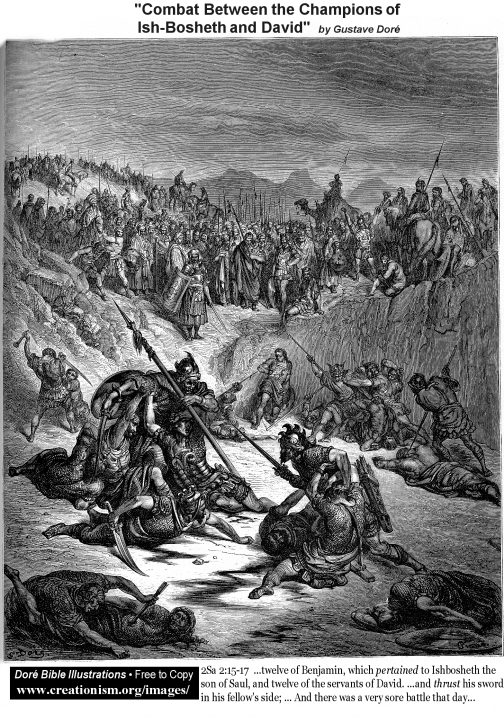
     At long last, David becomes king.  Of Judah, that is.  Despite what Saul's military captain, Abner, already knew, he decided to take matters into his own hands.  He staged a sort of coup by convincing Saul's still living son, Ish-bosheth, that he should be the next ruler.  He secures Ish-bosheth across the Jordan River in Mahanaim, Manasseh country.  He is then able to procure the loyalty of all the remaining tribes, installing Ish-bosheth as the king over the whole of Israel.  Only Judah recognizes David as king.
      It is amazing what people will do, even though they know what God's will is.  I'm not talking about when we are not sure.  I'm not talking about when we take step by step by faith because we are waiting on God to show us what to do.  I'm talking about when God has clearly shown us, and we think by doing the exact opposite, we are somehow going to change what God intended.  Abner, like his leader before him, did not bother to ask God for wisdom in this matter.  All Abner could see was that his power and control were about to end.  Maybe he even thought he was in danger because he had been Saul's number one guy.  He didn't know David very well.  Abner had been a loyal servant to Saul.  David set great store by loyalty.  The likelihood that Abner would have been rewarded, maybe even promoted was pretty high.  This stunt would cost him.  Had Abner asked God what should be done, he may have been given a pension and been enjoying retirement.  But Abner seems to be an ambitious man.  I don't know that Ish-bosheth had any plans of taking the throne when his father died.  I'm sure he had been told by more than one person that David was to be the next king.  That this is what God had ordered.  I can't believe that Abner did not know this too.  But the hunger for power can be devouring.  With the support from the lead strategist from his father's household, it was probably not a stretch for Ish-bosheth to imagine that they could pull off this coup.  Here is where the power struggle really begins.
     David's military man, Joab, and Abner meet in Gibeon.  They size each other up.  They evaluate each other's armies.  "And Abner said to Joab, Let the young men now arise, and play before us.  And Joab said, Let them arise."  Abner views this meeting as a chess match.  Both sides have kings. Who will declare "Checkmate"? Joab and Abner play bishop, rook or knight, and the rest of the soldiers are pawns in their little game.  How many casualties will there be?  How many men will be taken out, turn by turn before one is declared the winner?  Abner's army seems to be losing the match at one point.  Then Joab's brother, Asahel, another important piece, pursues after Abner.  He is determined to take him out of the game.  He ignores Abner's taunts and distractions, focused on eliminating this very important player.  But Abner makes the better move, and slays Asahel.  Abner knows Joab will come back with his fiercest move yet, but sometimes anger fuels us, and sometimes it backfires on us.  Abner knows this, and is counting on the latter.  Joab continues the pursuit, causing Abner to retreat into a defensive position.  As Abner gets closer to Ish-bosheth country, he is reinforced by Benjamin's tribe.  Joab has to settle for a stalemate.  Another game will have to be played another day.  He is not willing to lose any more men on this day.  Losing a brother was enough.  So, Abner returns to his king, and Joab returns to his.  Both men, more intent on playing a game than seeing the loss of life, until one of those lives was dear.  Joab and his remaining men bury his brother.  It is a sad reminder that war costs something. 
     I know that some believe that leaders play political games with soldier's lives.  And while that may be true in other countries, I have never thought it to be the case in America.  I don't believe it was a game to David, but I'm pretty sure Abner was not in the least concerned about his men, as long as he came out on the winning side.  In some countries, militia are used as pawns in a chess match.  And although many have accused our country of doing the same thing, I refuse to believe that.  Maybe I'm ignorant, but I'm convinced that when our military has to make a move, it really is to protect our interests, and to protect freedom.  I'm not saying that every display of our military power is always the best move, but I have never believed that our leaders have ever dealt carelessly with those lives, willing to throw them away as long as we win.  I don't believe that of our current President, and I don't believe that of our former President.  I don't believe that of our generals.  There are always power-hungry people, but as the daughter of a military man who served under some pretty high-ranking officials during his career, even though in a relative time of peace, I knew the character of some of these individuals, and I know they only had the best interests of the country and those who served under them.
     Ish-bosheth seemed to be a puppet king, succumbing to the string-pulling of his father's military captain.  Abner refuses to yield to God's will, and although he returned home safely, many of his men gave their lives for a fruitless cause.  That is selfishness at its highest, and though I haven't read ahead, I'm guessing that Abner will be taken out of the game in the next match.  The best move?  Heed God's will when we know it.  Ignoring it, avoiding it, fighting against it never plays out the way we planned.  God's strategy is always best, and we can never outplay Him.

Thursday, November 3, 2011

Standing Fast

Today's passage:  I Corinthians 16
     Paul says farewell to the Corinth church in this chapter.  He addresses some individually and the church as a whole.  He gives them a few last words of encouragement and advice.  Some of this encouragement is found in verse 13:  "Watch ye, stand fast in the faith, quit you like men, be strong."
     Standing fast.  In this verse, that probably means, be firm, don't give up, defend what you believe.  Can I make a parenting analogy?  As a parent, when I think of standing fast with my kids, I always have to stay a step ahead of them.  This means I have to think through each stage in their life, and prepare myself for the challenges they present.  I need to have ready answers and planned reactions.  When Paul says to stand fast, I'm sure he means all the definitions I already mentioned, but what if he also means to be quick?  Shouldn't we, as Christians, be a step ahead of Satan and his attacks?  Shouldn't we be watching for what the world will hurl at us, to knock us off balance? 
     How can I stand fast, when standing indicates not moving, but fast indicates movement?  It seems a little contradictory.  Going back to parenting, I have certain values and principles I want my children to learn.  They will test these and question these things in various phases of their lives.  I never relinquish them, I never abandon them, but I rush ahead and plant my feet again, so they understand that when they needed to obey Mommy and Daddy as a toddler, they still need to heed Mom and Dad as a teenager.  So how do I do that with God's Word?  I think the other phrases in the verse help me to see what I need to do.  First, I need to watch.  I know many people are not keen on current events.  Personally, I only watch the news because my husband is a news hound.  It forces me to pay better attention.  I think it is important that we watch worldly trends, not so we can participate, but so we can defend against them.  When we see something, we ought to gauge it by the Bible, and see what His Word has to say about particular activities.  A few years ago, I kept hearing teenagers talking about a particular celebrity who had burst onto the music scene.  I wondered why the sudden hoopla.  I decided to check it out and oh my!  Did I get an eye and earful!  This particular singer was so ungodly in her lyrics and videos, I was just stunned.  That is what is influencing our teenagers!  I was seriously appalled.  Now, I don't recommend turning on MTV on a regular basis.  But I think sometimes to stay a step ahead, we need to be aware of what is out there.  We need to watch and pay attention to the trends, because those are the snares Satan has set for our kids.
Courtesy of http://breadsite.org

     This verse also says to "quit you like men".  Quitting doesn't seem like it belongs in this verse, since he is talking about standing firm and being watchful.  The definition by Webster I particularly like is "To carry through; to do or perform something to the end, so that nothing remains; to discharge or perform completely."  When I think of doing this like men, I think of the military.  Soldiers follow through with an order given by their commander.  It is what they are trained to do.  Sometimes they have to quit a station to move ahead of the enemy and not allow them to advance further.  Sometimes they are engaged in combat.  As a woman, that does not appeal to me.  At all.  I am generally a peacemaker and do not like to engage in conflict.  There are those occasions when my husband hands me the phone when a political party calls for donations.  He chuckles when I won't back down from my conservative views and advise them that if they want my money they better get on the right track.  He lets me answer the door when religious organizations preaching heresy try to give us their literature.  When it comes to defending God's Word, I can be tenacious.  Now, I don't try to engage in debate, I never find that works.  But I am determined to let them know my resolve will not weaken on these issues.  If I am going to stand fast, I need to be studying God's Word, and praying that God will give me the words to say when I am engaged in battle.
     The last phrase in this verse says to "be strong".  Physically, I am not all that strong.  I know women with more muscle and are stronger.  Emotionally, I am often a weakling.  My heart is easily touched and I get all feminine and woman-like, crying at weddings, at sappy songs, at chick flicks, at people in need.  How strong am I spiritually?  I hope in that area, I have the strength to fight the good fight.  I could do a much better job memorizing Scripture.  I know a lot of parts of verses, but don't ask me where to find them.  I'm horrible at references.  Yet, if I want to stay a step ahead of my attacker, if I want to stand fast, I better be able to point out where I can support my position.  Satan will challenge me on this.  Just as he tempted Jesus in the wilderness by presenting Scripture, he will try to twist and distort God's Words so that I am convinced they say what he wants me to believe.  Its also important to know the context of verses.  Anybody can take a verse out of a passage and make it say what they want it to say.  I try so very carefully here, not to do that.  Sometimes I will do that by way of application, but hopefully never by way of interpretation or doctrine.  How many cults have been founded on a verse taken out of a passage that did not mean anything that they were trying to make it say?  Satan is a master at this.  If I want to stand fast, and stay that step ahead of him, I need to know what all of my Bible says.  Reading the whole passage is a really good way to defend against this.
     As a parent, as a soldier, as a Christian, God wants me to stand fast.  He wants me to watch the signs of the times, He wants me to defend His Word, He wants to give me spiritual strength to fight the Wicked One.  He wants me to stay a step ahead of the devil so I can defend against him properly.  God says His Word is quick and powerful.  Using it can make me the same.
Related Posts Plugin for WordPress, Blogger...