Showing posts with label Decisions. Show all posts

Monday, April 8, 2013

When a Molehill Becomes a Mountain

Today's passage:  Genesis 19: 17-38
     I wish I could just skip the end of this chapter  I wish there had been a way to avoid this sordid mess between Lot and his daughters.  And when I back up several verses, apparently there was.
     The most obvious way for Lot to have avoided some of this was if he had not been a drinker.  I think Lot must have had a history with alcohol because the oldest daughter knows that if she sets wine before Dad, he's going to overindulge.  How would Lot's eldest know this unless he had a history with drink?  He is so incoherent that the verses say "and he perceived not when she lay down, nor when she arose."  Did she spike it with something?  It doesn't appear that is the case.  He may have been drowning his sorrows because of losing his wife.  Aha!  Now there is where the real solution would have been, had Lot's wife still been alive, this would never have been able to come to pass.
Lot and his family fleeing from Sodom
Taken from Religion in the Home (Part 1)
By Charlotte M. Yonge
Engravings by Julius Shnorr Von Karolsfeld
Published by George W. Bertron, 1913
     This automatically starts the age-old argument that if Lot's wife had not been so attached to the things of this world and looked back at the inferno behind her, she would not have become a salt statue.  Let's not forget that she had left two married daughters behind and possibly grandchildren.  We don't read about any grandchildren, but that does not mean that her daughters had not borne any (especially as they would not have figured into Lot's future genealogy).  She was more than likely a grieving mother who is anguished that part of her family would not survive.  And I'm not saying that is the only reason she looked back, she may very well have been clinging to her old life.  Remember, security is a woman's number one need.  But could this have even been prevented?  Back up a few verses.  When the angel ushers them out of the city, where does he tell this family to go?  The mountain.  Why don't they do as the angel instructs?  Lot thought he had a better way.  He couldn't stand the thought of being that far away from society.  He suggests, no he begs, to enter into that small town of Zoar, not too great a distance from Sodom and Gomorrah.  I checked out a few Bible maps, and although there is no great consensus as to where these cities existed, somewhere along the coast of the Dead Sea, Zoar would have been situated at a diagonal across the Dead Sea, giving an inhabitant there a pretty good view of the smoke and destruction happening in Sodom.  I always thought that Mrs. Lot had looked back just as they had stepped outside Sodom's city gates.  But these verses make it sound as if they had already entered Zoar.  Eventually, Lot leaves Zoar, and goes where?  To the mountain, exactly where the angel told him to go at the start of all this.  Would Mrs. Lot have been able to have a good view of Sodom's destruction from the cave?  It is quite possible that might have happened, but if the angel suggested it, I'm thinking the chance of that was less likely.  The angel was probably trying to help Lot shelter his wife's anguished heart, knowing the temptation to look back at the city might be too great for a mother's love.  Lot was the one who argued, diverted, sidetracked.  And ended up in the mountain anyway, but without his wife, which prompts the whole incestuous mess that also gives rise to Israel's greatest enemies.
     As for Lot's daughters, why they would even devise such a scheme shows how little they had been taught about the ways of God.  Daddy had just offered them up to the men of the city a few short days ago, so how would this be any worse?  Mrs. Lot had perished so there was no possibility of a brother ever being born (as it appears Lot only had daughters) and now they were cut off from civilization by taking refuge in a cave.  When would they ever meet a husband?  Warped thinking I know, but they had been raised in a city of warped thinking.  Certainly the Sodom culture had rubbed off a little on Lot's daughters.  I can only say that at least they had the sense to know to get Dad drunk first.  I'm glad that Lot would never consent to this willingly while sober.
     So what is the lesson here?  Do things God's way.  When God suggests a course, don't negotiate.  He knows what is best and is trying to spare us a lifetime of pain.  Lot and the whole nation of Israel would have to live with his mistake for the rest of their lives.  His daughters would have to explain to Moab and Benammi that Granddad was also Dad. Is it any wonder that these two father nations that end up despising Israel?  Talk about dysfunctional.
     I would think that if God sent an angel to tell me something, if He thought it so important to dispatch one of His personal messengers to deliver me to safety, I might want to take his advice.  Lot ended up in the mountain anyway, but not without some loss. What I want may seem like a little thing, but it is the littlest things in my life that become the biggest problems.  If God tells me to go to the isolated mountain, the loneliness might overtake me, but I would rather succumb to that then the guilt and shame as a result of  living in the molehill.


Thursday, December 15, 2011

Prayer and Purpose

Today's passage:  II Samuel 21:1-14
    In college I worked at a highly popular fast food restaurant. Because of my school schedule, I worked many different shifts.  One year I worked early mornings from open until mid-afternoon.  The next year, I worked mostly evenings from late-afternoon until closing.  Since I was one of the few workers that had actually worked both shifts, I was privy to hearing the blame game.  When I worked mornings and something was undone, it was a tendency of my co-workers to say, "Oh, that didn't get done because of the closing crew."  When something was left unfinished in the evenings, those on that shift would often say,  "The morning crew never completes that."  Sure, there was the occasional time when you would see somebody doing nothing, but since we were the only golden arches that served many of the small towns in the area, and we were a lunch stop on the way to Branson, Missouri we kept pretty busy.  I was always the type of person that thought, instead of complaining about the undone job, just do it.  I know its more work, but so what?  Work is never evenly divided.
      I don't see David complaining a lot. Unlike the king before him, he takes responsibility for the way he has failed God.   After all he has been through so far, now God sends a famine in the land.  After three years, David decides to ask God about it.  Perhaps, in the beginning, David just attributed the famine to lack of rain or a weather cycle that would pass.  Some summers are particularly dry, some years a lot less precipitation.  Another year goes by and David is probably figuring out that this much time without rain is a little unusual.  By the third year, David recognizes something supernatural is going on here.  When David asks God why He is sending this famine, God tells him it is because of a sin Saul committed against the Gibeonites.  David could have told God this was not fair.  After all, he was not the one to break the treaty (one Joshua had established) with the Gibeonites, that was the last king.  Why should he be held responsible for the failures of his predecessor?  It's called leadership.  And guess what?  Every leader has to deal with the failings of the last presidency, er, leader.  David could have whined and complained about this for another couple years while his people continued to starve and while the rain still did not come.  Instead, he decides to solve the problem.  He offers a solution to the Gibeonites (an unfortunate one I am afraid) to appease their wrath, and guess what?  God sends rain.  Leaders find solutions.  Incompetent leaders complain about the problems handed to them.  It irks me when presidents or prime ministers complain about past problems mostly because they chose to run for that office knowing full well the problems facing them.  David had not asked to be king.  David did not campaign his way onto the throne.  God selected him which means he would have even more reason to murmur about this new situation.  But he doesn't.  He leads.  And that is something I've not seen a lot lately in our own country.
     I know this is a little more political than my usual post, but David's leadership style challenges me to think more positively when God allows difficulties in my life, especially ones not of my own making.  How does God want me to handle it?  Moan and groan like Saul, or pray and purpose like David?  Looking throughout history, I would say that most leaders fall into one of these two categories, and judging from the past, I think we can deduce which style has been most productive.  Complaining about things does not solve anything.  Blaming others does not resolve issues.  David witnessed that in the man who came before him, and he determined to be different.  He accepted the challenges put in his path and forged new ones.  With all his failings, David led his people, right or wrong.  With all his faults, David accepted the problems given to him and found solutions.  He didn't always do it the right way, but at least he did something, and he didn't place the blame on anyone else. I think we all could stand a little help in that department.

Monday, December 5, 2011

Generally Speaking

Today's passage:  II Samuel 18: 1-17
     There is no easy explanation for Joab.  He is a warrior with a military mindset.  Often he goes into a situation with a "kill or be killed" attitude.  And why shouldn't he since he has practically led every battle since David has been king? He is King David's nephew and has been his trusted friend and go-to guy.  He doesn't always carry out David's orders as precisely as he should.  Since he was family, he sometimes disregarded David's commands if he thought the ends would justify the means.  Since David was his uncle, he sometimes disobeyed David's orders because it was bad strategy.  As the general, he was in the midst of the conflict and he could see what would be best for the kingdom.  And being related to the king, meant that the king would more than likely show leniency with him as long as the battle turned out in their favor.  Joab hasn't always gone along with the program, but I have no doubts that his motives were pure, that his intentions were sincere.  His ambition was to serve his king, and if that meant defying him sometimes to keep him protected, than he had no qualms about doing that.  He respects David, but he doesn't fear him.  He knows that David values loyalty.  And like his methods or not, Joab is loyal.
     Absalom has decided to take Hushai's advice and go after his father himself.  This leaves David with no other option than to have his men try to subdue him.  This breaks David's heart.  We can see how anguished he is when in verse 5 he says, "Deal gently for my sake with the young man, even with Absalom."  Doesn't sound like a lot of wiggle room in that statement.  It is not a wanted-dead-or-alive command by any means.  So I know Joab does not misinterpret this, he just chooses to forget he heard it.  From Joab's perspective, his cousin Absalom has caused nothing but grief for David for a few years now.  Joab may feel partially responsible for this, since it was at his own bidding that Absalom was invited back to the palace.  Joab thought David and Absalom could mend their relationship, but instead it had become more strained.  And then Absalom decides to rebel against his father in the most despicable way.  I'm sure Joab was not only infuriated by Absalom's actions, but humiliated.  Joab was probably muttering to himself, if he had just stayed out of this family affair, if he had only kept his thoughts to himself, if he had never encouraged David to reach out to Absalom then they would not be in this mess.  Had his heart not been touched by his cousin's despair at being isolated from his father, he might not have to contend with this family war.
Absalom is caught in a tree--Taken from The Boys of the Bible
By Hartwell James
Henry Altemus Company, 1905, 1916
     There is no disputing what David said as Joab departs to fight this battle.  Every one of the soldiers understood this clear order to spare Absalom if it could at all be helped.  When Absalom's abundance of hair (maybe he should have had it cut before riding into the woods) gets caught in some tree branches, donkey surging on ahead without him, he is a pitiful sight.  He must have been really stuck, because I'm sure he must have been flailing about trying to free himself to no avail.  He can not harm any one in this vulnerable position.  Even if he had bow and arrow on him, he is not likely to get off a good shot.  One of David's soldiers reports this situation to Joab.  Joab rebukes the soldier for sparing him.  The soldier is not apologetic for following the king's orders.  He even argues that had he decided upon this action, Joab would have not backed him, but would have left him out to dry.  This soldier does not have the advantage of a familial relationship with the king.  He reminds Joab clearly of David's plea to not kill Absalom.  Joab really has no excuse here, and feels he doesn't need one.  This cousin of his, had more than aggravated his father, he had aggravated him.  This was an embarrassing situation-- to be fighting in the woods trying to regain the throne from the one he had tried to help.  Joab felt that if they were to spare Absalom, this would be a sign of weakness to any other usurper.  If, however, the king's own son were duly punished for his treasonous act, wouldn't it cause future rebels to tread more cautiously?  Joab does not spare Absalom.  And it is not pretty.  He shoots three arrows directly into him, and has ten armorbearers finish him off.  Then they dig a hole and bury the body in the woods, covering it with stones.
     I'm not sure how Joab is going to explain this disobedience because I chose not to finish reading the chapter at this point, but I know there are enough witnesses to make Joab look really bad.  Joab doesn't seem too concerned.  He did what he felt needed to be done.  He knows what the king said, but just as he has done in the past, he also knows that he is trying to keep his king on the throne as long as possible, and he will take any action necessary to achieve that.  Is Joab happy about this deed?  I doubt it.  He just killed his cousin.  That can't be a euphoric feeling, but Joab keeps his feelings on the sidelines when it comes to battle.  He has an almost robotic response when he has a military decision to make.  Disregard feelings, disregard orders, disregard relationships.  What is going to achieve the objective?  Joab was a man of action.  He was decisive.  This is why David keeps him as one of his generals.
     I'm not saying Joab was right or wrong here.  If he allowed Absalom to live, Joab knew David would have forgiven him and he knew Absalom would have probably attempted this same thing again, and possibly succeed the next time.  Do I think Joab should have disregarded David's orders?  Not really.  But I also know, that God was meting out judgement on Absalom and it is unfortunate that this is how it came to pass.  Absalom wasn't exactly merciful towards his brother (not saying he should have been).  And his lack of mercy on Amnon brought about a lack of mercy from Joab.  But I won't be surprised if Joab's lack of mercy is revisited upon himself.

Sunday, November 27, 2011

Unbelievable

Today's passage:  Hebrews 4:12
     I will admit it.  I believed in Santa until I was twelve years old.  Well, let's say for a couple years I started to have doubts, but since I never came out and asked the question, my parents allowed me to continue to defend Mr. Claus.  I was certain that my parents did not have the money to put all those gifts under the tree, especially for five kids.  By sixth grade, I was seriously getting made fun of (sorry, Mom, if you didn't realize all this).  But loyal person that I am, I was insistent that he was real.  Of course, this meant I had to lay down a case for Easter Bunny and my personal tooth fairy, Angelique.  My tooth fairy even wrote me a letter in beautiful handwriting that was not my parents, so I knew she was real.  The day came when I discovered it was Mom and Dad.  My Dad came into the room to switch out a coin for a tooth, and pretending to be asleep, I spotted him.  I continued to pretend to be asleep not wanting to startle him with a "Gotcha!"  Confronted the next morning with my discovery, my Dad insisted that I was asleep because he checked.  It's called pretending, Dad, something I have always done very well, thus my penchant for theater.  Yes, I still debate this point with him even though he has been in Heaven these seven years now.  I'm sure he is refusing to cede this point.  Well,   this was a very difficult idea to let go of.  I had believed in these imaginary figures for about ten years.  That is a long time to believe in something and find out it is not true.  I wasn't thrilled that I looked pretty foolish among the other sixth graders who had long ago given up the notion.  I know my parents weren't trying to be cruel or subject me to undue ridicule, they wanted me to be a kid for as long as possible.  Keeping Santa alive, was one way for them to do that.
     Before we had kids, my husband and I discussed the Santa Claus/Easter Bunny/Rudolph/Tooth Fairy conundrum.  Do we let them believe, or do we tell them the truth.  Now, I am not trying to persuade anyone to do what they have already decided to do.  I am not going to think you are a horrible person if you do the Santa Claus thing.  I believe that is a decision every family has to make on their own.  But my husband and I decided that if we were to allow them to believe in these fictional characters, when they finally discovered that they were not real, how much would they think it was pretend, and how much of it would they think was Mommy and Daddy lying to them.  It is possible that they would understand it is like a joke you tell, and be fine when they discovered the punchline.  But we felt that there was a real distinct possibility that they might look at it as being deceitful and lose trust.  If Mommy and Daddy lied about that, maybe they lied about Jesus, maybe they lied about the Bible.  Again, I'm not trying to convince anyone to do anything differently, I'm just revealing our thought processes on the matter.  My husband and I came to the conclusion that it was a chance we were not willing to take, not when our sons' souls might be at stake in the future.  So we choose not to include Santa in our Christmas festivities.

     Here is the real reason for this post, and I hope you have been able to tune in long enough to hear it.  We have repeatedly explained to our boys that Santa is not real.  My eight year old gets it.  My four year old is less certain.  After all, St. Nick is everywhere.  On the radio, in the stores, in the sales papers.  The other day, as I was finishing up my food prep for Thanksgiving Day, my four year old calls to me, "Mom, come here quick!"  I rush into the living room and see a snippet of the Macy's Thanksgiving Day parade on the TV.  On the float is none other than the jolly old fellow himself bellowing out "Ho, ho, ho!"  My four year old, eyes all innocence, looks up at me and says, "Well, Mom, I guess we were wrong."  Seeing that real, live man dressed in a Santa Claus suit completely changed his mind about the legitimacy of Santa Claus.  Needless to say, I had to explain the man was just pretending to be Santa Claus.  I know he really wants to believe in him.
     Thinking about that, we have God's Word that tells us exactly who Jesus Christ is.  How is it we are more willing to believe what is on a TV set than what is in our own Bible?  Why do we have people who will believe anything they hear on the radio or in the newspaper, but not from God's own Word?  People believe what they want to believe.We have a Book that gives us all the truth we need.  Why do we have to be more convinced that Jesus Christ was the Son of God, than we need to be of aliens or vampires?  God's Word is more real than Santa Claus.  It is more tangible than the Easter Bunny.  It is more faithful than the Tooth Fairy.  Believe in those things if you want, but make sure you believe in the real thing.
     Back to II Samuel on Monday.  Enjoy the rest of your Thanksgiving weekend!

Wednesday, November 23, 2011

Heads or Tails

Today's passage:  I Samuel 12
    Heads, you win.  Tails, you lose.  I think some people think this is how God handles our lives.  That somehow God is up in Heaven flipping a coin, and depending on which side faces up is how He will deal with us.  I'm thankful that my God is so much more complex than that.
     Reading this passage about David's brokenness over the consequences for his sin, reminds me a bit of "Heads or Tails", not because that is how God deals with Him, but because we are apt to think that if David says some kind of magic prayer, he will end up with the heads side of the coin and everything will be hunky-dory.  God does not work that way.  If our lives were just a coin to God, why is it so many people have more Tails than Heads?  If our lives were just a flip in the air, leaving things to chance, then we would have no reason to live in a way that was pleasing to God, because the outcome would never have any connection to how we lived.
The Death of David and Bathsheba's Son--Taken from Treasures of the Bible (The United Kingdom)
By Henry Davenport Northrop, D.D.
The International Publishing Company, 1894
     In this passage, God could have spared David's unborn child.  He could have considered David's heartfelt pleas and stayed His Hand.  But He doesn't.  It is not because David got the Tails side of the coin.  It is because God knows how best to handle David's heart.  He knows how best to handle mine.  When I was a teen, there was a song by a pop music parody master that said, "I'd rather rip my heart right out of my rib cage with my bare hands and then throw it on the floor and stomp on it til I die..."  Humorous, but haven't we all had those moments?  Those times in our life when it felt like God was ripping our heart out of our chest and holding it in His bare but capable Hands?  Or worse, throwing it to the floor and stomping on it?  David's face to the ground, his eyes overflowing with tears, his heart too full for food or company is pleading for God's mercy.  Doesn't God hear him?  Shouldn't God spare him?  I can't answer that.  I can't understand God's ways.  I know that David is not the only one who had sinned.  Who knows that God's decision to bring this judgement might not have been for Bathsheba?  He was holding her heart too.  God was not up in Heaven, laughing deviously, flipping a coin, saying, "Well, let's see how this all comes out.  I'll let this nickel decide."  God is purposeful.  God is just.  God wants my worship.  God wants my best.  He knows best how to achieve those things in my life, and in the lives of others.  And since I am not a navigator of hearts, I am not a spelunker of those inner caverns, I cannot pretend to know what God already does.  He holds that pulsating center of thoughts and emotions in His hands, and He knows how tightly to squeeze to get it pumping again.  He knows just how much pressure to apply to make it pulse for Him.
     Poor David.  I can say that, and my emotions be little affected because I didn't know him.  I can objectively read this passage and not be touched by his pain.  But there are people who have impacted my life, who may be in a similar situation as David was.  No, they may not be about to lose a child (or they may be), they may not have sinned as egregiously as David did, yet their sin is costing them.  God may have their heart that is in no way connected to mistakes or unholiness.  Those Davids may be beseeching God for mercy in their lives.  And God will give it.  But not necessarily in the situation they are in.  After God took David's child, despite the broken heart, the earnest prayers, God was merciful.  How?  God gave David another son, Solomon.  And He allowed him to win another battle against the Ammonites, the battle they should have won when Uriah was killed.  God created us.  He knows how best to keep us alive and afresh for Him.  Just because I say it doesn't make us automaton's devoid of emotion and reason, yahooing every difficult circumstance in our lives.  But it makes me feel a whole lot better knowing that the One who created my heart, knows exactly what to do with it.  And that gives me much more peace than a coin flip.

Tuesday, November 22, 2011

I Did it My Way

Today's passage:  II Samuel 11
     Maybe the reason we have so many bumps in our road in this life is because when we have too many victories, too many successes, we lose our way and wander from God.  I can only believe that is what happened to David in this chapter.  What happened here?  How did David go from being a man who asked God what to do, who quelled his enemies (all Jehovah haters) to such depravity in this passage?  It is hard to fathom.  But it certainly shows me how careful I must be.  It is a warning that each day we must live anew and devoted to God.  I can not assume that because yesterday was a "good" day, that today will not be a bad one. I can not depend on the Bible reading and prayer from last week to get me through this week.  I need to be searching for God each and every day of life.  I need to grasp hold of His wonderful mercies, of His Words of Life every day that I can.  Does it mean I still may fall?  Yes.  But the more of God's Word I have in me, the more of His wisdom I have.  The more wisdom I have, the more able I am to discern situations and hopefully steer clear of ones that could doom me.
     Let me point out one more thing in this passage.  Sometimes if we want to do things our way long enough, God says okay.  What am I talking about?  After David has committed this sin with Bathsheba, after he finds out they are going to have a child together, he does everything he can to make it look like Uriah fathered that child.  He calls him back from battle and encourages him to go home to his wife.  This backfires because Uriah has an inordinate sense of duty which dictates to his conscience that he should still act the soldier even back on the home front.  So then, David keeps Uriah off the battlefield for a few days, apparently getting him drunk so that his conscience will be dimmed, and then perhaps he will go home to his wife.  This doesn't work either.  Too intoxicated, Uriah can only stumble as far as the servant's quarters, where he spends the night.  David is getting frustrated.  Does it seem that maybe God is giving David an out here?  I mean, in both of these instances, David could have made this situation right.  He could have owned up to his sin, asked forgiveness of this brother, and let God handle the matter.  But David is still plotting and scheming.  He gives Uriah a note to deliver to Joab when he returns to battle.  David has assessed enough about Uriah that his loyalty will have him deliver his own death warrant to the general, unopened and unread.
Nathan Confronts David
Original source and illustrator unknown

     Think about that.  Wasn't Uriah even a little curious as to what the letter contained?  Wouldn't he have wanted to sneak a little peek?  God could have had that happen.  That certainly would have been an awkward scenario.  But God lets David carry out this treacherous plan.  Uriah delivers the letter with David's wishes to have him killed, Joab reads and seems to immediately understand the situation.  Maybe Joab had been accustomed to David's wandering eye.  David did have a few wives already.  Joab does not ask questions.  He does what his king orders.  The move he makes is contrary to any he would make at other times.  Joab is too good of a military leader to do what he does here.  He moves his troops ridiculously close to the enemy wall.  In Judges, there is a similar story, where Gideon's son, Abimelech goes close to the wall and a woman drops a millstone on his head, which injures him enough that he could die a slow suffering death.  He chooses to have his men to run him through so that his death is quick and so that a woman does not get the credit for his demise.  Joab refers to this incident when he sends a messenger back to David to inform him of Uriah's death.  He basically tells him, "Ordinarily, we wouldn't have been so close to the wall as our forefather, Abimelech, but you did want Uriah dead, and we achieved that objective."
     David is relieved.  Little does he know that God allowing him to have his own way, is going to bring greater grief than David feels he can bear.  Sometimes God lets us have our own way.  Many times He gives us chances to make things right, to come clean, but if we refuse, God will allow us to bear the full consequences of our choices.  I will make mistakes.  I will make big mistakes.  Prayerfully, at the first opportunity, I will make it right, and not compound it with more foolish choices.  Prayerfully, I will allow His Word to saturate my decision making to avoid the mistake in the first place.  God allows me to do things my way, but it doesn't mean I will get away with sin.

Saturday, November 19, 2011

A Servant's Choice

Today's passage: II Samuel 9
     David's kindnesses to Mephibosheth is a familiar story.  I've taught it in Sunday school on many occasions.  It is a beautiful application of God's love for us.  In case, anyone reading this is not that familiar with this narrative, I will give a quick overview.  Years before, David and Jonathan (Saul's son) had made a pact that they would take care of each other's families should something happen to either of them.  I guess you could say it was their last will and testament.  Jonathan and his father were killed in battle, which ushered in the time for David's reign.  He has been on the throne for a little while now, but is just now able to fulfill his promise.  He has Jonathan's son, Mephibosheth brought to the palace and assures him that he will be treated as one of his own sons.  Mephibosheth became lame when a nursemaid dropped him as a boy, trying to secure his life when Saul and Jonathan were killed.  It really is a nice story.  But I'm more interested in the part of the story that rarely gets told.  I'm thinking about the man who reported to David that Jonathan's son was still alive.
     The name of the servant who gives David this pertinent information is Ziba.  I'm really glad God chose to give us his name because referring to him as Mephibosheth's servant each time is a lot of typing and a mouthful. We don't know a lot about Ziba.  But I think his part of the story tells much about him and even more about David.
David Shows Kindness to Jonathan's Son, Mephibosheth--Taken from Standard Bible Story Readers, Book Three
By Lillie A. Faris, Illustrated by O.A. Stemler and Bess Bruce Cleaveland
The Standard Publishing Company, 1926
      It was the custom at that time for kings to destroy any future threats to the throne.  Usually, the first order of business when a king put a crown on his head was to make sure there was nobody else who could do so as well.  We've already seen this happen at the very beginning of David's reign when Ish-bosheth, that other son of Saul, was established over the rest of Israel.  Everyone was expecting David to destroy this usurper.  But he didn't .  And if he had, I think he may have never been able to keep his promise to Jonathan.  David summons Ziba to the court because he is one of the few men remaining from Saul's household.  The king asks him a very direct question with little wiggle room.  "Is there not yet any of the house of Saul, that I may shew the kindness of God unto him?"  Ziba can now make a choice.  He can choose to tell the king he doesn't know, he can choose to tell him that there is nobody remaining, or he can choose to tell him the truth.  Ziba chooses the last option.  I think he chooses it because of David's character.  Ziba could have believed that this was a false facade David was putting on to ferret out his enemy and have him destroyed.  David had used deceit in the past (although I'm not sure Ziba would have been privy to that).  But David's desire is to show God's love to this unknown person.  And I think anyone who has met David knows his love for God is real and he would never use God as an excuse for a masquerade.  So Ziba believes his request to be genuine and is able to give him this important information.
     After David meets with Mephibosheth, he calls for Ziba again.  David realizes that Ziba could have lied to him.  He fully understands that this was a great risk for Ziba to reveal this information.  It was dangerous for him and it was dangerous for the man he was trying to protect.  So when David chooses to give Mephibosheth back all the land that had belonged to his father and grandfather, and knows that someone will need to take care of this land (since Mephibosheth will now be living comfortably in the palace) he chooses the man who risked the most to make this reunion possible.  He chooses Ziba.  And here is the kicker, Ziba had fifteen sons.  It also says he had twenty servants.  Now, I'm not sure if that means he was in charge of twenty servants, still in hiding from Saul's demise, or if they were servants in his own household, but that's a lot of people living in one house.  Ziba was being rewarded for making the right choice.  Maybe he wasn't sure at the time if it was right, but given David's history, he had to trust that the king would spare another successor.  And since he did, his family would have a lot of land to roam.
     Sometimes, I am presented with decisions where it doesn't seem like there is a right choice or wrong choice.  I am kind of in that predicament right now. Sometimes there is no past history to observe to be able to know whether to trust someone.  Sometimes there is no past precedent to be able to base my decision on.  When this happens, I have to study God's Word, pray and ask for the Holy Spirit to give me peace about what I choose.  God has given us a past history to observe, and that history is that I can always trust Him.  He has given precedents, landmarks, that show He will always be faithful and that His Word never fails us.  I can make a servant's choice anytime I choose Him.

Sunday, November 6, 2011

Games People Play


Today's passage:  II Samuel 2
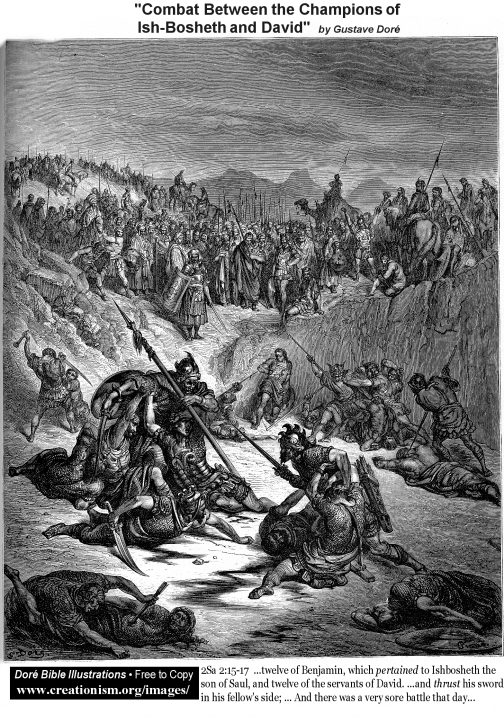
     At long last, David becomes king.  Of Judah, that is.  Despite what Saul's military captain, Abner, already knew, he decided to take matters into his own hands.  He staged a sort of coup by convincing Saul's still living son, Ish-bosheth, that he should be the next ruler.  He secures Ish-bosheth across the Jordan River in Mahanaim, Manasseh country.  He is then able to procure the loyalty of all the remaining tribes, installing Ish-bosheth as the king over the whole of Israel.  Only Judah recognizes David as king.
      It is amazing what people will do, even though they know what God's will is.  I'm not talking about when we are not sure.  I'm not talking about when we take step by step by faith because we are waiting on God to show us what to do.  I'm talking about when God has clearly shown us, and we think by doing the exact opposite, we are somehow going to change what God intended.  Abner, like his leader before him, did not bother to ask God for wisdom in this matter.  All Abner could see was that his power and control were about to end.  Maybe he even thought he was in danger because he had been Saul's number one guy.  He didn't know David very well.  Abner had been a loyal servant to Saul.  David set great store by loyalty.  The likelihood that Abner would have been rewarded, maybe even promoted was pretty high.  This stunt would cost him.  Had Abner asked God what should be done, he may have been given a pension and been enjoying retirement.  But Abner seems to be an ambitious man.  I don't know that Ish-bosheth had any plans of taking the throne when his father died.  I'm sure he had been told by more than one person that David was to be the next king.  That this is what God had ordered.  I can't believe that Abner did not know this too.  But the hunger for power can be devouring.  With the support from the lead strategist from his father's household, it was probably not a stretch for Ish-bosheth to imagine that they could pull off this coup.  Here is where the power struggle really begins.
     David's military man, Joab, and Abner meet in Gibeon.  They size each other up.  They evaluate each other's armies.  "And Abner said to Joab, Let the young men now arise, and play before us.  And Joab said, Let them arise."  Abner views this meeting as a chess match.  Both sides have kings. Who will declare "Checkmate"? Joab and Abner play bishop, rook or knight, and the rest of the soldiers are pawns in their little game.  How many casualties will there be?  How many men will be taken out, turn by turn before one is declared the winner?  Abner's army seems to be losing the match at one point.  Then Joab's brother, Asahel, another important piece, pursues after Abner.  He is determined to take him out of the game.  He ignores Abner's taunts and distractions, focused on eliminating this very important player.  But Abner makes the better move, and slays Asahel.  Abner knows Joab will come back with his fiercest move yet, but sometimes anger fuels us, and sometimes it backfires on us.  Abner knows this, and is counting on the latter.  Joab continues the pursuit, causing Abner to retreat into a defensive position.  As Abner gets closer to Ish-bosheth country, he is reinforced by Benjamin's tribe.  Joab has to settle for a stalemate.  Another game will have to be played another day.  He is not willing to lose any more men on this day.  Losing a brother was enough.  So, Abner returns to his king, and Joab returns to his.  Both men, more intent on playing a game than seeing the loss of life, until one of those lives was dear.  Joab and his remaining men bury his brother.  It is a sad reminder that war costs something. 
     I know that some believe that leaders play political games with soldier's lives.  And while that may be true in other countries, I have never thought it to be the case in America.  I don't believe it was a game to David, but I'm pretty sure Abner was not in the least concerned about his men, as long as he came out on the winning side.  In some countries, militia are used as pawns in a chess match.  And although many have accused our country of doing the same thing, I refuse to believe that.  Maybe I'm ignorant, but I'm convinced that when our military has to make a move, it really is to protect our interests, and to protect freedom.  I'm not saying that every display of our military power is always the best move, but I have never believed that our leaders have ever dealt carelessly with those lives, willing to throw them away as long as we win.  I don't believe that of our current President, and I don't believe that of our former President.  I don't believe that of our generals.  There are always power-hungry people, but as the daughter of a military man who served under some pretty high-ranking officials during his career, even though in a relative time of peace, I knew the character of some of these individuals, and I know they only had the best interests of the country and those who served under them.
     Ish-bosheth seemed to be a puppet king, succumbing to the string-pulling of his father's military captain.  Abner refuses to yield to God's will, and although he returned home safely, many of his men gave their lives for a fruitless cause.  That is selfishness at its highest, and though I haven't read ahead, I'm guessing that Abner will be taken out of the game in the next match.  The best move?  Heed God's will when we know it.  Ignoring it, avoiding it, fighting against it never plays out the way we planned.  God's strategy is always best, and we can never outplay Him.

Monday, October 24, 2011

Unfailing Love

Today's passage:  I Corinthians 13:8
     "Charity never faileth..."  I've seen a lot of movies recently about older people losing their spouses.  We have had a few members of our church who have been going through this stage in life.  I remember when my Grandma had reached a point where dementia forced her sons to make a decision about her care.  We knew Grandpa couldn't care for her on his own anymore.  He protested and insisted he could do it.  Convincing him was not easy.  Had we lived closer, we could have helped more, but an hour and a half is even a great distance when someone's health is failing.  If it had only been her mind, Grandpa would probably never allowed it, but she was having other health issues too which required around-the-clock care.  He went to the nursing home every day.  He sat with her, played cards with her, talked to her.  She was not the woman he had married.  This Grandma I visited in the nursing home was not the sharp-eyed pragmatist I had known all my life.  She barely knew me.  Her memory was dull, and my Grandma's memory had never been dull.  In her younger years, she had worked for the Civil Service, and if you know anything about that occupation, not just anybody tests well enough to obtain that line of work.  I don't know how difficult the exam may be today, but when she took it, you had to have some smarts about you and she had them.  Yet, this woman who did not laugh as often as Grandpa's jokes, who didn't seem to know her own grandchildren had her husband at her side every day.  He went early in the morning and stayed until visiting hours were over.  I know it was hard for him to go home to that empty house.  His life was a few miles away.  I think of their love, and I think of God's.  It never fails.
     Grandma didn't live long after she was put in the nursing home.  I don't know what else we could have done, and I'm not saying that being put there ended her life early.  I know that she had been a busy, active person all her life, and hours sitting would have been foreign to her, even if it was sitting with Grandpa.   After her three boys had grown, she kept busy.  She turned their basement into a ceramics shop.  She made beautiful ceramics.  She gardened, canning green beans and jellies.  I've yet to taste anything like her raspberry jelly.  She crocheted.  I still have one of her afghans. 
Romantic drawing of couple snuggling by the fireplace.
Snuggle by the Fire
Artist: Mary Stewart Cutting (1858-1932)
Image Appears In: The Wayfarers
Date Image Published: 1908
Courtesy of www.reusableart.com
     I don't remember whether she went into the home in the spring or the summer, but I remember that around Christmas time that same year, we were attending her funeral.  The hardest thing was knowing how alone Grandpa would be.  At least he could be by her side when she was in the nursing home.  At least he could bring her treats, or play dominoes with her.  He could hear her voice, he could hold her hand.  Now, he had to find other ways to occupy his time.  He did that for about two more years, and then he went to Glory to be with his wife.  His passing was sudden.  We didn't know he had any health problems and God took him unexpectedly.  Some couples say they love each other, but other couples show it.  My grandparents loved each other.  My Grandpa told my Grandma that if she married him, he would do the dishes every night.  And he did.  It wasn't just a promise he made to get her to wear his ring, he followed through with his commitment.  I got the feeling he enjoyed doing the dishes, because he always sang while washing.  Maybe in his Navy days he had a lot of KP duty and knew the most efficient way to get the job done.  In any case, after every meal, Grandpa filled the sink with suds and washed all the dishes, even when Grandma had a house full of company.  He let us help of course, on occasion.

     As loving and strong as any human relationship we see on this earth, none of them exceed God's love for us.  None of them last longer than God's love.  His love never fails us.  There is nothing I can do, no way I can act, no thing I can say that will cause God to withdraw His love from me.  If like my Grandma, I became a person completely different than who I am, God would not suddenly stop caring for me. While any of us still have life, He will never take back His plan of salvation.  He will never say, "No, I didn't plan for that person to be saved."  When Jesus died on the cross, it was for all eternity.  The love He showed for me on Calvary is a lasting work.  It was and is enough.  As our Advocate, Jesus never goes to the Father and says, "I didn't die for that one."  His love is everlasting, it will never cease.  What about the Holy Spirit?  How is His love unfailing?  He never gives up on seeing people come to Christ.  It is true that He will eventually stop knocking on an individual's heart's door.  If that individual continues to push Him away, He will eventually stop knocking.  But not because He no longer loves that person.  And when one person rejects Him, it doesn't cause Him to give up on the whole human race.  There are other hearts still inviting Him in. 
     As sweet and endearing it is to see older couples still in love with each other, still wanting to be together, their love is not as powerful as my God's love.  Although, watching these dear older saints is potent, magnify that enduring love by the greatest strength, and then you will have my God's love.  My love may fail Him.  My love may fail my husband and children.  But I can never say that about Him.  I will still be praising Him for His love when I arrive in Heaven.  I wish He could praise me about my love for Him.

Friday, September 30, 2011

Working or Worshipping?

Today's passage:  I Corinthians 7:17-40
     "There is difference also between a wife and a virgin.  The unmarried woman careth for the things of the Lord, that she may be holy both in body and in spirit:  but she that is married careth for the things of the world, how she may please her husband."
     I think somewhere along the way, I either forgot about this verse, or didn't understand it fully.  Up until a few years ago, my husband worked the "afternoon" shift.  This means he left for work late afternoon, and did not return until after midnight.  As a teacher, I worked a usual school day, which means that for the first five years of our marriage, we rarely saw each other.  In some ways, it was almost like I was still single.  I didn't rush home to make dinner, since it was only me.  I stayed late grading papers, because I would go home to an empty house.  I often spent time with friends when the school day ended, because I was not able to enjoy his company.  I didn't drop any of the church ministries I was involved in because after all, the Lord should always be first.  Somewhere along the way, I neglected to make my husband my priority.  I think it is because I never really transitioned from being single to being married.  I guess I still felt single.  I always knew that my husband should be my priority.  I always understood that now that I was married it would be different, but since our routines didn't change much, it didn't feel very different.  It was easy for me to behave the same.  I said yes to a lot of things to which I should have no.  I see that
now.           
     After the kids started coming along, there were definite ministries I knew I could not be involved and had to quit.  Still, after only one child, it was mostly just little guy and me.  Daddy still worked every night, although now that I was home, I was able to spend time with him during the day.  I felt more like a married woman than I did in our earliest years.  Two more children, and you would think I would have slowed down with responsibilities outside my home, but I feel busier than ever.  I'm not sure that this is always a good thing.  I have a problem with one little word.  NO.  I can say no to my kids.  I can say no to my husband.  I just have a hard time saying no to anyone else.  I have seen how I have made others more of a priority.  I can see how I should have handed some of my church responsibilities to other people.  This is not quitting.  This is not getting less involved.  I am showing love for God by loving my husband better.  I have neglected our home.  I am getting better, but nobody can keep up the schedule I'm keeping and expect a clean house.  When I am not here to clean it, when I am exhausted running around to everything under the sun, how can I expect dishes to be done, laundry to be folded, floors to be mopped?  I'm getting better.  My husband never complains.  He tells me on occasion, we have three kids, things are going to get messy.  I always argue, not this messy.  I say, other people who have this many kids manage.  Other people who have young children do not seem to turn white when an unexpected knock comes on the door.  I have been looking around lately.  I am at everything.  Other ladies are not.  Other ladies actually do miss some things so they can go to the laundromat, or go to the grocery store, or just do the weekly household chores.  I don't see every mother at every birthday party, every bridal and baby shower, with kids in tow.  I think those things are important,  especially as regarding my church family.  But I'm beginning to think I have it all wrong.  When did my church family become more important than my real one?  I have had to do a lot of soul searching this morning, and I think that perhaps it is time to lay some things down.  I have tried to balance.  Being home during the day seems like it should give me ample time to get everything accomplished, but when the responsibility list outside my home grows greater, it leaves less time to pick up the broom and dustpan.  It leaves little time to tend to my husband who works so hard.  I'm not saying that I will stop attending events, that I will stop teaching my Sunday school class, that I will not take a meal to somebody who is ailing.  I'm just looking at how I've been a wife and mother for these last several years, and if I were grading myself, I would have to give myself bad marks.  I've gotten some things right.  But I know that my family has been pushed farther and farther down the priority list.  A clean home is not everything, I understand that too, but I am showing less love for my family when every week I have to scramble to find something to eat because I haven't had time to go grocery shopping or when I have to search high and low for matching socks because I haven't put the laundry away yet.  Not everything gets done in the best of homes.  But somehow I have equated my love for God with busyness.  I have become Martha instead of Mary.  Some weeks are naturally going to lend themselves to hectic schedules, but should every week?  I have a lot to pray about.  God will always be my highest priority, but serving God does not mean I have to neglect my home.  That is certainly not serving my husband, or my children.  I am remembering something one of my college professors, a pastor's wife, once said, "Don't get work and worship confused.  They are not the same thing."  Have I been working, thinking I have been worshipping?  I am not to worship my husband, but the verse above says I am to please him.  When is the last time I have done that?  Maybe I should ask him. 

Sunday, August 14, 2011

A Leader to Follow

Today's passage:  I Samuel 14:24-52
     My first job in college was working at McDonald's.  My manager was a soft-spoken man, a Christian, who could be seen mopping floors as often as in the office filling out invoices.  Something about seeing your manager getting his hands dirty with the rest of the workers, gives you a sense of respect for your boss.
     I feel for Saul.  He wants to get things right, but he doesn't know how.  Have you ever met someone who was trying so hard to lead, who was trying so hard to earn respect, and failed miserably?  I have.  I've met people who want to love God and serve Him and at every turn, seem to do the opposite.  It is almost like they don't know how.  The only thing I can recommend to these people is to do things God's way.  If you don't know what that is, like anything else in life, you need to find out how.  You can find out how by going to His House and by going to His Word.  Really, it sounds simplistic, but that is the only way to know what God wants from you.  Reading books that men have written can be very helpful, but unless those are supplements to reading God's Word, all the books in the world will not help.  Saul's life is a good example of someone who had the tools but did not use them.  He had access to one of God's greatest men--Samuel.  But rarely do we see Saul consulting with him, only after he tried his way first, which only created messes for Samuel to try to correct.
     Saul's command for the people to fast until they had suppressed the enemy was not directed by God.  It was Saul's assumption of appeasing God for the displeasure he had already caused Him.  Ordering this fast, in effect, caused the people to sin in a greater fashion because by the time they had battled all day on empty stomachs, they were famished enough to kill the looted livestock right in the field, and eat it without draining off the blood.  This was definitely against God's laws.  So, Saul's attempt to please the Lord, by calling this fast, in essence caused greater displeasure.  This leads Saul to his next decision which is to ask the priest for prayer to determine whether they should go after the Philistines.  He doesn't get an answer.  We have already seen that Saul does not like to wait.  When God does not give him an immediate answer, he wants to know why.  He deducts that there must be sin in the midst, but he does not first ask God if the sin is his.  He immediately guesses that the sin must be among his soldiers.  Another mistake.  We should always check with God about our own sin before going after someone else's.  Jonathan is discovered to be the culprit.  While out in the woods, Jonathan had eaten fresh honey from an open hive.  He was not aware of his father's order to fast.  The people's respect for Jonathan was so great, that when Saul casts lots to determine who had sinned, they do not tattletale on Jonathan.  They could not be sure how the lots would come out, but they were willing to take their chances and even risk their lives for this young man.  Jonathan seemed to be able to demand respect without even trying, something his father was not able to do.  Why?  Because Jonathan did not try to demand it.  He followed God, which earned respect from the people.  He didn't base his decisions on what people thought, he based them on what God thought.  Would these same men have been willing to die for their king?  I think not.  I think the situation would have been drastically different.  Saul tried too hard.  He tried too hard to garner respect from people, and did not try hard enough to respect God, which would have given him men's respect as well.
     It may seem that the world does not respect us.  Actually, in my experiences, they do.  More than they will ever let on.  When we put God first, when we do what He wants from us, respect from others will eventually follow.  They might begrudgingly admit to it, but in moments of weakness, they will admit their admiration.  Not for us, so much, but for our devotion to Someone they cannot see.  I sometimes heard the sniggling remarks when our McDonald's manager mopped another floor.  Many workers had to feign disrespect, because in their estimation, that was beneath a manager to be doing those kinds of menial tasks.  But beneath the outward bravados, I saw workers who felt able to go to him and ask him about things.  I saw the respect in their eyes, if not coming from their mouths.  He did not have to earn respect by ordering us to do these things, although he would often ask us politely to attend to something, because he led by example.  When he saw something amiss, and he was able to do it, he would do it.  When he was not able to, and instead asked us, we usually responded without grumbling, because we knew if he could, he would.  Some people have a natural ability to earn people's devotion.  This manager was one of those people, and I learned a lot just by watching him.  Saul could have learned a lot by watching his son.  He could have learned even more by watching Samuel.  Saul could not watch another king, he was the first.  That is why, he needed God's guidance even more. 
     When I want respect, I need to give God His respect first.  The rest will follow.  Maybe subtly, maybe without a lot of outward demonstrations, but quietly and simply, people will fall in line.  You will be surprised how many people will follow, when You are following Him.
    

Monday, August 8, 2011

Battling

Today's passage:  I Samuel 11:7-15
     I have viewed several war movies.  Some were pretty graphic, but as graphic as they were, the battle scenes usually only took 5-10 minutes of the film.  Some films have two or three battle scenes, which still adds up to only a half hour of a 2 or 3 hour movie.  The reason I mention this, is because most of us have no comprehension how long an actual war battle would take.  I guess guys are really engrossed with bloody battles, I could do without them.  I'm interested in the end result and how it fits in the storyline, but as for the actual battle itself, I don't need to see or hear all the gory details.
     War is grueling.  Battles are not five or ten minutes long.  They take hours.  It is physically depleting, mentally draining, and psychologically exhausting.  And that is just the fighting part.  What about all the setup before, and cleanup afterward?  Soldiers would be strategically placed, waiting for their cue.  Artillery would be stationed, ready to roll on command.  Officers would be alert, waiting for some sign to attack or defend.  All of the waiting puts a soldier in a sort of nervous frenzy.  When the fighting actually takes place, adrenaline kicks in and he becomes a machine prepared to pummel anything in his path.  I know it would be the adrenaline because my police officer husband has says it has happened to him in high-pressure situations.  The adrenaline rush gives the soldier or rescue person a kind of tunnel vision which only allows them to see the task at hand.  This is why when an officer has to take down a criminal, and more than one shot is fired, calling them "trigger happy" is not usually accurate.  Many times, the adrenaline has kicked in , and the officer has switched into survival mode.  For those of us never having been in this type of situation, (and thankfully I haven't) it would be easy to be critical of the end results.  On the battlefield, the scenario would be the same, but on a larger scale.  It would be easy to see how the soldier would switch into survival mode and not even be fully aware of all his actions until the battle had ended.  Even though he experienced it first-hand, the tunnel vision view would only give him a narrow scope of what had taken place.  A soldier on the sidelines, might be able to paint a broader picture. 
Saul Destroys Nashan the Ammonite's Army--Taken from Treasures of the Bible
By Henry Davenport Northrop
International Publishing Company, 1894
     Saul will become general for his first battle as king of Israel.  He slays oxen and parcels their portions throughout the tribes of Israel.  The message he sends is this:  Fight with me and Samuel, or this is what will become of your livestock.  I like how Saul includes Samuel in this battle summons, so the people have no doubts that the man of God is in agreement.  The people congregate and Saul sends the messengers back to Jabesh-gilead to tell them rally troops will be there tomorrow.  Verse 11 says: "...and they came into the midst of the host in the morning watch, and slew the Ammonites until the heat of the day:  and it came to pass, that they which remained were scattered, so that two of them were not left together."  I mean, this is hours of fighting.  Not minutes like the movies show.  From the morning until the heat of the day would at the least be from 9am until 2pm.  I believe it was probably longer than that, because references I read said the morning watch was in the early hours of the morning.  Whether that is before sunrise or after, I cannot be sure.  The heat of the day may be noon when the sun is directly overhead, but when today's dermatologists talk about sunscreen coverage, they talk about protection during the hottest part of the day (2-3 pm).  What is meant here?  I don't know.  Suffice it to say, the battle took a good portion of the day.  Saul and the Israelites are victorious.  Still in battle mode, many of the Israelite soldiers (adrenaline pumping) are poised to lasso up any dissenters who refused to join them in taking down the Ammonites, and execute them as well.  God's Spirit is still upon Saul, and he is able to keep the adrenaline force from clouding his judgement.  He is able to see this action would be unwise and declares mercy on anyone in Israel who did not see fit to aid them.  Instead, they have a worship service in Gilgal. 
     I am in a battle every day.  These battles are sometimes only minutes long, like in the movies.  Some take hours or days, like on a real life battlefield.  My enemy (Satan)seems stronger than me, and I assure you, he wants to take me down.  He wants to take me down in the small matters first, because the taste of victory will encourage him to topple me in bigger areas of my life.  I need a soldier's tunnel vision for the battle before me,  so I will not be distracted by the battles around me.  I need God's Holy Spirit to supply me with adrenaline to defeat the enemy.  I need His wisdom, and His peace to calm me after a victory so that I can give Him the glory for the success.  I am a soldier, and unlike the movies, my battles are for a lifetime. 

Wednesday, August 3, 2011

Invisible

Today's passage:  I Samuel 8
     "According to all the works which they have done since the day that I brought them up out of Egypt even unto this day, wherewith they have forsaken me, and served other gods, so do they also unto thee."
     Recently, I have been feeling like the invisible man.  Being at home all the time is a blessing, but sometimes I get a little stir crazy.  I feel the need for some adult conversations.  I notice myself at church sometimes just rambling on and on to anyone who will listen, because I need to talk.  There have been several events recently that I have or have not attended and wondered if anyone noticed I was or was not there.  I get the sense that nobody remembers me. I have concrete examples for this, not just suppositions.  And when I think this way, I wonder if I am making any impact in life.  I am not saying these things for anyone to pat me on the back and say, "I remember you".  I am not looking to be reassured that I am important, because even when I feel like this, I know that I am important to my family and to God.  It just seems like several events have led up to this post.  Reading today's chapter, I think I can identify with Samuel.
     Samuel is now an old man with two sons of his own.  He parented them, like Eli parented his two sons.  Samuel established his boys as judges when they did not have the character to be in that position.  Dollar signs shone in their eyes, and it was their only motivation for doing the job.  The people have had enough.  They approach Samuel with a request.  They want a king.  They want to be like the surrounding nations.  Who wouldn't be hurt by this demand?  Samuel felt forgotten.  He felt like all the good he had done in Israel had been disregarded.  He felt rejected.  God reassures Samuel that he is not being rejected, they are rejecting Him.  Samuel is probably getting a sense of how God feels everyday with His people.  He created them, He separated them, He gave them a unique identity. He provided for them, supplied for them, protected them but they want to be like every one else.  They forget all He's done, and like a little tag-along brother, Israel wants to run with the big kids.
Samuel's Farewell--Taken from Standard Bible Readers, Book Six
By Lillie A. Faris, Illustrated by O.A. Stemler and Bess Bruce Cleaveland
The Standard Publishing Company, 1929
    God instructs Samuel to give the people what they want, but to warn them how their lives will never again be the same.  Samuel educates the people on the price of a monarchy.  The next several verses give a list of all the king will require. This does not deter them.  They are insistent on wanting a king.  Truth be told, they had already made up their mind before weighing the pros and cons of this decision.    I've met so many people who ask for advice without ever having the intention of taking it.  Some people just ask for counsel to see if it will agree with what they had already decided.  The people did not come to Samuel to ask for his advice on the matter, they just wanted his blessing.  Now Samuel understood how God must feel sometimes.  Too many times, we go to God, not for His wisdom or His direction, but for His blessing.  We want Him to bless the decision we have already made and get upset when He wants to take us on a different path.    Let me get back to the pity party I had started earlier.  I have set the table for some company, if you would like to join me.  When I feel forgotten, when I feel like I am not very important, I need to remember that God is treated like that every single day.  I may have moments in my life that feel this way, but God has endured it since Creation.  He is the only One who deserves to be remembered.  He is the only One who deserves praise and glory and tribute and honor.  If He doesn't get everything He deserves, if He is forgotten, why should I feel like I deserve better?  If I feel like nobody knows who I am, I am just getting a taste of what my God experiences.  He doesn't have pity parties.  He doesn't say, "Woe is me!"  He doesn't go to the garden to eat worms.  He deserves all the praise every person has to give which He does not receive as He should.  If I'm feeling forgotten, I better look up.  There is Someone who deserves to be remembered more than I do.  And the One who deserves the most, remembers me.

Monday, August 1, 2011

Excuse Me

Today's passage:  I Samuel 6
     Probably one of the biggest excuses policemen hear from people they have pulled over is, "Oh, I didn't know."  And more than likely they are telling the truth.  People are not aware of many laws.  Do you know what?  That doesn't mean you will not necessarily still get a ticket for it.  Now sometimes, policemen will be merciful and only give out a warning.  But people should not expect this, and should not complain against the policemen for enforcing what the general public should already know.  Ignorance is not an excuse.  If I don't know, it is my responsibility to find out.  Sometimes the best way of finding out, is suffering the consequences.
     After seven months, the Philistines finally devise a plan for getting rid of that wretched Ark.  I'm not sure why it took so long.  Even if the Ark had resided in each of Philistia's five major cities for a month, that still leaves two months left over.  Maybe it took them that long to decide what to do with the thing.  In the meantime, they are suffering from the boils until it leaves their country.  After consulting their wise men, they melt down gold and dip some of their emerods and field mice in it to send as a trespass offering with the ark.  Now when the wise men first propose this plan they say, "If ye send away the ark of the God of Israel, send it not empty," which sends alarm bells ringing in my head, "Uh-oh, they aren't going to open that box, are they?"  But do you know what? They had sense enough not to do this.  They do put it on a cart (which was a no-no), but I don't think God expected them to have enough knowledge about His Ark not to do this, and he does not dole out punishment for it.
     They hitch up some milk cows to the cart, secure the ark on it along with a chest of the gold items, and send it on its way back to Israel.  Some of the Philistines follow behind, just to make sure it reaches its destination, and doesn't get waylaid somewhere in their country.  As it reaches one of the borderlands, a field in Beth-shemesh, the Israelis of course are thrilled to see their beloved symbol back on their soil.  They immediately take it down from the cart (they knew it should not be on there) and offer the milk cows as a sacrifice.  Many people had gathered by this time.  All of Israel was rejoicing that the Ark of the Covenant had been returned.  Then they did something that even the Philistines knew not to do.  They looked in the Ark.  Why would they do such a thing?  Did they think they could get away with such behavior?  Were they that ignorant, when people from another land, who worshipped other gods, knew not to do this?  The Philistines had more respect for God's Ark, than its own people did. God smites them.  And the number is pretty astounding.  Over 50,000 people are killed.  Does that mean 50,000 people took turns looking into the Ark?  I'm guessing no.  I'm guessing several hundred may have, but several thousand more stood by to watch without giving any warning, without trying to stop them.
     What does this tell me?  The people had lost any respect for God and His ways.  This could be because Eli had been an ineffective priest.  He was nearly 100 years old at his death, which would mean he had been a priest in Israel for a very long time.  Beth-shemesh is only about 30 miles from Shiloh, the religious capital at the time.  That doesn't seem so far a distance for these field-hands not to know what God's Word taught.  But chapter 2 already told us, that because of the corruption of Eli and his sons, many people had stopped coming to the tabernacle to offer sacrifices.  If they were not going there to offer sacrifices, they were probably not going there for much of anything else.  When they fell away from this, they more than likely fell away from studying the Scriptures on their own.  When they fell away from that, they started to drift from revering God as He should be revered.  Little step by little step produces big consequences.
     So why would God not punish the Philistines for their ignorance in putting the Ark on a cart, and not spare His own people for looking into it?  Forgive the worldly quip here, but as Uncle Ben in Spider-Man said, "With great power, comes great responsibility".  The more knowledge we have, the more we are accountable.  If the Beth-shemites were ignorant, it would be their own fault, for neglecting to worship at the tabernacle (even with the corrupt priests) and then neglecting to study God's Word on their own.  Maybe I'm wrong, but I don't think God excuses us from our responsibility just because someone else is not living up to his.  God still expects us to be faithful.  He still expects us to follow through.  He will hold those doing wrong accountable for their actions, but He will also hold us accountable for our wrongdoing.  The Israelites should have known that they were not to look in the Ark.  The Philistines were not God's chosen people.  He did not expect them to behave as if they were.  He did not expect them to know all the details of how to treat His Ark.  They obviously knew the big one which was not to look inside.  But He wasn't going to hold a heathen nation responsible for the details they did not know.  The Israelites had been given this information thoroughly, and still had it in His Word to reference.  They would be held responsible for what they did or did not know, because if they didn't know, they could find out.
     How does this apply to me?  God expects me to know what His Word says.  He expects me to go to His house to find out, and He expects me to go to His Word to find out.  If I am not doing either of those two things, I can not expect God to excuse my bad behavior because I claim ignorance.  I should know, and if I don't know, I should take the opportunity to find out.  If I make a decision without consulting His Word first, and believe it or not, He can direct me through it, even today, I have no excuses when my plans go awry.  If I make plans and do not pray to Him about them, I shouldn't complain when my expectations are thwarted.  Just because I don't do those things, doesn't mean God is going to be merciful to me, although He may choose to be.  But I can only blame myself if He chooses to allow me to suffer the consequences. 
     God might be like the policeman who gives only the warning, but if He chooses to give me the ticket or send me to jail, ignorance will never be an excuse.

Saturday, July 16, 2011

Snake Bite

Today's passage:  John 13/Genesis 3
     "I speak not of you all:  I know whom I have chosen:  but that the scripture may be fulfilled, He that eateth bread with me hath lifted up his heel against me."
     For a couple of years now, I have been struggling with pain in my heel.  It started slowly, sometime after I had my third child.  When I would get out of bed in the morning, it would be difficult to put any weight on it. The pain some days was almost unbearable.  I tried wrapping it, massaging it, medicating it, nothing seemed to work. Obviously the first question would be, "Why didn't you go to the doctor about it?" Many moms will understand this, sometimes we are too busy to take care of ourselves the way we ought to.  Mommies tend to put off what they need to do for themselves to take care of their families.  My husband had taken on sidejobs in addition to his regular job, and his health issues (which seemed far more serious at the time) were the only ones we could schedule appointments for on his actual days off.  When I finally was able to get to the doctor, she guessed that I have plantar fasciitis (an inflammation of the heel tissue) with a possible bone spur.  She recommended avoiding backless shoes (goodbye my beloved sandals) and stretching the heel muscles with some physical therapy exercises.  I followed her recommendations.  I started doing the stretches, but my youngest was only a few months old at the time and still in the unpredictable sleep pattern stage.  It seemed no matter how early I would get up to do these, he would wake up in the middle of my stretching.  It was hard to get into a routine, and I got out of the routine for so long, that I forget to even do them now.  I need to put a message on my alarm in the morning that says, "Stretch!"  You would think that hobbling around the house on one foot for the first part of the morning would be reminder enough, but I'm so focused on what I need to get done, it doesn't even occur to me.  I've lived with the pain for so long, it is just second nature.
     I am thinking back to the verse in Genesis, when God is rebuking the serpent in the Garden of Eden.  "And I will put enmity between thee and the woman, and between thy seed and her seed; it shall bruise thy head, and thou shalt bruise his heel."  The heel that would be lifted up against Christ was an infected heel.  It was a heel filled with Satan's venom.  It would do a lot of damage in the coming days.  It was the heel of Judas Iscariot, the betrayer. 
     We have been subjected to Satan's devices for so long, we are practically immune to them.  We notice a little bite at first, maybe we try to do something about it, but eventually we get used to it.  The pain continues.  We limp from place to place, hardly noticing that our whole foot is infected and the infection is spreading. Eventually, the infection weakens our heart.  We haven't taken any medication to counteract its effects, we've become accustomed to parts of our body not functioning properly.  It is not surprising when we make ungodly decisions because we haven't had proper therapy.  We haven't read our Bible, we haven't prayed, we haven't attended church, we haven't guarded our eyes and our minds. Satan's poisonous bite, without proper medical attention will destroy us.  If I don't take the time to tend to it, I will do something I will regret.  I wonder if this is what happened to Judas.  He had no idea that Satan had possessed him because it started in his heel, the farthest part from his heart, and worked its way up until it was too late.  There is a remedy for a snake bite.  Destroy the snake.  Christ did that when He died on the cross for me.  When I accepted Christ, I have the power to bash the serpent in the head, and prevent him from injecting his poison.  He will scurry away and find another victim.  In God's time, Satan will not be able to infect anyone else.  But how many will fall prey before his time is up?
     The obvious solution to my heal mending would be to follow the doctor's orders.  I should remind myself every morning to do those exercises before my heel becomes an even worse problem.  If I have become accustomed to the pain, I really ought to do something about that.
   

Saturday, April 23, 2011

What He Knew

Today's passage: Isaiah 49
     I am not a quick decision maker.  Sometimes, it is my downfall.  I like to mull things over.  I do not like to fail, so I tend to examine every angle to be sure that I will succeed.  In the first few verses of this passage, the Lord Jesus tells about His future coming.  He says, "....I have laboured in vain, I have spent my strength for nought, and in vain..."  In people's eyes, He was going on a doomed mission.  This was not going to end well and would appear to be a failure.  We know differently.  How Satan must have been celebrating when Christ died on the cross.  How he must have made plans for what he thought was his triumph.  He would soon find out that Christ succeeded for all eternity. 
     From a human perspective, I would not want to go where I was not wanted, I would not want to woo those who had no love or need for me.  I would not want to expend precious time and energy on a project that seemed hopeless and futile.  From a spiritual perspective, every tract I give out that is thrown to the ground is a soul that needs Christ.  Every person I invest emotion in, who may betray my trust, is a potential servant for the Lord.  Every hour I spend teaching rowdy, sometimes ungrateful, children is time training future teachers, preachers or missionaries.  Do I always view it this way?  No.  Not always.  Sometimes I don't give out the tract, take someone under my wing, throw myself into my lesson the way I should, to my shame.  Sometimes I want to see the bottom of the pool before I decide to dive in.  I'm so thankful that my Lord Jesus Christ did see the end of His earthly life beforehand and decided to go through with it anyway.  He knew about the scorn, the rejection, the hatred He would face.  He knew about the scourging, the crown of thorns, the crucifixion.  He knew about His Father turning away from Him when He needed Him most.  He knew.  And He did it anyway.  Because He also knew about the empty tomb, the sinner who believes, the reunion with His Father.  It was not in vain.  It was not for nought.  It was not wasted.  That is what He knew.
From the Manger to the Cross--Taken from The Children's Friend (Part One)
By Mrs. Adelaide Bee Evans
Review and Herald Publishing Association, 1911, 1928
     Thank you, Lord Jesus for what you knew and for coming anyway. I am not worth it.  You know that too.  But thank you for making me feel as though I am worth something to go to all the trouble of saving my worthless soul.  I am humbled and amazed (every day and in every way.)
Related Posts Plugin for WordPress, Blogger...